

Skip to content
Search

Latest Stories

Follow Us:
Top Stories

Can we find a way to listen to, and even laugh with, one another again?

Opinion

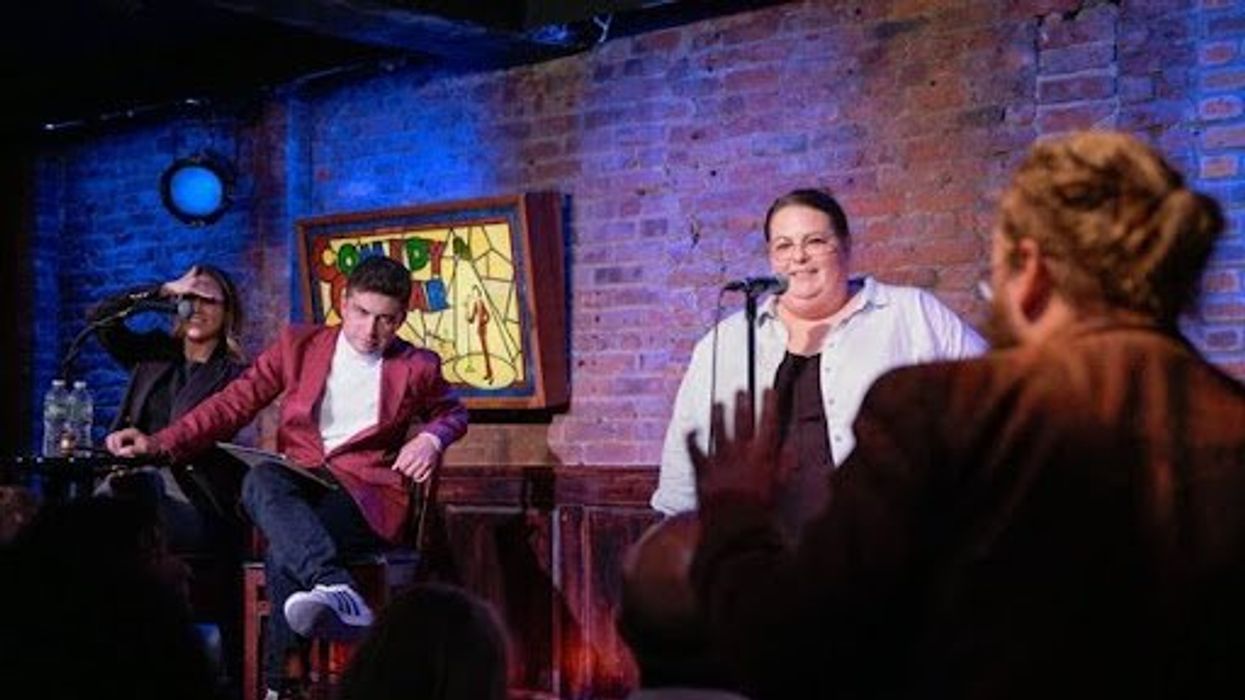
Braver Angels debate night in New York

“No one punched each other in the face,” one man said after a Braver Angels debate. “This is New York City, after all. That’s not always guaranteed!”

Courtesy Braver Angels

Timmis is director of social media for Braver Angels and the blue co-chair of the Braver Angels NYC Alliance.

Almost every time my boyfriend and I get into an argument, he ends up making me laugh. He can’t help it — or so he says — because he’s a born-and-bred Irishman, with dark humor in his blood.

Usually when this happens — when I find myself fighting a smile — we end up forging a path through whatever conflict we’re entangled in. Suddenly the problem, though no less serious, feels like something we can take on together.

In the words of John Cleese, “A wonderful thing about true laughter is that it just destroys any kind of system of dividing people.”


In so many ways, humor is essential for our emotional, spiritual and psychological well-being.

It can offer an entry point into saying hard things, and an opportunity to repair when they don’t come out quite right. It can diffuse tension and strengthen bonds.

At its core, humor reminds us that we’re human.

It’s no surprise, then, that it’s also distinctly missing from our political landscape.

But does it have to be?

A few months ago, my friend Brent Morden — red co-Chair of the Braver Angels NYC Alliance — and I asked ourselves a question: Could we have a debate on a serious topic ... and make it fun?

We decided to host it at the Comedy Cellar, a legendary comedy club in Manhattan where some of the most prolific comedians have performed. (Dave Chappelle, Chris Rock, Robin Williams, Amy Schumer, Jon Stewart, and on, and on, and on.) We recruited our very own Luke Nathan Phillips to come up from Washington, D.C., and serve as debate chair. And we brought nearly 150 New Yorkers together on a Wednesday night for a debate on “Resolved: Smash the Patriarchy!”

My stomach was in knots leading up to the debate. It was the kickoff event to launch our new alliance, and we’d never hosted a big, in-person event in New York City before. How was this about to go?

As one man gleefully exclaimed directly following the debate, “No one punched each other in the face!” He was genuinely impressed. “This is New York City, after all. That’s not always guaranteed!”

There were periods of tension during the night, to be sure — times when the knots in my stomach only tightened. But there were also moments when speakers took on the spirit of the venue and cracked a few jokes — the audience erupting into laughter.

And then, after it was all over — once we survived our first big test — we headed around the corner to the Olive Tree Cafe to break bread and grab beers together. Suddenly, two people who had just been challenging one another were now happily chatting about something entirely different.

Humor and politics can be a tricky thing. We take politics seriously because the impact it has on people’s lives can be gut-wrenching and profound.

But maybe it could do us some good not to take ourselves too seriously. Maybe we can find a way to listen to and even laugh with one another again.

For more on humor and politics, check out “ Jesters and Fools,” a documentary featuring different comedians reflecting on the state of politics and political polarization.
Read More

Strange Days Indeed: Why ‘Nobody Told Me’ Echoes America Today

Political Polarization and Extremism

Getty Images

Strange Days Indeed: Why ‘Nobody Told Me’ Echoes America Today

I was driving in my car the other day when a familiar song from my youth came on the radio. The opening line of John Lennon’s “Nobody Told Me” immediately hit me with unexpected force . A song I loved fifty years ago suddenly felt like it was written for this very moment.

Nobody told me there’d be days like these. Strange days indeed.

Keep ReadingShow less
Jennifer Lawrence speaks during the "Die My Love" press conference at the 78th annual Cannes Film Festival at Palais des Festivals on May 18, 2025 in Cannes, France.

Jennifer Lawrence questions whether celebrity activism still matters in politics. As the 2026 midterms approach, explore the decline of celebrity endorsements, rising polarization, and the evolving role of pop culture in shaping voter behavior.

Getty Images, Pool

Jennifer Lawrence Questions Whether Stars Still Influence Politics

Eight months before the 2026 midterms, one of Hollywood’s most recognizable figures has offered a blunt assessment of her industry’s political influence. Jennifer Lawrence, known for speaking out on issues from gender equality to democratic norms, now questions whether celebrity activism has any real impact.

In a recent interview, Lawrence stated that “celebrities do not make a difference whatsoever in who people vote for.” This is notable both because of her prominence and because it comes at a time when American politics is deeply intertwined with culture and entertainment. She described the Trump era as a time when she felt she was “running around like a chicken with my head cut off,” trying to use her platform to sound alarms. But after years of backlash, polarization, and the sense that celebrity statements only “add fuel to a fire that’s ripping the country apart,” she’s questioning the value of speaking out.

Keep ReadingShow less
What the Oscars can teach us about democracy
An oscar statue on display in a glass case
Photo by Martti Salmi on Unsplash

What the Oscars can teach us about democracy

On Sunday night, millions of Americans will watch the Academy Awards. They may tune in for the red carpet, Conan O'Brien’s jokes, or the live performance of the hit song “Golden.”

But behind the glitz and glamour, the Oscars have a bigger lesson to teach – how changing the way we vote can improve our democracy.

Keep ReadingShow less
Michael B. Jordan standing next to Delroy Lindo

Michael B. Jordan and Delroy Lindo at the 41st Annual Santa Barbara International Film Festival.

Getty Images, Phillip Faraone

Not OK: Curb Slurs and Hate Speech To Avoid The Monstrous

John Davidson shouted out the n-word while Michael B Jordan and Delroy Lindo presented a prize recently at the British Academy Film Awards.

Was it hate speech or a mistake made due to a disability?

Keep ReadingShow less