




Rosenfeld is the editor of Voting Booth, a project of the Independent Media Institute.
The nation's collective political eyeballs, and probably tens of millions of dollars, have now turned toward Georgia. That's not because the presidential outcome is too close to call, since Joe Biden has become president-elect without its 16 electoral votes. It's mostly because the outcome of a highly unusual pair of Senate runoff elections in eight weeks will decide whether Congress will remain divided or switch to Democratic control.
The eyeballs of election administrators have also focused on Georgia — for a different reason.
The upcoming audit of its unofficial election returns will not only decide whether a presidential recount will be conducted. It will also be the most high-profile use yet for a relatively new way of checking the accuracy of returns.
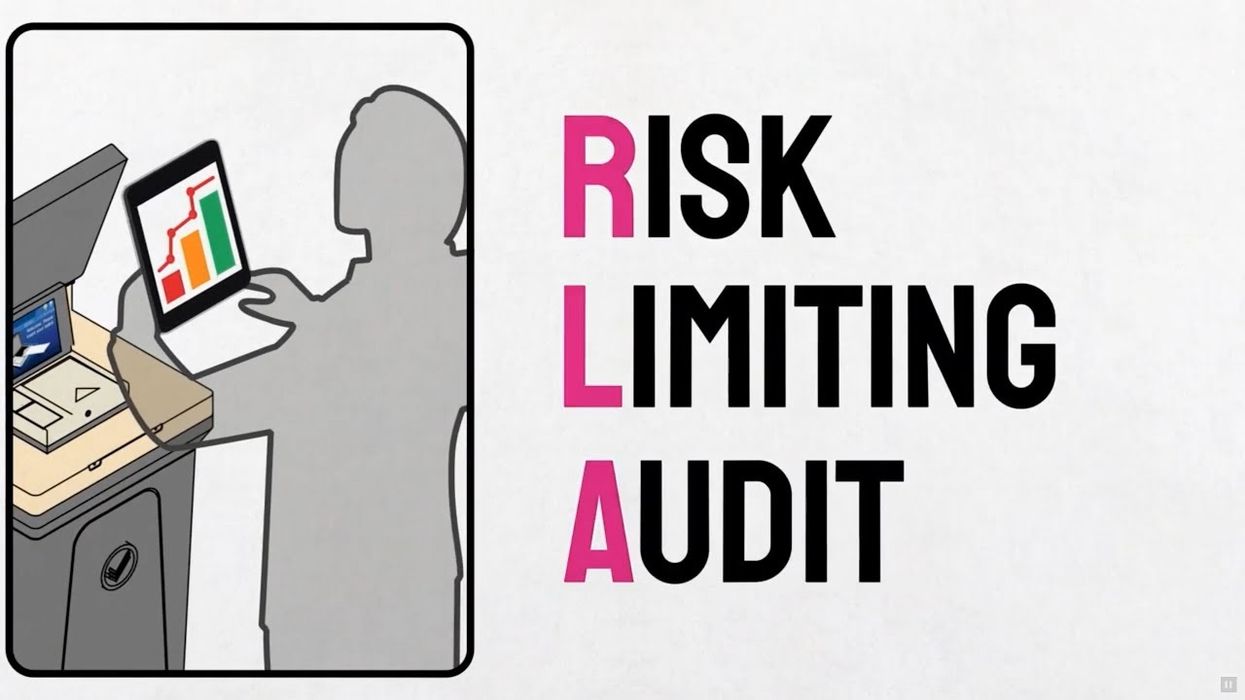
It is called a risk-limiting audit, and it is a barely-tested process in Georgia. Whether the forthcoming audit will be targeted by President Trump's campaign lawyers is an open question. But it will be the highest-profile test yet for an obscure process that was created by statisticians to convey public assurance that vote counts can be trusted.
As of Monday, more than 98 percent of the ballots had been counted and Biden was up by 2 tenths of 1 percent, or 11,000 votes out of 5 million cast. Provisional and military ballots were left to be tallied before Friday's deadline for the 159 counties to finalize and certify the results, totaling the legally cast ballots.
Then comes the RLA. Under a state law enacted last year, it has to happen — and by Nov. 20, when the state result is supposed to be locked down.
"Our hope and intent in working with the counties is to move that earlier," said Gabriel Sterling, a state voting system implementation manager. "And at that point, whoever comes in second, either President Trump or Vice President Biden, either one of them, whoever is in second place, can request that recount."
The audit is an exercise that will assess if the electronic totals from a county's central tabulators match randomly sampled paper ballots. It is based on a statistical formula where auditors set an accuracy level, which is usually 90 or 95 percent. If the manually examined and counted votes from the paper ballots do not match the electronically compiled results, then more paper ballots are randomly pulled until the accuracy level is reached.
A risk-limiting audit typically looks at one race — not every race, importantly — to produce its confidence estimate. In most cases, a noncontroversial contest with a large winning margin is picked, because the formula's math means as a wider margin translates into the need to examine fewer ballots.
For example, in an RLA pilot conducted after the problematic June 9 primary in Fulton County (one of four such tests conducted in the state), county officials only needed to examine 27 randomly chosen ballots to have 90 percent confidence in the electronically totaled results. That number of ballots drawn was small because Biden won 84 percent of the county's Democratic presidential primary, in which 160,000 votes were cast.
When asked how Georgia planned to conduct its RLA after a presidential election, officials said the state would not audit the presidential race but would instead pick a down-ballot statewide contest such as public service commissioner.
"The algorithm will then say, in County A, Precinct 22, pull out the ballot that is the 300th in the stack. And in County B, in two precincts, pull others out," explained Walter Jones, who heads voter education efforts for GOP Secretary of State Brad Raffensperger. "We'll instruct the counties to do that. I don't know if it will be some kind of Zoom call or conference call or if we'll just send an email and they just send us the results and we'll total it up."
The California nonprofit VotingWorks is advising Georgia on the audit.
Indeed, an RLA based on Georgia's statewide presidential results would not be expeditious, as it would evolve into almost a full recount, which is a different legal process that is only supposed to occur after the results are certified.
That's because a statewide audit based on the presidential votes where the margins are so close would turn into a "full hand count" of almost all ballots, according to the audit tool created by RLA's creator, mathematician Philip Stark of the University of California, Berkeley. The number of ballots to get checked grows exponentially as the winning margin shrinks.
While top Georgia officials expressed confidence in their new system and underscore they have seen no evidence of voter fraud, whether the RLA will be accepted by voters in the state — and across the United States — remains an open question.
Whether an accuracy estimate based on a down-ballot race would be accepted or attacked by Trump's campaign is more easily answered, especially if the votes cast in his election are not examined in a process intended to judge the accuracy of the state's overall vote-counting technology.
Under any scenario, Georgia's RLA will be the highest-profile test to date.