



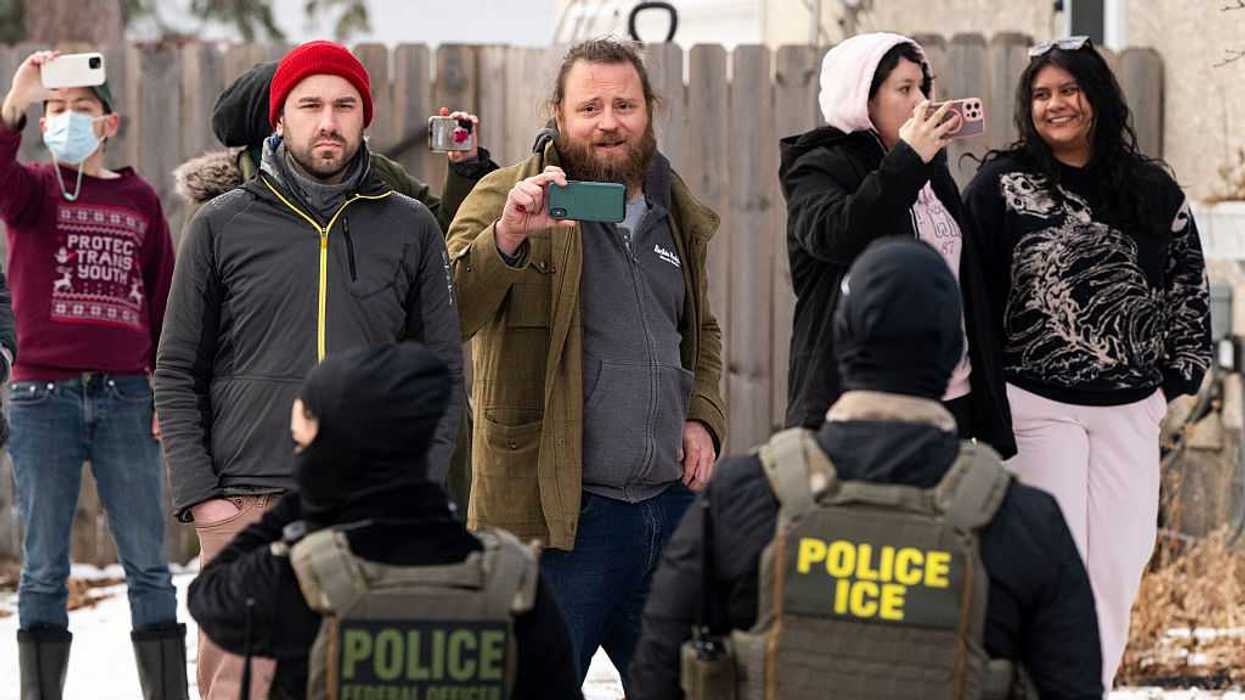

In a time of repeated violent clashes between civilians and federal law enforcement, particularly involving Department of Homeland Security operatives, recording and documenting their activity is crucial to ensuring truth and accountability.
What has been demonstrated over the last month, following the killings of Renee Good and Alex Pretti, is a strong deviation between narratives from the federal government and video and eyewitness accounts of the violence that has taken place. Inaccurate or twisted realities from federal enforcement agencies are not a new trend, but it is an impediment to justice. Bystanders who continue to report on and record the actions of federal agents serve an important place in upholding American democracy and a commitment to the truth. However, documentation comes with risks.
A Quick Look: The Surveillance State
Simply put, surveillance is everywhere in the modern state. There are common examples, like Ring doorbells and CCTV monitoring systems. These tend to be rather visible, the latter often accompanied by a sign that says, “SMILE! You’re on camera.” At the same time, there exists a more sophisticated level of modern surveillance tech that can collate information on individuals more easily than ever before.
Alejandro Ruizsparza is one of the co-directors at Lucy Parsons Labs, based in Chicago. LPL looks into the technologies that perpetuate state and corporate harm, and counters them via investigations, litigation, and education.
Using Chicago as an example, Ruizsparza shed some light on how surveillance is all around us:
“I think the average person, whether they’re aware of it or not…they’re always interacting with some kind of surveillance dragnet in the city. There are license plate readers at almost every major road in Chicago, if not all of them, as well as, I think, every highway in Illinois, if not most of them. You’re driving in your car, and your driving is constantly monitored,” Ruizsparza said. They also mentioned auditory surveillance systems, such as ShotSpotter, and facial recognition tools like Flock. “The surveillance is there. Right. It’s almost become part of, like, the water we swim in.”
Who It Impacts
License plate readers, facial recognition tracking, surveillance cameras, audio surveillance, and social media tracking are all surveillance technologies that can collect data on people every day. The abundance of surveillance technology is generally justified by crime-prevention and safety claims, so it’s worth noting that the surveillance state does not impact all populations equally.
“Black and brown people will generally be more targeted by these kinds of tools just because that’s where they’re deployed most often,” said Ruiszparza. “When we were dealing with ShotSpotter in Chicago, one of the things that came up quickly and was a really big rallying point for all of us was that the deployment of the auditory devices were only placed in wards that had less than 50% Caucasian people living in the ward. So, there is a very obvious demographic that is being targeted when it comes to the deployment of these devices.”
In addition, many facial recognition software were trained on Caucasian models. As a result, they tend to be less accurate at identifying Black or brown individuals. There are other factors that may make you more or less vulnerable to surveillance, including gender, age, or occupation. For example, if you have attended a protest, consider yourself an activist, or maybe you’re a journalist like me, you might find yourself more vulnerable to surveillance. Or, maybe, you simply have a phone.
Phones, Apps, and ICE
Aside from the complicated technology and private surveillance organizations employed by the government, phones, and more specifically the apps that are on them, are hotbeds for gathering data and sending it out to an entity that purchases it. But what, exactly, is the data that’s being collected?
“Any app that you download that is taking data points about you, requests your location, and then stores that somewhere,” said the Electronic Frontier Foundation’s Senior Staff Technologist Bill Budington. “By and large, you’ll be aware of it because it asks for permission, and it will. A lot of times your phone will also make it obvious that this has recorded your location for this amount of time. So be aware of that.”
Budington explains that ads on apps also collect data, and can inform those who buy that data more about the individual it’s been farmed from; think interests, hobbies, location, etc.
“A lot of the so-called surveillance capitalism that we're living under is based on the permissions-greedy advertising ecosystem that makes it so that your eyes are more valuable if they have more information about you,” Budington said. “The value per ad served will be more if there's more information that's delivered to an ad exchange about you.”
The data stored tends to be sold by data brokers; however, it can also be divulged to the government via a court order. While the Fourth Amendment generally requires the government to obtain a warrant before searching someone’s private information, a recent ACLU investigation has revealed that the DHS is circumventing the Constitution by purchasing data directly from data brokers.
The DHS also uses other tools to obtain data directly, such as Webloc. According to 404Media, Webloc uses social media monitoring and phone surveillance to create commercial location trails of mobile devices over a city or neighborhood.
“That, to me, is alarming because it circumvents, I would argue, Fourth Amendment due process rights because some of this data that the government used to have a warrant for, now they can just purchase,” says Nicole Bennett, a PhD candidate at Indiana University who researches digital technologies and data systems, and their influence on migration.
In addition to purchased data, information obtained from government databases and FOIA requests suggests that ICE holds contracts with surveillance tech giants beyond Webloc, such as Palantir and FiveCast, to enhance its operations and social media surveillance.
The combination of sophisticated surveillance tools at DHS’s disposal and the illegal purchase of information from data brokers puts any person involved with ICE, be it undocumented immigrant or bystander, at risk. This risk amplifies when a person records ICE activity and then shares it, tying them to a specific time and place through a string of data.
- YouTube youtu.be
Britton Struthers-Lugo on knowing your rights when recording video, Latino News Network
Sousveillance
“Sousveillance” is the act of recording by any member of the public, in essence, surveilling the surveillance state.
As mentioned previously, documenting the actions of federal agents is essential in upholding democracy and justice. Recording is also a right upheld by the First Amendment, and it must be done at a distance (at least an arm’s length), so as not to interfere or obstruct an officer on duty.
Here’s some practical advice on how to protect yourself if you’re planning on recording federal agents.
- Wear a face mask or covering and sunglasses. These help conceal you from surveillance cameras in the area or from footage that might be captured and shared without your consent.
- If you can, leave your phone at home. Opt for a recording device that does not connect to the internet, if possible. The caveat here is that if that recording device, such as a standard camera, is confiscated, information can be more easily obtained from it than from a password-protected device.
- Turn off location permissions on your apps. This can be done in your phone settings. Alternatively, you can delete any app that collects data from your phone if you are going into a protest situation (this would largely be social media apps).
- Turn biometrics off on your phone. Opt for long passwords instead. "Biometrics are easily circumvented just by an officer holding your phone up to your face and it being unlocked,” says EFF’s Bill Budington. “If you have a long, complicated passphrase, then that’s going to be much harder for them to plug into one of these forensic imaging devices and unlock it that way.”
- Use airplane mode. This minimizes real-time data location. You can use apps like CoMaps to navigate a city without being online or having your cellular data turned on.
- Use the camera app from your lock screen, rather than opening up your device. This ensures your phone remains locked if it is confiscated mid-recording.
- Remove metadata from photos and videos.* Metadata contains information about location, device used, camera-setting specifications, and a whole host of other information that can be used to track you. An easy way to remove metadata is to send an image or video to yourself through Signal, and then re-download it.
- *PhD candidate and researcher Nicole Bennett advises keeping an original copy of any file that’s been edited or scraped for metadata removal. “You may have to provenance yourself. Like, yes, I was actually here at this time,” she explains. “That’s [Signal] a way you can scrap or wipe the metadata, but then there’s the risk of someone official saying ‘Well, we can’t prove that this was taken at that intersection at that day and time.’”
- Blur faces and other identifying features in any video or photo you take. This is to reduce the harm that may also be caused to others through your documentation. If there are any identifying details, such as tattoos or bystander license plates, take the time and attention to blur or crop these details out before posting. Keep an original copy of the file for the same reasons as above.
- If you’re a journalist, store assets in the newsroom, if possible. “There’s power in keeping data in the newsroom, because it’s not easy for police to raid a newsroom and take footage, or take journalistic material. You know, notwithstanding the Washington Post journalist who was in her personal home,” said Budington.
- In any recording situation, assess self-risk. If you feel the risk is too high, stop recording and leave the situation. See below.
Assessing Self Risk
Threat modeling is a framework often deployed in the security and privacy space. The goal of threat modeling is to identify any potential threats or vulnerabilities in a software system, including potential attackers. It looks at identifying possible motives for attacks, and methods that might be used to expose vulnerabilities in software. A similar line of thinking can help an individual assess their potential risk when interacting with ICE at any level.
“[Threat modeling], it’s sort of an approach that we use to think about our assets, which are the things we want to keep safe, right. It might be our identity, it might be our location. It could be much more explicit,” LPL’s Alejandro Ruisparza said, “And you pair that against threat. So, what are the risks? What am I at risk of being threatened by and what’s the capability of that threat?”
For example, if an individual is engaging in activities that could lead to their arrest, then they should ask themselves if they are actually willing to be arrested. Ultimately, it is up to each individual to assess their own risk and what they are willing to endure should that risk become a reality.
As a data governance researcher, Bennett is well aware of the personal risks that come with having an online presence.
“There are certain things I don’t post. And I’m aware, but I have a very low risk profile. You know, I’m a U.S. citizen, I live in a smaller town. I, you know, like there’s all these things that make it much less risky for me versus another individual,” she said.
“It’s a question of how much risk can I take on individually, maybe collectively, and how can I make sure that I maintain that risk level? I think those are key questions,” Ruisparza finishes.
For more information on this topic, including the latest on ICE surveillance technology contracts, check out the investigative work being done by the EFF, Fight for the Future, 404 Media, and Lucy Parsons Lab.
Britton Struthers-Lugo is a freelance journalist and a photographer based in Chicago, Illinois.








The President Invited Iran to Bomb My Home