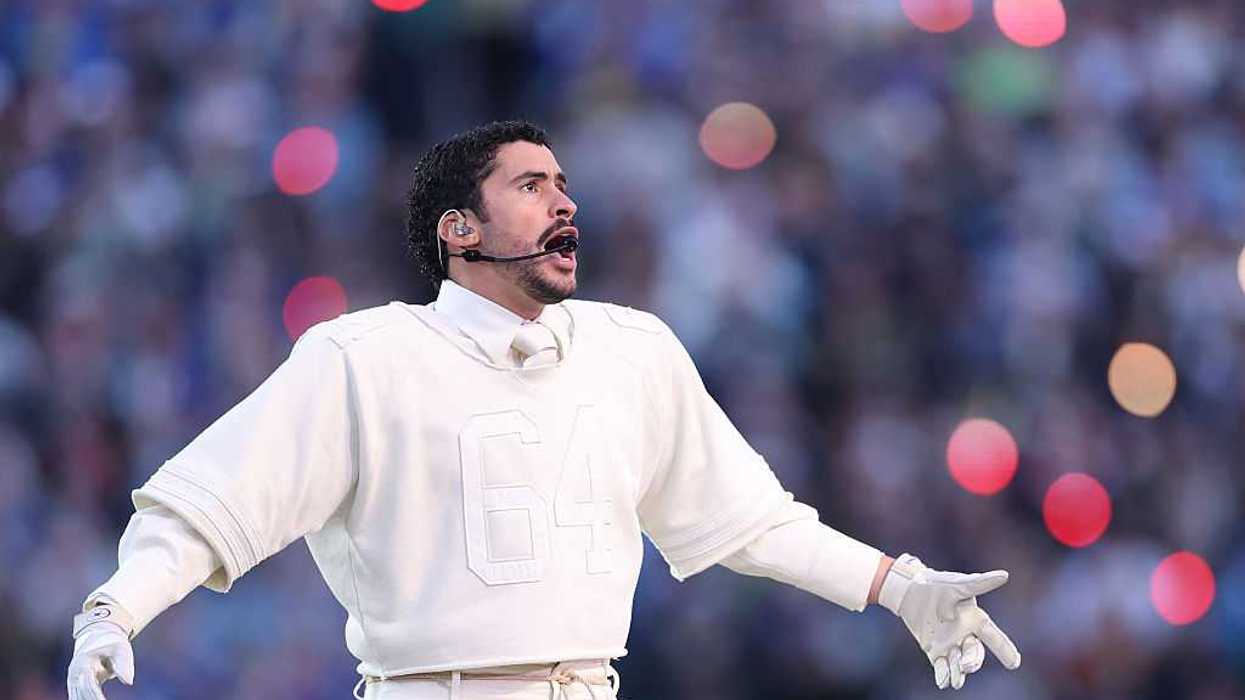
Bad Bunny’s Super Bowl performance was the joy we needed at this time, when immigrants, Latinos, and other U.S. citizens are under attack by ICE.
It was a beautiful celebration of culture and pride, complete with a real wedding, vendors selling “piraguas,” or shaved ice, and “plátanos” (plantains), and a dominoes game.
The show paid homage to Puerto Rico while also featuring other Latino cultures.
There were shoutouts to Mexican food with a vendor from the Los Angeles-based taco stand, Villa’s Taco.
There were real boxers sparring, Puerto Rican Xander Zayas and Mexican-American Emliano Vargas. A highlight was a guest performance by Puerto Rican icon Ricky Martin, in the music business for 40 years, who started his career with the island boy band “Menudo.” Also dancing in the “casita,” the little house, were Colombian superstar Karol G, and the Bronx-born rapper and songwriter Cardi B, of Dominican and Trinidadian descent. Dancing with the “casita” guests were Chilean actor Pedro Pascal, Latina actor Jessica Alba, Venezuelan baseball star Ronald Acuña, and the rising Puerto Rican rapper and singer-songwriter Young Miko.
Also featured in the show was María Antonia “Toñita” Cay, owner of Brooklyn’s Caribbean Social Club, one of the last surviving Puerto Rican social clubs in New York City.
I’m not Puerto Rican. I'm a fourth-generation Mexican American, but I felt represented in this halftime show. I watched it with my 88-year-old Mexican American mother, and a few friends, including a Peruvian American and a European American.
We dined on my mother’s Mexican chicken and rice, but we also made Puerto Rican “tostones” (fried plantains) and also drank “coquito,” a Puerto Rican coconut nog. We didn’t watch the game at all, except to check how many minutes until halftime. We spent the first half of the game eating and dancing to Bad Bunny songs.
Bad Bunny is popular not just with Latinos but worldwide. A video of people exercising in China while singing Bad Bunny songs in Spanish recently went viral. Leading up to the Super Bowl, Bad Bunny challenged people to learn Spanish, and hundreds of viral videos showed people of all races and ethnicities trying to learn his lyrics.
Bad Bunny had his critics, who were upset he planned to sing all in Spanish, and some falsely claimed he’s not a U.S. citizen. Only 6 million of them tuned in live to an alternative Super Bowl show.
Bad Bunny’s show is expected to be the most-watched halftime show ever with 135 million viewers. Indeed, Bad Bunny has topped Spotify as the #1 Global Artist for the fourth time in as many years. .
Bad Bunny didn’t go on tour on the U.S. mainland for his last album, as he voiced concerns that his fans could be harassed by immigration enforcement agents. He did not criticize ICE during the halftime show, as he had when he won a Grammy a week earlier.
"Before I say thanks to God, I'm going to say 'ICE out.' We're not savages, we're not animals, we're not aliens. We are humans, and we are Americans," he said at the Grammys.
At the end of his Super Bowl show, Bad Bunny sent a message: America is more than just the United States.
Bad Bunny sang all his music in Spanish but also said, “God Bless America” in English. Then he proceeded to name all the countries in the Americas, including his native Puerto Rico, and ended by saying the “United States” in English. Then he named Canada and his homeland of Puerto Rico.
Many people don’t know that Puerto Rico is a territory of the U.S., and since 1917, all Puerto Ricans have been U.S. citizens, a move by then-President Wilson to draft Puerto Rican men into World War I. But those living on the island are not allowed to vote for president, and their representative in Congress cannot vote on the House floor on any final legislation.
Some of Puerto Rico's struggles were demonstrated in the halftime performance, which featured those who labored in the sugar cane fields, and the electrical poles represented the frequent power outages in Puerto Rico, exacerbated by the devastating Hurricane María in 2017.
The power went out after Hurricane Maria in 2017, and it took nearly a year for power to be fully restored. When President Trump visited the island, he threw paper towels, and many Puerto Ricans took it as an insult, reinforcing their belief that their treatment as second-class citizens by the government in Washington is not an illusion.
Bad Bunny’s song “El Apagón” is about the all-too-often power outages on the island, made worse by government corruption and gentrification of the island.
The power went out after Hurricane Maria in 2017, and it took 11 months for all the power to be restored. When President Trump visited the island, he threw paper towels, and many Puerto Ricans took it as an insult, reinforcing their treatment as second-class citizens.
Trump’s insistence on renaming the Gulf of Mexico the Gulf of America reflects his failure to understand that America is not just the United States.
Bad Bunny ended by saying, “We’re still here." Then he spiked a football that was inscribed with the message, "Together We Are America."
Bad Bunny’s performance was one of resistance and resilience.
Behind him, a large video board displayed the message, "The only thing more powerful than hate is love."
I can’t think of a more unifying message. We are all Americans, and we danced, cheered, and some of us even cried as we saw our American culture represented in one of the biggest stages imaginable.
Teresa Puente teaches journalism at Cal State Long Beach and is a fellowship coach with The OpEd Project.