



Skip to content
Search

Latest Stories

Top Stories

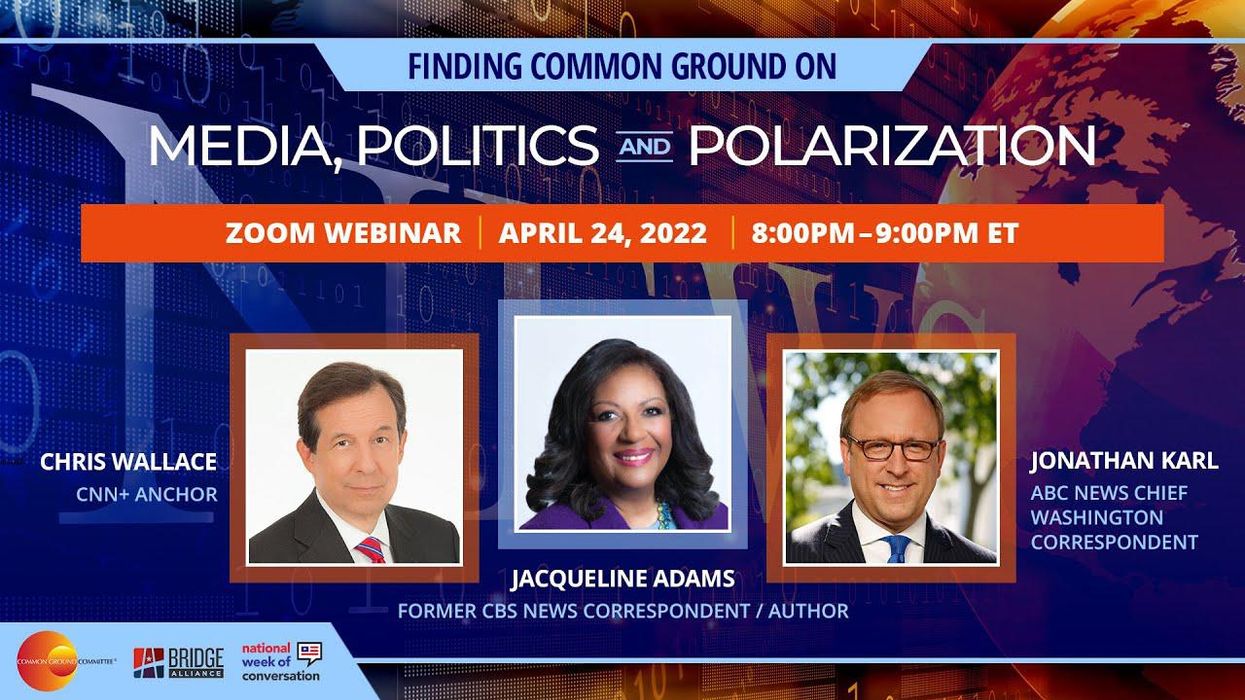
Video: Finding common ground on media, politics and polarization

Finding Common Ground on Media, Politics, and Polarization

How can the media play a role in decreasing polarization? Tune in for a conversation with two leading political journalists. Common Ground Committee and Bridge Alliance host a special virtual event to kick off the National Week of Conversation 2022. For decades, journalists Chris Wallace and Jonathan Karl have covered the political scene – from interviewing Vladimir Putin to covering President Biden’s inauguration. Now, hear their insights as they seek common ground on how the media impacts American attitudes, and how public trust can be restored as news outlets navigate a changing landscape. Register now for this candid conversation with two award-winning journalists, moderated by former CBS News correspondent and author Jacqueline Adams.

Read More

Can MAGA go any lower defending Donald Trump?

U.S. president Donald Trump delivers remarks at the U.S.-Saudi Investment Forum at the John F. Kennedy Center for the Performing Arts in Washington, D..C on Nov. 19, 2025.

(Brendan Smialowski/AFP via Getty Images/TCA)

Can MAGA go any lower defending Donald Trump?

I remember it well. It was Oct. 7, 2016, a Friday. That afternoon The Washington Post dropped a bombshell, the perfect October surprise, just a month before the presidential election.

Earlier in the week, Hillary Clinton had been hammering Donald Trump on the news that he may not have paid taxes for 18 years.

Keep ReadingShow less
Hardliners vs. Loyalists: Republicans Divide Over Mamdani Moment

U.S. President Donald Trump shakes hands with New York City Mayor-elect Zohran Mamdani (L) during a meeting in the Oval Office of the White House on November 21, 2025 in Washington, DC.

Photo by Andrew Harnik/Getty Images

Hardliners vs. Loyalists: Republicans Divide Over Mamdani Moment

Yesterday’s meeting between Donald Trump and New York City's Mayor-elect, Zohran Mamdani, was marked by an unexpected cordiality. Trump praised Mamdani’s “passion for his community” and called him “a very energetic young man with strong ideas,” while Mamdani, in turn, described Trump as “gracious” and “surprisingly open to dialogue.” The exchange was strikingly civil, even warm — a sharp departure from the months of hostility that had defined their relationship in the public eye.

That warmth stood in stark contrast to the bitter words exchanged before and after Mamdani’s election. Trump had dismissed him as a “radical socialist who wants to destroy America,” while Mamdani blasted Trump as “a corrupt demagogue who thrives on division.” Republican Senator Rick Scott piled on, branding Mamdani a “literal communist” and predicting Trump would “school” him at the White House. Representative Elise Stefanik went further, labeling him a “jihadist” during her gubernatorial campaign and, even after Trump’s praise, insisting that “if he walks like a jihadist… he’s a jihadist.” For Republicans who had invested heavily in demonizing Mamdani, Trump’s embrace left allies fuming and fractured, caught between loyalty to their leader and the hardline attacks they had once championed.

Keep ReadingShow less
Trump's Clemency for Giuliani et al is Another Effort to Whitewash History and Damage Democracy

Former NYC Mayor Rudy Giuliani, September 11, 2025 in New York City.

(Photo by Michael M. Santiago/Getty Images)

Trump's Clemency for Giuliani et al is Another Effort to Whitewash History and Damage Democracy

In the earliest days of the Republic, Alexander Hamilton defended giving the president the exclusive authority to grant pardons and reprieves against the charge that doing so would concentrate too much power in one person’s hands. Reading the news of President Trump’s latest use of that authority to reward his motley crew of election deniers and misfit lawyers, I was taken back to what Hamilton wrote in 1788.

He argued that “The principal argument for reposing the power of pardoning in this case to the Chief Magistrate is this: in seasons of insurrection or rebellion, there are often critical moments, when a well- timed offer of pardon to the insurgents or rebels may restore the tranquility of the commonwealth; and which, if suffered to pass unimproved, it may never be possible afterwards to recall.”

Keep ReadingShow less