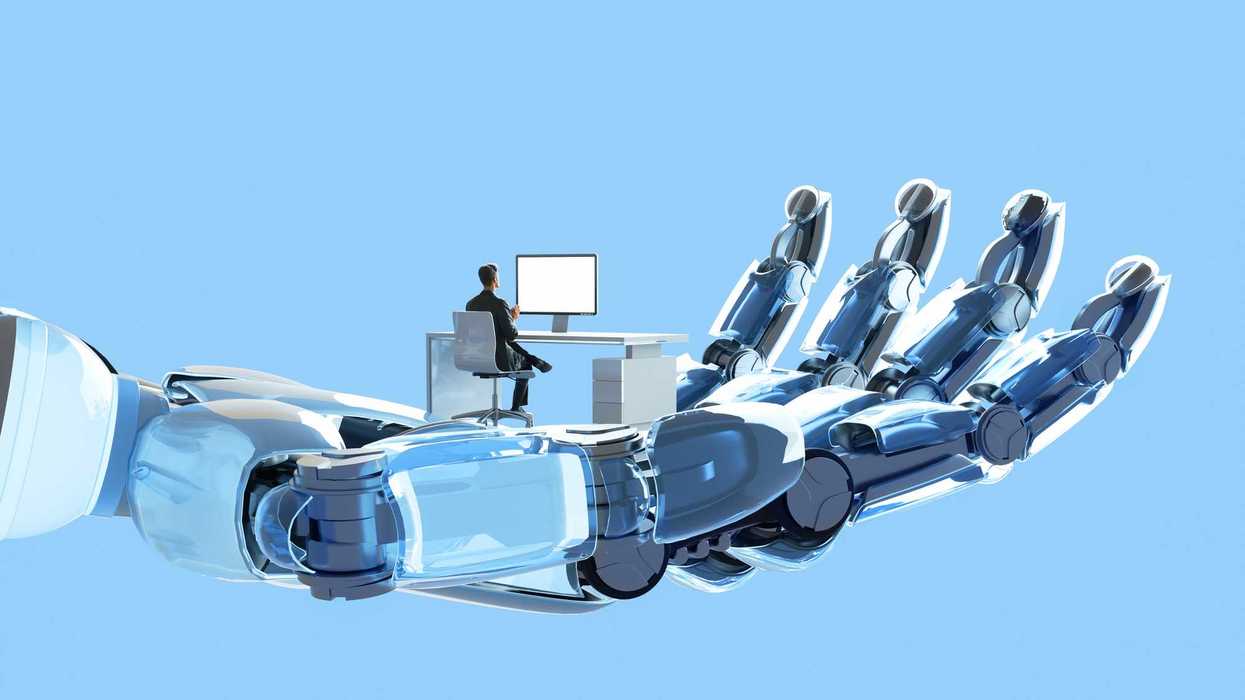

A democracy is only as robust and vibrant as the citizens who sustain it. Self-government depends upon people willing to deliberate honestly, reason carefully, and exercise judgment responsibly. With the emergence of AI, this obligation becomes even more consequential because these powerful systems can either deepen human agency or quietly erode it. They can either help citizens think more clearly and participate more meaningfully, or they can encourage the outsourcing of judgment itself and the slow substitution of synthetic plausibility for human responsibility.
Imagine, then, publishing a book warning humanity about the epistemological collapse supposedly ushered in by artificial intelligence. Imagine assembling endorsements from solemn guardians of the humanities, critics of automation, custodians of truth, defenders of interpretation against probabilistic sludge. Imagine presenting yourself as a kind of intellectual fire marshal standing before a burning building, yelling that people must immediately stop playing with matches.
And then imagine your own book turns out to contain fabricated citations, hallucinated references, invented quotations, and synthetic confabulations produced by the very systems whose dangers you claim to expose.
Well, astonishingly, that is precisely what happened with the recently published book The Future of Truth by Steven Rosenbaum.
And how did Mr. Rosenbaum respond when readers discovered that the book warning us about the epistemological dangers of AI had itself smuggled in fabricated citations and synthetic quotations into its pages? With mortification? With embarrassment? With contrition? With the ordinary human shame that arises when one is caught violating one’s own stated principles so completely and so publicly?
Of course not.
Instead, we were treated to a spectacle of post-hoc rationalization masquerading as profundity. The collapse of the book’s credibility was repackaged as further evidence of the book’s importance! The failure itself became the thesis, as it were. As one reads along, one almost expects him to announce that the inaccuracies only proved how urgently we must read his inaccurate book about inaccuracies. And then, defying the ridiculous, that was precisely what Rosenbaum did: He said, “These A.I. errors do not, in fact, diminish the larger questions that the book raises about truth, trust and A.I.”
Well, of course, they do not diminish them, but they do diminish the book and its author spectacularly.
The book is about truth and trust, and yet the author himself failed at the elementary practice of verification. How can one deliver a sermon on epistemic rigor while outsourcing one’s footnotes to a stochastic autocomplete engine and then declare oneself vindicated when people notice?
Even worse is this peculiar modern move to hide behind a machine as though it were an unruly intern who slipped something embarrassing into the manuscript. “It’s the AI that made the errors, not me” is rapidly becoming the twenty-first-century version of “mistakes were made.”
No, Mr. Rosenbaum: You made the errors.
You used the tool. You signed the contract. You accepted the authority of authorship. You placed your human name on the cover rather than listing the author as “Large Language Model, Version Unknown.”
The entire point of being human is that we are not merely output systems. We are capable of judgment, deliberation, doubt, scruple — that’s our human bailiwick. We can stop, we can verify, we can say: Hey, this sentence sounds plausible, but I should check whether it corresponds to reality before presenting it to thousands of readers. That is our slice of the divided labor pie.
And then, when we fail, we, humans, are supposed to be capable of something machines are not: Contrition. And actual contrition. Not sleek, too-clever- (or maybe too-stupid-) by-half post-hoc rationalization disguised as profundity; nor should we be converting our embarrassment into an advertisement for the very thesis whose collapse occasioned the embarrassment; nor should we indulge ourselves in insulting the intelligence of our readers by pretending that a humiliating failure of scholarship somehow deepens our work’s philosophical importance.
There is something oddly revealing in all this. Many critics of AI speak as though the machine itself were the central moral actor, as though silicon were secretly plotting the liquidation of truth. But the more immediate spectacle is much pettier and much more human: Vanity amplified by convenience, and obviously a whole lot of good old laziness. People lusting for authority of thought but putting in the actual work of thought. Wanting the appearance of mastery while quietly delegating the difficult work of verification to a predictive engine, and then blaming it for not doing a perfect job.
In any case, at the very least, the irony is exquisite. A book warning us about epistemological collapse becomes itself an artifact of epistemological collapse. A denunciation of synthetic authority turns out to depend upon synthetic authority. The critic becomes the demonstration. The cautionary tale writes itself. All of which is amusing enough, as these things go, but when the matter concerns the quality of democratic participation, we need to take these questions far more seriously than this.
Ahmed Bouzid is the co-founder of The True Representation Movement.