




Klibanoff is managing director of Made By Us.
In the last few months, you might have found yourself thinking:
“This shouldn’t be how things are. Why do we do things this way?”
“I feel helpless to make change. There’s nothing an average person can do.”
“How did we get here? And why didn’t I learn this in school?”
“I don’t even know what I think anymore.”
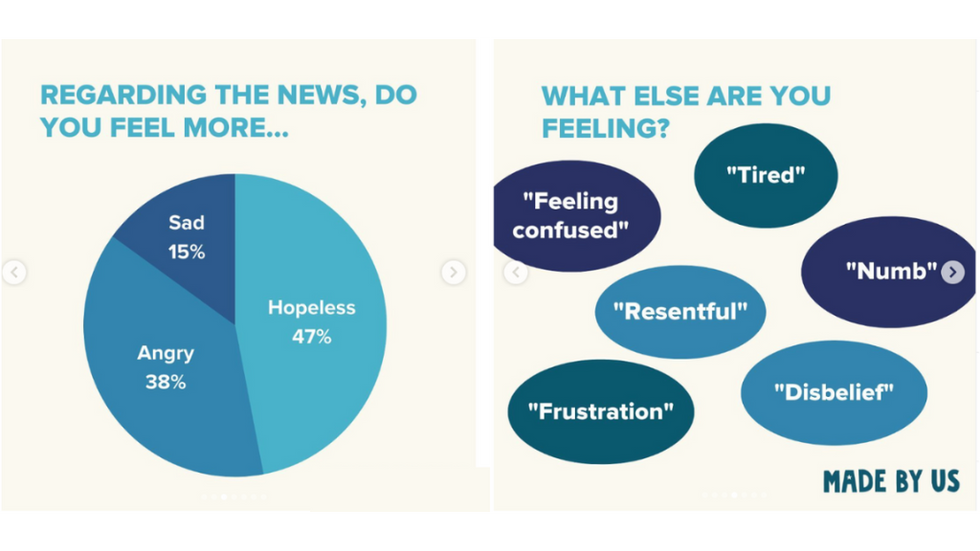
You’re not alone. Amid uncertainty, violence, loss, inflation, global threats, crises of all kinds – no matter what part of the United States you’re in, or what side of the political aisle you’re on, the fatigue and disconnection is evident. We saw this in real time, when Made By Us held a mental health check-in with our online following in the wake of the Uvalde, Texas, shooting. The responses from that mostly Gen Z collection – young adults, a demographic with a reputation for persistent, passionate advocacy in the face of tough circumstances – revealed a grim mood.
So where can we turn for help, for hope? How can we support our fellow citizens, especially younger generations? When active, informed participation in our democracy seems urgently needed, yet daunting at the same time, where do we even begin?
We invite you to meet us at the starting line this summer, as part of an emerging tradition that serves as an antidote to hopelessness: the Civic Season.
We first held the Civic Season last year, as a way to use the time between Juneteenth and July 4 to school-up on our history and skill-up our civic activity, taking inspired action to shape the future we want for our country. Co-created by Gen Z leaders – alongside more than 300 cultural and civic organizations, from the Smithsonian and National Archives to local historical societies, governments and community groups – the Civic Season helps you explore what you stand for, with more than 750 credible resources, passionate communities and avenues to amplify your voice.
This summer, we’re excited to grow this new tradition, and we invite you to be a part of it. The 2022 Civic Season centers around a few pillars that are known to empower and equip active citizenship, as well as ward off hopelessness:
Connection. From feeling like you’re part of our nation’s story (you are!) to meeting new friends and neighbors, connection to others undergirds our democracy. It starts with knowing who we are and what we value – and then reaching out to others to learn and grow. The Civic Superpowers Quiz can help you identify your special skills and others who share them. The Storycorps collection invites you to hold a meaningful one-on-one conversation for the historic record. And the Civic Season Zine is the public square where all our experiences collide and refract.
Celebration. Forming a “more perfect union” is an ongoing journey, sustained by the everyday actions of everyday people. To revive our civic imagination and fight fatigue, it’s important to celebrate along the way. You can join the Civic Season Kickoff party at the headquarters in Atlanta, find a local celebration near you or tune into the livestream.
Knowledge. If we know better, we can do better. To shape a just and free society that lives up to the ideals in our founding documents, we have to understand “how we got here.” We’ve assembled hundreds of ways to learn and grow from credible history sources. Whether you have five minutes or a whole day, want something virtual or in-person, you cna find something that suits your preferences. You might try a virtual field trip, an ancestry workshop, or a book club.
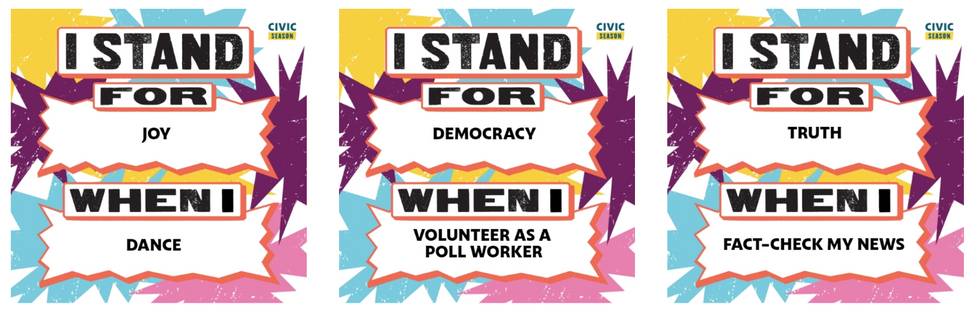
Starting where you are, with what you have. No one can do it all – we each bring different strengths to the great American project. And the iconic Civic Season posters, created by the Globe Collection at MICA, prompt us each to reflect on what we stand for and how. You might find all the ways in which your everyday actions are already shaping our country, whether that’s listening to a friend, fact-checking your news, shopping local or painting a mural. Make your own here.
Democracy is more than elections. It’s a year-round civic and cultural practice up to each of us to sustain. Whether you find yourself passionate about gun control, health care, accessible curbs for people in wheelchairs, or wishing your neighborhood had more outdoor dining, affordable housing or welcoming events for immigrants – these are all civic issues that require our interest, knowledge and action.
Many, perhaps even most, of us want to be engaged citizens. It is rewarding to feel that you have a say in the direction of your country, and to activate that power; and it is frustrating to feel that you can’t make a difference in nudging the world a bit closer to your own values. Civic Season offers avenues to explore those values, critical context to understand yourself as part of your community/country/world, and paths to take action and be heard.
Come out this summer and join the momentum. Let us know what you find by sharing your experience using #CivicSeason. And be a part of shaping this tradition for years to come!










U.S. Secretary of State Marco Rubio delivers a keynote speech at the 62nd Munich Security Conference on Saturday, Feb. 14, 2026, in Munich, Germany.
Marco Rubio is the only adult left in the room
Finally free from the demands of being chief archivist of the United States, secretary of state, national security adviser and unofficial viceroy of Venezuela, Marco Rubio made his way to the Munich Security Conference last weekend to deliver a major address.
I shouldn’t make fun. Rubio, unlike so many major figures in this administration, is a bona fide serious person. Indeed, that’s why President Trump keeps piling responsibilities on him. Rubio knows what he’s talking about and cares about policy. He is hardly a free agent; Trump is still president after all. But in an administration full of people willing to act like social media trolls, Rubio stands out for being serious. And I welcome that.
But just because Rubio made a serious argument, that doesn’t mean it was wholly persuasive. Part of his goal was to repair some of the damage done by his boss, who not long ago threatened to blow up the North Atlantic alliance by snatching Greenland away from Denmark. Rubio’s conciliatory language was welcome, but it hardly set things right.
Whether it was his intent or not, Rubio had more success in offering a contrast with Vice President JD Vance, who used the Munich conference last year as a platform to insult allies and provide fan service to his followers on X. Rubio’s speech was the one Vance should have given, if the goal was to offer a serious argument about Trump’s “vision” for the Western alliance. I put “vision” in scare quotes because it’s unclear to me that Trump actually has one, but the broader MAGA crowd is desperate to construct a coherent theory of their case.
So what’s that case? That Western Civilization is a real thing, America is not only part of it but also its leader, and it will do the hard things required to fix it.
In Rubio’s story, America and Europe embraced policies in the 1990s that amounted to the “managed decline” of the West. European governments were free riders on America’s military might and allowed their defense capabilities to atrophy as they funded bloated welfare states and inefficient regulatory regimes. Free trade, mass migration and an infatuation with “the rules-based global order” eroded national sovereignty, undermined the “cohesion of our societies” and fueled the “de-industrialization” of our economies. The remedy for these things? Reversing course on those policies and embracing the hard reality that strength and power drive events on the global stage.
“The fundamental question we must answer at the outset is what exactly are we defending,” Rubio said, “because armies do not fight for abstractions. Armies fight for a people; armies fight for a nation. Armies fight for a way of life.”
I agree with some of this — to a point. And, honestly, given how refreshing it is to hear a grown-up argument from this administration, it feels churlish to quibble.
But, for starters, the simple fact is that Western Civilization is an abstraction, and so are nations and peoples. And that’s fine. Abstractions — like love, patriotism, moral principles, justice — are really important. Our “way of life” is largely defined and understood through abstractions: freedom, the American dream, democracy, etc. What is the “Great” in Make America Great Again, if not an abstraction?
This is important because the administration’s defenders ridicule or dismiss any principled objection critics raise as fastidious gitchy-goo eggheadery. Trump tramples the rule of law, pardons cronies, tries to steal an election and violates free market principles willy-nilly. And if you complain, it’s because you’re a goody-goody fool.
As White House Deputy Chief of Staff Stephen Miller said not long ago, “we live in a world … that is governed by strength, that is governed by force, that is governed by power. These are the iron laws of the world that have existed since the beginning of time.” Rubio said it better, but it’s the same idea.
There are other problems with Rubio’s story. At the start of the 1990s, the EU’s economy was 9% bigger than ours. In 2025 we were nearly twice as rich as Europe. If Europe was “ripping us off,” they have a funny way of showing it. America hasn’t “deindustrialized.” The manufacturing sector has grown during all of this decline, though not as much as the service sector, where we are a behemoth. We have shed manufacturing jobs, but that has more to do with automation than immigration. Moreover, the trends Rubio describes are not unique to America. Manufacturing tends to shrink as countries get richer.
That’s an important point because Rubio, like his boss, blames all of our economic problems on bad politicians and pretends that good politicians can fix them through sheer force of will.
I think Rubio is wrong, but I salute him for making his case seriously.
Jonah Goldberg is editor-in-chief of The Dispatch and the host of The Remnant podcast. His Twitter handle is @JonahDispatch.