






The following article is excerpted from "Citizen’s Handbook for Influencing Elected Officials."
Most Americans don’t know where legislative ideas originate. They should be comforted to see the source: often, it’s them! Many bills introduced in legislatures are prompted by a problem, need, or desire articulated by a legislator’s constituent. The person will reach out to their lawmaker, explain the issue, and propose a solution. And sometimes, just like in the cartoon I’m Just a Bill, the legislation becomes the law of the land.
“The best ideas I get for legislation come from town hall meetings,” said one House Democratic subcommittee chairman. Building legislation based on constituents’ real-life experiences not only ensures the lawmaker is fulfilling a genuine community need, but it also provides the legislator with a story behind the bill. Storytelling in advocacy is a powerful tool for both constituents and lawmakers.
It was just such a story that led to the passage of new legislation related to helping victims of disasters and tragedies in the U.S. Such a scenario played out after the tragedy of the Boston Marathon bombing. On April 15, 2014, Manya Chylinski was perched at the finish line of the iconic race. In a split second her life changed when two bombs exploded, killing three people and injuring hundreds more. Manya counted herself lucky, as she was not physically harmed. However, in the days and weeks that followed, she was plagued with a variety of mental health issues. She experienced fear and anxiety and was finally diagnosed with PTSD.
Unfortunately, she discovered that while the Federal Emergency Management Agency (FEMA) provided services for those physically harmed because of the bombing, individuals with mental health issues resulting from the disaster were not assisted. She told this to her congresswoman, Rep. Ayanna Pressley (D-Massachusetts), who introduced bipartisan legislation to correct the problem. “When disaster strikes—whether it be a natural disaster or mass violence—survivors are often left grappling with lasting trauma that has devastating impacts on their mental health,” Rep. Pressley said.
Yet Manya’s advocacy for her cause went beyond just suggesting a bill idea to her member of Congress. She did podcast interviews and wrote op-ed pieces for her local papers. She teamed up with other national mental health advocates, urging them to add the Pressley bill to their legislative agenda. And she sought allies in the Massachusetts statehouse and state government executive branch, adding more voices to the cause.
And on December 22, 2022, the “Post-Disaster Mental Health Response Act” was signed into law by President Joe Biden. The law expands eligibility for FEMA’s crisis counseling assistance, ensuring that people can access free crisis counseling and community care following traumatic events. “If we’re talking about these things from day one, more people are going to know that help is available if they need it,” Manya Chylinski said.
The legislation and subsequent grants have had a profound impact on the mental wellness of recent victims of disaster or tragedies. Communities have benefited from the new mental health grants, such as East Palestine, Ohio – which saw a train derailment in 2023 that released hazardous materials into their environment, or Lewiston, Maine – which in 2024 was victimized by a mass shooting resulting in 18 deaths.
Constituents telling their story and inspiring legislative solutions is especially important when interacting with new or freshman members of Congress. “A lot of our initial legislative ideas came from constituents, and it resulted in some of the most successful bills,” said a House communications director working for a first-term member of Congress. New lawmakers are desperate to make a name for themselves, and advocating a constituent’s cause through legislation is a perfect way to do so.
At a time when many Americans don’t see their government working for them, Manya’s efforts prove that citizen engagement can be a practical force for good in our democracy. Sometimes the government works just like you learned from I’m Just A Bill!
Bradford Fitch is the former CEO of the Congressional Management Foundation, a former congressional staffer, and author of “The Citizen’s Handbook for Influencing Elected Officials.”










 Scenes from Favela Rocinha, Brazil - (R-L) Rows of brick homes, Hugo Balta on a motorcycle taxi, and steep, winding roadsHugo Balta

 Following our HWF Civic Futures kickoff last week with Eric Liu, our design partners at Public/Official have created a unique visual to capture the “civic scaffolding” spirit of this conversation.
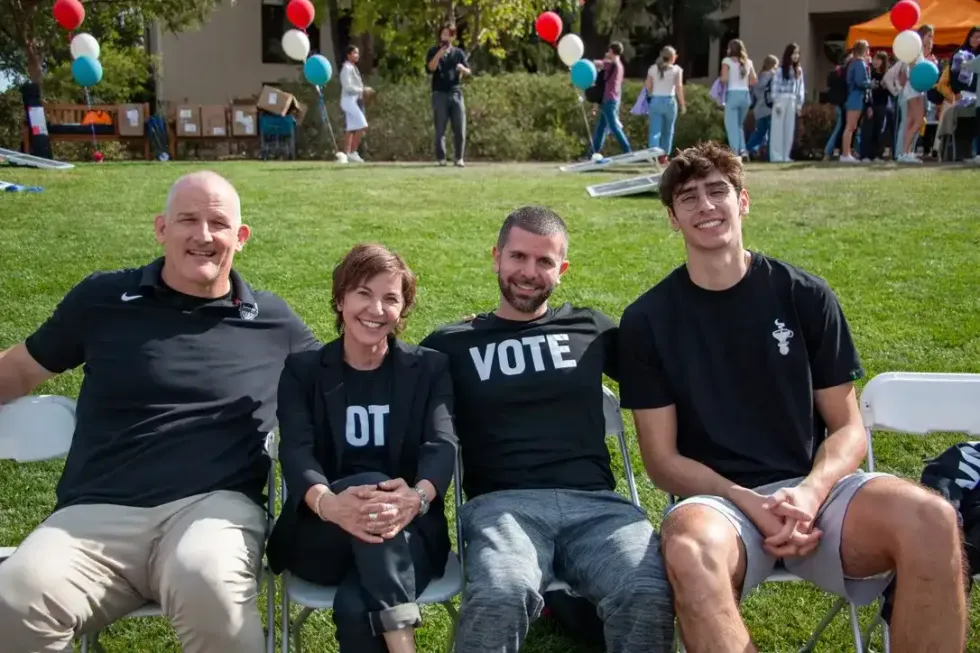 Lisa, Coaches Rev and Matt Elkin, and former Stanford Men’s Basketball star Maxime Raynaud at Stanford’s “All Vote No Play” Democracy Day, 2025