


The Fulcrum is committed to nurturing the next generation of journalists.
We asked Val Amiel Vestil, a Fall Fulcrum Fellow, to share what democracy means to him and his view of its current health.
I came to America expecting to learn about democracy in classrooms, libraries, and humongous white pillars in government buildings. Instead, some of my most revealing lessons came from a park, a subway station, and a grocery store.
I have lived in the United States for more than a year now, having arrived from the Philippines in August 2025 to pursue my master’s degree. Before coming here, my lens of democracy was contained in concepts like elections, freedom of speech, constitutions, political participation, and the right to vote. This lens remains largely about all these, yes, but living here has added something more ordinary to that definition.
Democracy, I contemplate, is the expansion of people’s meaningful options–the ability to choose, participate, challenge institutions, and change course.
I began noticing this in parks.
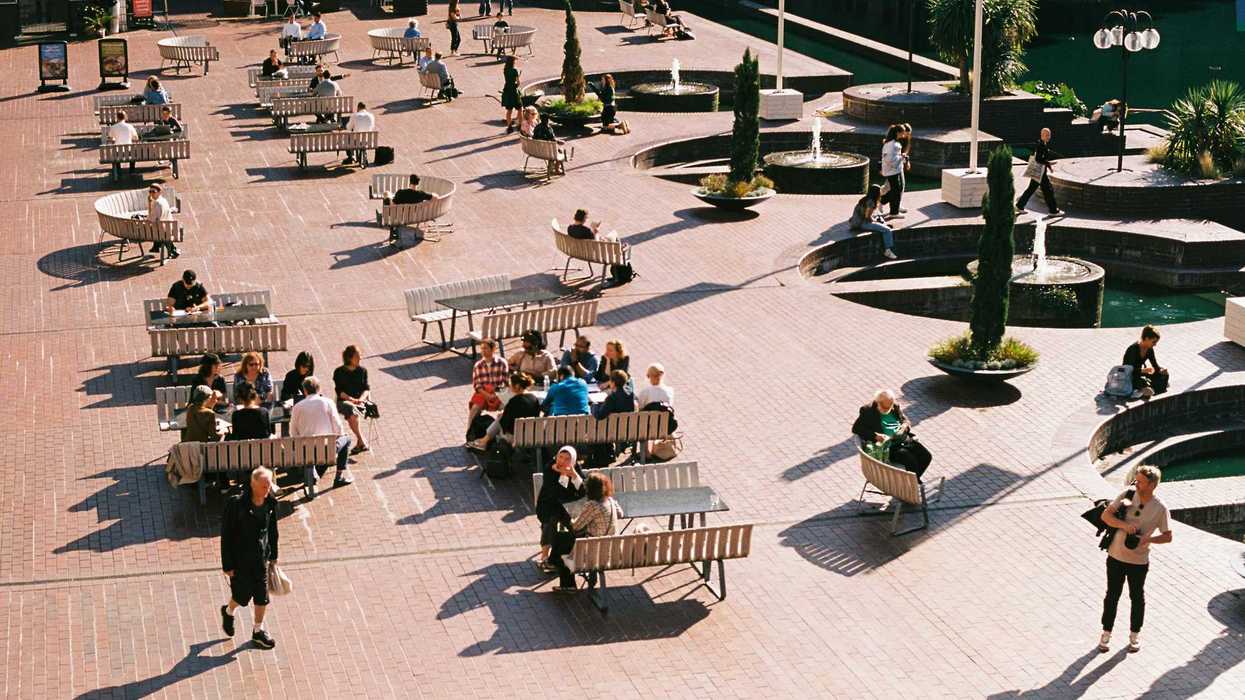
In Ann Arbor, where I live, public parks and pavilions let people simply be after a day's work. They are free, landscaped, and maintained. I have since encountered similar public spaces across the six states I visited over the summer, without exception. Even Yellowstone National Park, thousands of miles from where I live, reminded me that public spaces can be treated as something ordinary and accessible rather than exceptional.
The Philippines is not without parks. We have the Ayala Triangle in Quezon City, the University of the Philippines Academic Oval, the Legazpi Park in Makati, and other beautiful public spaces. But these public green spaces often felt limited, fragmented even. They felt concentrated in particular developments, mostly in upper- to upper-middle-class areas. Research by Czarina Saloma-Akpedonu and Erik Akpedonu traces how ambitious plans for Manila and Quezon City envisioned public green spaces that were never fully realized, leaving only remnants of those visions today.
I think about this when I remember living in Makati. I loved walking to work and passing through its green spaces. But I also knew that this experience was a privilege. Outside these pockets of relative comfort, millions navigate densely populated communities, long commutes, and limited public space. Bonifacio Global City, for example, aesthetically mirrors the shopping centers and polished avenues of Manhattan, but it is a bubble of its own. From the tall towers that rise throughout it, you can look beyond the glass and steel and see very different urban realities when you direct your eyes to the ground: corrugated tin roofs packed tightly together, narrow streets crowded with people, and families using every available surface.
A park, I realized, is an option. So is a bus.
When I visited New York, I was struck by how easily I could travel from Manhattan to Queens, or from New Jersey to New York City, by bus or train. I did not need a car. I did not need someone who knew the city like the back of their hand to guide me. I could look at the subway systems or the maps, get on a train, and go.
In Metro Manila, getting from one place to another required far more time, planning, and tolerance for uncertainty. Commuters often contend with overcrowded buses and trains, limited route integration, and severe road congestion. TomTom’s 2025 Traffic Index ranked the Philippines as the world’s third-most congested country, after Colombia and Malta, with an average congestion level of 44.6 percent. By comparison, the US ranked among the least congested countries overall, with an average congestion level of 19 percent. In Manila, a trip that looks short on a map can become a daily negotiation with traffic, transfers, and long waits – we’re talking more than an hour on the road for a 3-kilometer car ride.
This is not to say that American transportation is perfect, nor that the Philippine transportation system has no value. It is simply a contrast that made me think about what robust transportation systems give people: options.
The economist and philosopher Amartya Sen calls these kinds of opportunities “capabilities” — the substantive freedoms people actually have to do and be what they value. A formal right means little if the conditions necessary to exercise it are absent. That idea helped me name what I was experiencing as I adjusted to living in America. Freedom isn't just having a right. It is having a real choice.
I encountered another version of this at a Trader Joe’s in Ann Arbor. I had bought five of its now-famous canvas tote bags to send home to my family in the Philippines. There was a buying limit of five tote bags per person, but the cashier accidentally rang up six. I noticed only after I got home, so I called the store.
“Do you need my name?” I asked. “The receipt? Anything?”
“No,” the employee told me. “Just come back and tell them you spoke with Kate. We’ll refund you.” I remember thinking: It’s that easy?
The amount was trivial. What stayed with me was how easy it was to fix. In the Philippines, getting a refund for a five-dollar tote bag might require speaking with several levels of supervisors, waiting for approvals, and repeatedly explaining what had gone wrong. Here, I didn't have to navigate a bureaucratic obstacle course to prove something had gone wrong.
A refund is an option. An easy one at that.
The philosopher John Dewey argued that democracy extends beyond being a form of government; rather, it is primarily a “mode of associated living, of conjoint communicated experience,” something expressed through the everyday relationships and institutions through which people live. Robert Dahl, by contrast, identified criteria for a democratic process, including effective participation, enlightened understanding, and control of the agenda.
These ideas have changed how I look at both America and the Philippines. I do not think democracy can be measured only by whether people vote every few years. I have begun to see it also in the number of meaningful choices available to ordinary people: whether they can move through their cities, access public spaces, navigate institutions, make themselves heard, and correct decisions that affect them.
By no means has America given me a picture of what a perfect democracy could look like. These observations also don’t mean that I see the Philippines as a failed one. But living here has given me another way to see home. It has taught me to ask a simpler question: How many meaningful options does a person earning the minimum living wage actually have?
A park is an option. A bus is an option. A refund is an option. And perhaps a healthy democracy is, ultimately, one that keeps expanding those options in the ordinary lives of the people it is supposed to serve.
Val Amiel Vestil is a Graduate student at the University of Michigan. Val blends environmental scholarship with nine years of journalism leadership, founding a nonprofit that has trained more than a thousand reporters and championed solutions‑driven climate coverage across the Philippines and Asia‑Pacific.