



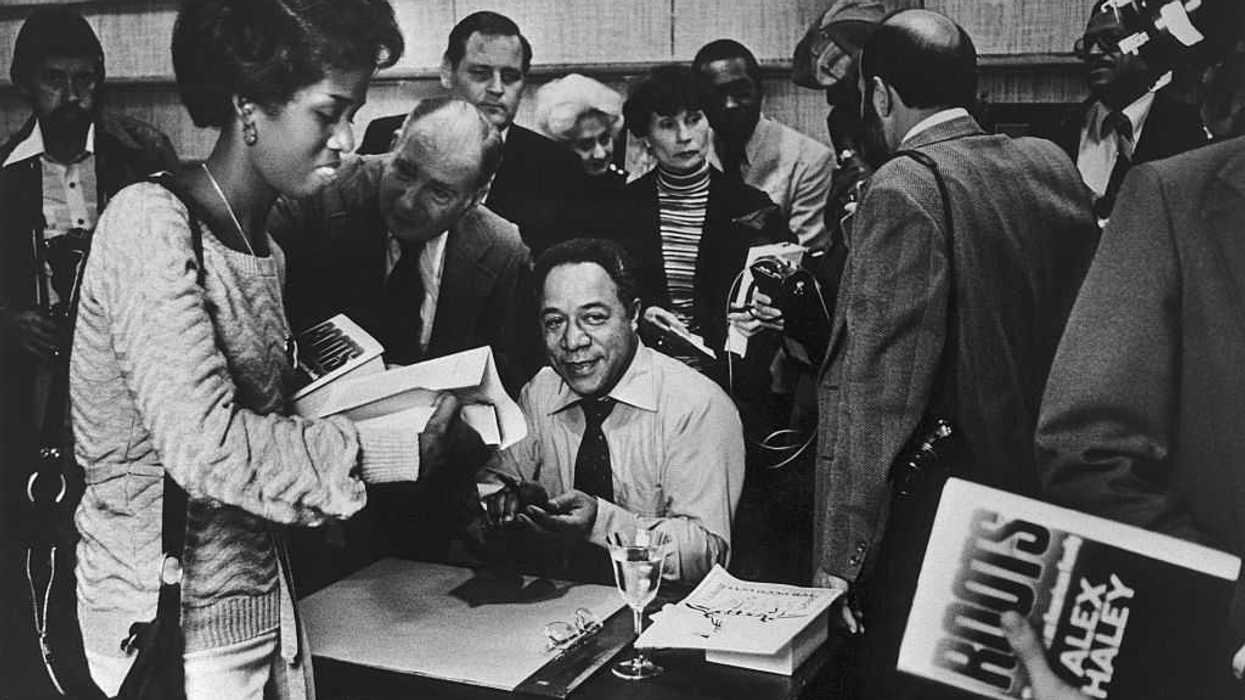

Long before DNA tests promised to unravel our histories, there was Roots. When Alex Haley’s book appeared fifty years ago, it did more than recount a family’s journey—it called America to reckon with a central truth: we cannot understand who we are unless we remember how we got here.
This summer, as the nation marks the fiftieth anniversary of Roots, I found myself on the grounds of the Alex Haley Farm in Tennessee, invited to speak at the Children’s Defense Fund’s Summer Institute. Upon arrival, I felt the weight of the stories that had rooted themselves in that soil—the ones spoken and the ones carried in silence. The farm, now a living classroom, embodies the values Haley and Marian Wright Edelman championed: that children deserve honest stories, and democracy depends on them.
The Tennessee hills are unremarkable at first glance, but their quiet insistence on the ordinary gives them power. Haley never wanted a monument to himself; he wanted a place where people come to do the work, where memory becomes responsibility.
Roots changed America not because every detail withstood scholarly scrutiny, but because its deeper truths refused to be ignored. Haley grasped what historians sometimes miss: facts alone don’t move nations; stories do. When Roots arrived during the Bicentennial, it interrupted our self-congratulation with a sharper question: who had freedom, and who did not? While fireworks marked two centuries of liberty, Haley reminded us that millions lived those years as an inheritance, not of freedom, but of captivity.
Haley’s work democratized genealogy, turning the search for ancestry into a collective reckoning. Black families, long denied records and recognition, found permission to ask questions once deemed unthinkable. White Americans, too, faced histories their families had never spoken aloud. Libraries and kitchen tables became spaces where old silences broke, and new stories began.
We now inhabit an age glutted with information and starved for wisdom. Algorithms can summarize centuries in a moment, but wisdom requires humility—something Haley modeled in his lifelong search for Kunta Kinte’s story. He listened deeply, doubted, revised, and listened again. He approached memory with reverence, understanding that history yields no insights to the incurious or the arrogant.
The Children’s Defense Fund honors that spirit. The farm isn’t a nostalgic museum; it’s a living laboratory where new leaders grapple with justice, democracy, and the moral formation of children. The conversations here return to the stories our children inherit—their sense of belonging or exclusion, the voices they hear or never do. Every curriculum, every omission, shapes who they become.
The genius of Roots was never just in tracing one family’s tree—it was in insisting that Black history is American history, not a sidebar. Haley rejected the false choice between patriotism and honesty. Real love of country, he argued, requires the courage to remember truthfully and to tell that truth plainly.
Today, debates over history education often suggest that complexity threatens unity. Haley taught the opposite: a nation grows stronger when it can name both its achievements and its failures. Denial breeds fragility; truth fosters resilience. That is why remembering matters: it is how a nation becomes honest enough to endure.
In my role as a cleric, I see the church struggle with this, too—quick to celebrate redemption, slow to confess what needed redeeming. Yet Scripture grounds hope in remembrance, not erasure. Israel remembered Egypt. Jesus remembered Passover. Communities are redeemed not by forgetting wounds, but by telling the truth about them.
Haley knew names matter. Stories matter. Remembering is an act of resistance against a culture that pretends Black lives began with their recognition by others. In my own family, as in so many, stories are passed down across kitchen tables, more faithful than any official record. Haley validated that inheritance, giving ordinary families the conviction that their stories deserved to last.
Perhaps, fifty years later, Roots offers a new invitation. In a polarized America, genealogy becomes metaphor. Every family tree holds contradiction—heroes beside failures, courage beside compromise. No honest lineage, and no nation, is simple. The lesson is not to choose pride over accountability, but to hold both at once. That is the unfinished work of every generation.
As I reflect on my time together at Haley Farm, I’m compelled to consider how I and others might carry this unfinished work forward in our own spheres of influence. Whether in classrooms, congregations, boardrooms or homes, we are called to remember honestly, to listen deeply, and to share stories that expand, rather than shrink, our common understanding. Likewise, I invite you to ask: what stories in your care still need a voice, or a reckoning? What will you do, in your role, to ensure that memory becomes the beginning of responsibility and change? The work endures through us.
The Children’s Defense Fund and Alex Haley, in their different ways, call us to remember so that memory becomes responsibility rather than nostalgia. As I left the farm, I was reminded of Haley’s infamous admonishment: “Find the good and praise it.” Understand, Haley never ignored evil; he chronicled it. But he believed that hope demands disciplined attention to the good that survives even the worst history.
Today, our civic imagination swings between romanticizing the past and fearing the future. Haley suggested another way. We honor our ancestors not by embalming their memories, but by carrying their work forward.
The fiftieth anniversary of Roots deserves more than commemoration. It deserves a renewed commitment to telling fuller, braver American stories—stories that can hold sorrow and triumph, bondage and freedom, lament and possibility. Moreover, the work of remembrance and storytelling will require the leadership of young people whose voices bring new questions, perspectives, and urgency. As they claim their rightful place at the table, they do not simply inherit stories—they curate, challenge, and expand them for the future. The Haley Farm, in the end, is less a monument than a mirror. We come seeking to understand through legacy; we leave understanding ourselves.
Rev. Dr. F. Willis Johnson is a spiritual entrepreneur, author, scholar-practioner whose leadership and strategies around social and racial justice issues are nationally recognized and applied.