
In a Thanksgiving Day column in the New York Times, Lydia Polgreen wrote about her love of her father’s work across Africa to improve ordinary people’s lives. But Polgreen’s later work as a correspondent in Asia and Africa taught her “to be skeptical of her childhood convictions.
“I saw firsthand,” she continued, “how institutions of the kind my father worked for sometimes reinforced old hierarchies and systems of extraction and exploitation.”
Today, with wealthy nations slashing support for the poorest countries, she confessed that “the possibility of making strides against the grave problems bedeviling the world’s poorest people seems quite small indeed.”
But Polgreen also wrote eloquently against surrendering to despair. In a column after her father’s death, she observed:
“We live in a time dominated by pessimism and cynicism. These poses are a kind of armor against the vulnerability of hope. To be cynical is to close the door to the possibility of disappointment. To be pessimistic is to foreclose the risk of being made a fool by optimism.
"I realize now that the most precious thing my father gave me was an example of how to live a life devoid of cynicism and pessimism….”
It is an important reminder. How often do we slip into cynicism—individually or within the organizations we’re a part of—as a shield against the vulnerability of hope? How often do we let pessimism dictate the scale of what we dare ask of people?
Our first reaction might be: Not me. Not us. But a cheerful fundraising email cannot mask an organizational culture that keeps its members doing busywork instead of real civic engagement. Many nonprofits are afraid to make big asks of volunteers. Instead, they provide petitions and email form letters, the fleeting gestures of transactional advocacy.
Those online petitions and email form letters are electronic flickers that take nearly zero effort by the signer and have nearly zero effect on the recipient.
Sign, click, done—for us.
Receive, scan, delete—for the Congressional office.
Only 3 percent of Congressional staff say email form letters are highly effective with an undecided member of Congress. Three percent.
We can’t protest our way out of every crisis—though protests matter.
We can’t litigate our way out of our current predicament—though lawsuits matter.
We can’t vote our way out, when elections might be months or years away—though elections matter.
We need all of that—but we also need what we almost never name, transformational advocacy: Ordinary people building sustained, trusting relationships with the officials who make decisions in our name.
Transformational advocacy doesn’t start in Washington. It starts locally, with people forming chapters, learning together, and finding courage together.
Invite Americans to join a local advocacy group when there are endless shows to stream? Ask them to get trained to meet with a member of Congress when Wordle and other games beckon? It sounds unrealistic.
It isn’t.
But I know how hard it can be to get citizens off the couch. This year, I’ve been coaching the United Church of Christ Climate Hope Affiliates to launch their first 11 chapters. At a launch in October in Redding, California, the host had 12-15 yeses, but 18 attended and 13 joined the chapter. The new members would start with a four-part new group training session, held every week for four weeks.
On a call with organizing staff from four different organizations, I asked how many they thought would make it to the first training. They knew it was hard to get Americans off the couch two times in a row, so the guesses ranged from three to ten. It turns out that the attendance for the first three training sessions was 10, 12, and 12.
The organizer didn’t wear cynicism as armor.
The organizer had, as Polgreen wrote in her column, “a bias toward the vulnerability of hope.”
On leaving the Constitutional Convention in September 1787, Elizabeth Willing Powell asked Benjamin Franklin, "Well, Doctor, what have we got, a republic or a monarchy?"
Franklin replied, “A republic, if you can keep it.”
Those new advocates in Redding, and in groups like theirs across the country, are starting and sustaining the important work of keeping our republic, of keeping our democracy.
Sam Daley-Harris is the author of “Reclaiming Our Democracy: Every Citizen’s Guide to Transformational Advocacy” and the founder of RESULTS and Civic Courage. This is part of a series focused on better understanding transformational advocacy: citizens awakening to their power.



 Following our HWF Civic Futures kickoff last week with Eric Liu, our design partners at Public/Official have created a unique visual to capture the “civic scaffolding” spirit of this conversation.
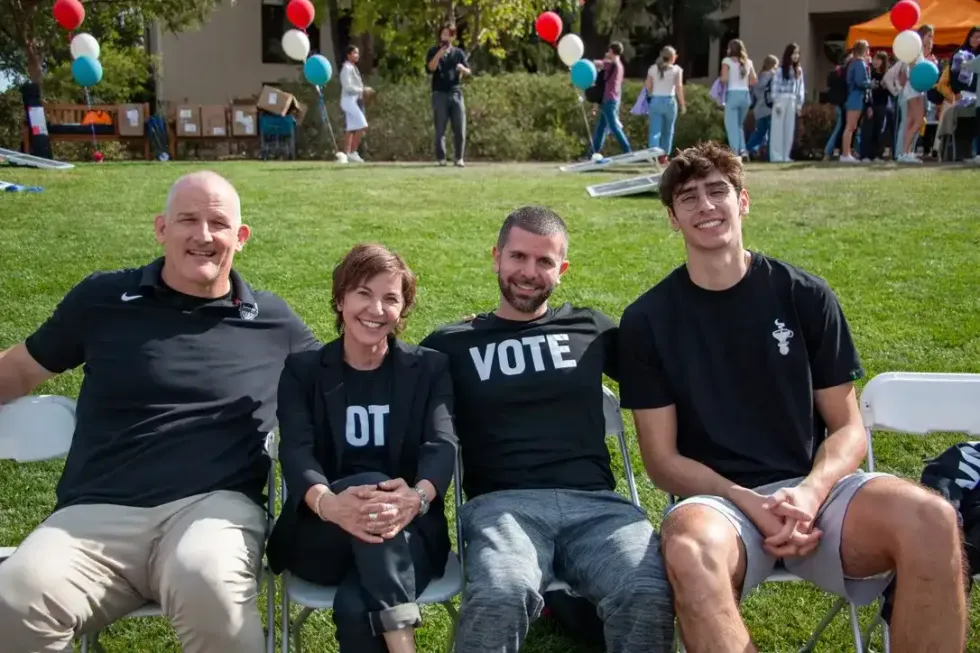 Lisa, Coaches Rev and Matt Elkin, and former Stanford Men’s Basketball star Maxime Raynaud at Stanford’s “All Vote No Play” Democracy Day, 2025