


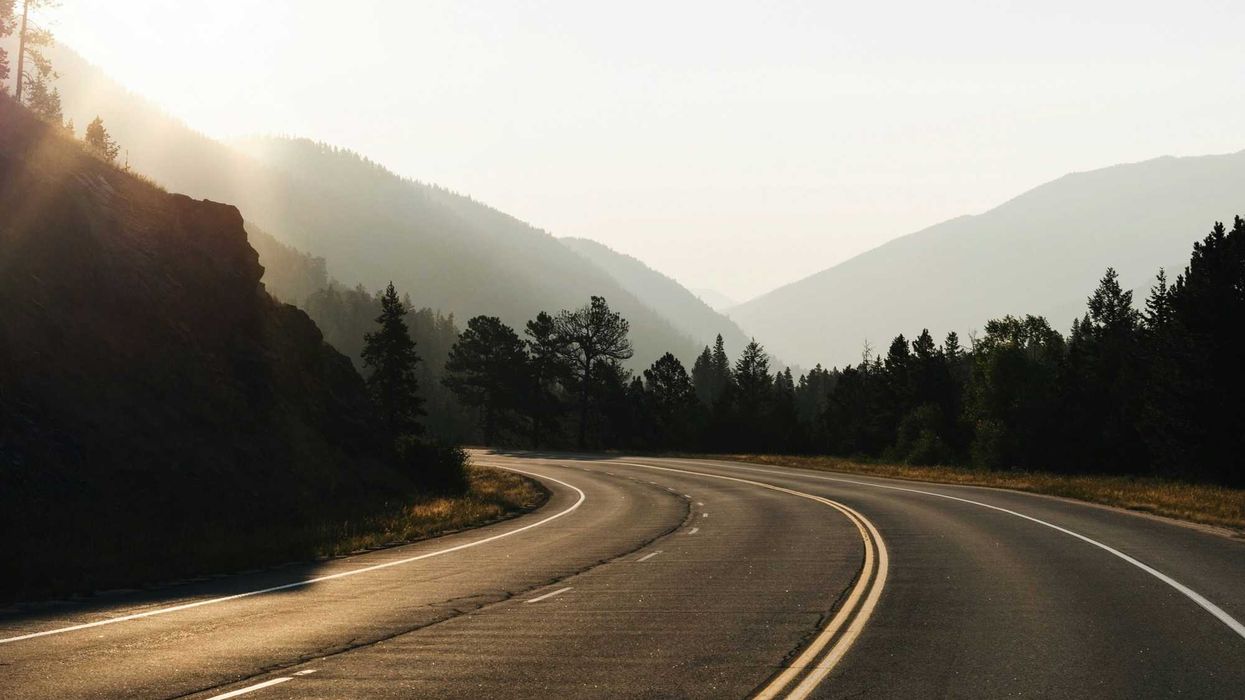

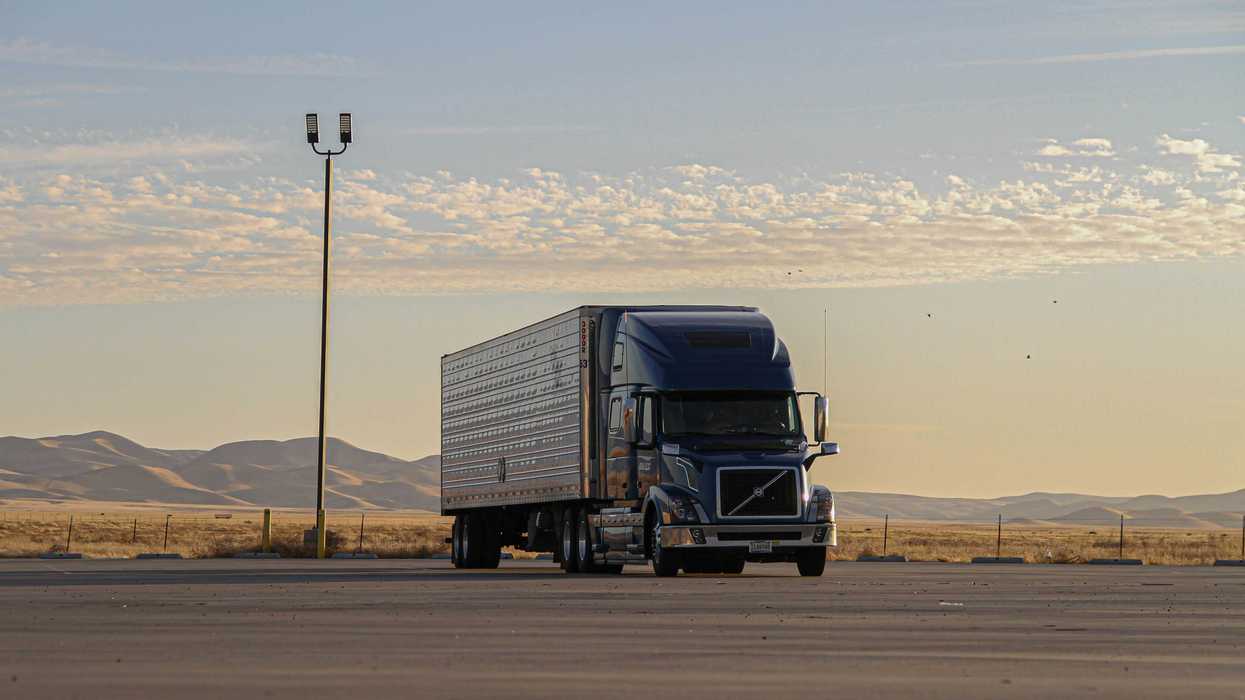
Despite its size, Afghanistan has only a single highway running through it. It’s called National Highway 1, or Ring Road, and I spent a little time on it myself years ago. It has no major intersections, not really. Just 1,400 miles of dusty road that cuts through mountains and across minefields to connect small towns and ancient cities.
Over many decades, America helped build and rebuild Ring Road to support free trade and free movement throughout the country.
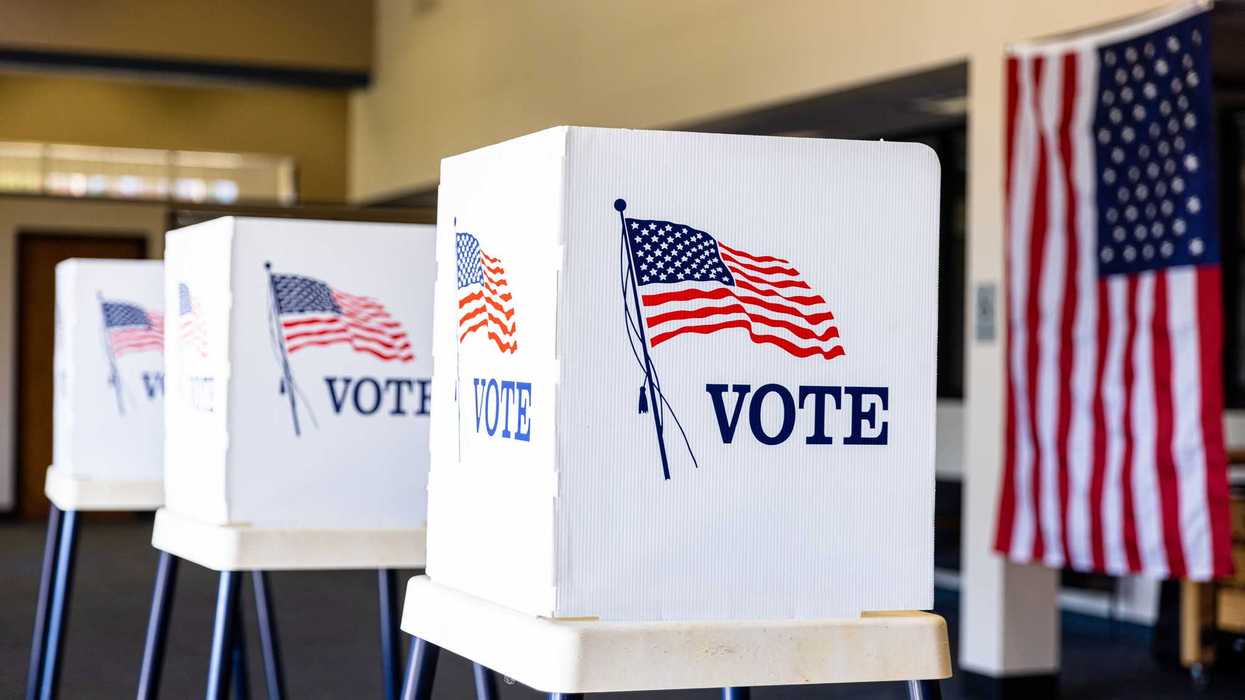
During Afghanistan’s 2009 presidential election—only its second since ratifying its new constitution—U.S. Army convoys drove on Ring Road carrying ballots cast by brave Afghans who had stood in line to vote while under threat from the Taliban for doing so. A threat so credible that they needed armed troops to protect them.
(Some people don’t know and could never imagine what it’s like to watch people try, and ultimately, fail, to vote themselves out from under tyranny. And it shows.)
When those on the side of liberal democracy left the country, Taliban thugs took full control of Ring Road, restricting travel on it almost exclusively to men who pay bribes. Women traveling just about anywhere are required by law to be chaperoned by a male relative.
It’s probably oversimplifying the matter, but it’s not totally untrue to say that when the Americans left in 2021, we took with us Afghanistan’s most practically and symbolically important open road.
That’s ironic, because the open road might be the most pervasive American idea.
From Lewis & Clark to the Underground Railroad, the Gold Rush, Kerouac, Route 66, the Great Migration, Ventura Highway, Thelma & Louise, Old Town Road, and a gazillion other examples, this idea of the open road permeates our history and our culture.
What could be more quintessentially American than striking out and, for better or worse, getting on with one’s journey?
If to be American is to be on an epic road trip, I think to govern America is to manage a big, messy intersection—the point where all our individual journeys inevitably, and necessarily, meet. Here’s what I mean: Think of the busiest, most complex intersection you’ve ever driven through. That intersection is our government in miniature. The intersection’s job is not to tell us where to go. Its job is to help us get to where we’re going without running each other over.
The literal intersection I think about is known in my city as “Five Points,” so named because it’s where five major multi-lane roads converge. Many cities have an intersection like this one. And to be honest, it’s almost always a bit of a mess.
Five Points is probably too big and complicated, and making a left turn through it at rush hour can feel pretty dicey. Still, most of the time, it basically works. When it’s working really well, we barely even notice it.
So what, exactly, makes this big messy intersection work?
First and probably foremost, there’s the rule of law. That’s the traffic signal and the cop who gives us a ticket when we run a red light. Driver’s ed. Traffic court.
The rule of law is necessary, but it’s grossly insufficient for making the intersection work.
There’s no explicit rule of the road, for example, dictating how to treat a fellow driver who accidentally pulls out too far making a left turn, and now they’re caught in the middle of the intersection when the light changes. Some will honk or flip the bird, and that’s their right. Most of us will wave the driver through to keep traffic flowing because even though we’re going to different places, we’re driving different cars, and we care about different things, we trust that we share a common goal.
We all want to get to where we’re going—safely and reliably.
To that shared end, most of us pay taxes, and those taxes help ensure the intersection is maintained and the green and red lights are timed correctly so we don’t worry too much about getting T-boned. That’s the social contract.
Taken together, the rule of law and the social contract make up a fairly free and liberal system that enables our journeys.
Five Points is not a perfect system, though. There are things we’d change about it.
I might prefer a roundabout to a traffic signal. You might think the “No right on red” sign is overbearing. We all hate potholes or roadwork that takes a lane out of commission and slows us down. So we advocate for the changes we want to see. We complain about the potholes. And we should.
But when you think just how complex this intersection is, it’s really a wonder that it works as well as it does, allowing so many cars to pass through it freely every day without incident. The same is true of our government.
Even so, sometimes the system fails.
Like when a storm takes out a traffic signal, and suddenly the intersection feels even more chaotic than usual. But while maintenance crews are en route, and we trust that they are, we drivers know what to do in the meantime. We behave as though we have stop signs. We make eye contact with other drivers and pay close attention to whose turn it is.
To get through the temporary crisis, we give each other grace, we remember our shared goal, and we work collectively toward it. That’s our civil society. Our fail-safe.
But our government only works when the people in charge of it are also committed to our goal—to get to where we’re going—and they uphold the rule of law, honor the social contract, and encourage civil society.
So what happens when our leaders don’t give a rip if we get to where we’re going because they believe having a common origin is more important than having a common goal? (A totally unoriginal idea asserted by just about every authoritarian ever.)
Let us imagine it.
Imagine what happens if a storm takes out a traffic signal, and instead of dispatching a maintenance crew, they send a wrecking ball (or a chainsaw)?
Imagine if they turned our public roadways into private tollways, dividing us into lanes and separating us from one another with concrete barriers.
Imagine if they replaced the traffic signals with big, gaudy, golden toll booths and charged an exorbitant fee. Not a tax that goes back into the system to make it work better, but a fee that goes into their pockets. A cost so high that most of us can’t afford it.
Imagine if they fired all the traffic cops, installed toll booth operators, armed them, and told them that we, the drivers, are the enemy.
Imagine if, more and more every day, the place where our journeys intersect weren’t well-regulated, but mobbed up.
Imagine if they told us they were going to do all that, and we elected them anyway.
Imagine there’s no more American liberal democracy. It’s easy if you try.
But of course, that’s just a thought experiment. Nothing like that could ever happen here because to be American is to take to the open road, free and unafraid to go your own way. Right?
The most epic road trip story I’ve ever heard was not a thought experiment and it was not an American story. It really happened, and it involved an Afghan friend who messaged me one day out of the blue.
Shabnam was a midwife and interpreter I’d worked with in Afghanistan. She was living in Europe now and wanted to do a video call and catch up.
Though we were older now, Shabnam looked younger than I’d remembered as she told me about her journey and what had inspired it. She said that after nearly a decade of waiting for the Special Immigrant Visa she’d been promised by the American government in return for her service, she’d grown too afraid of the constant Taliban threats to wait any longer. So she’d left her two young daughters with her sister in Kabul and human trafficked herself across Central Asia and Russia. Eventually, her daughters joined her in Europe.
On early morning video calls, Shabnam would coo over pictures of my toddler daughter. Her now-tween daughter joined our call one day, and she remembered me and called me “Sweetie”—a nickname she had first parroted back at me when she herself had been a toddler. I cried into my coffee.
A few years later, in the summer of 2021, Shabnam called me again, this time about a journey she hoped I could help her orchestrate. She was desperate to evacuate her sister, whose connection to Shabnam, a known American conspirator, put her at grave risk of Taliban vengeance killings now that it looked like Kabul would fall.
I tried, as many veterans did, and like most of us who tried, I failed. I failed to help her or anyone else I tried to help in those horrible days during the withdrawal and its aftermath.
I told Shabnam I was sorry for failing her. I was sad that after so many years since quashing al-Qaeda and after so much money and so much suffering, it seemed all we’d managed to do was line the pockets of so many defense contractors.
Shabnam saw things differently, though.
She told me, “Yes, for my whole life we have been at war, but for twenty years we saw it could be different, without Talib, without a woman walking only with a man in the street. With school. School for women.”
She told me those women would draw strength from that memory—the memory of walking freely to school on the open road—and that recollection would inspire them to fight their oppressors someday.
I choose to believe her and to hope, mostly because I don’t see the point in the alternative. But also because I was struck by the steadfastness of her voice as she asserted, so plainly, that such a small shadow of a memory of what freedom feels like would be enough to build upon.
I think about that conversation now, and I think of how in America, we are lousy with freedoms to build upon. Not faint memories to cling to, but real, robust freedoms that we enjoy and take for granted every day, right now.
What we lack is not collective memory, but collective imagination.
The founders drew some inspiration from history—right back to Cicero, even. But their real trick was not in what they were able to replicate from the past; it was in what they were able to conjure up for our future, out of thin air.
Shabnam’s hope for what the daughters of Afghanistan might imagine for themselves someday is a long shot, not unlike what our founders did in imagining American liberal democracy into existence in the first place.
In our current political moment, our task is much simpler.
First, we must let ourselves imagine what might happen if we really throw it all away.
Then, we must protect our liberal democracy by continuously reimagining it into being. Especially now. A more perfect union and all that.
Because when we prize nostalgia over imagination, we invite illiberalism. And when we venerate the past so much that we fail to imagine anything could ever be better than what came before, we don’t merely invite illiberalism—we pull up a chair for it and offer it a cup of tea.
The system is broken, yes. But I believe we can, and we must find common cause in fixing it. And I hope against hope we can muster the courage and creativity to imagine something better.
I choose to believe and to hope, mostly because I don’t see the point in the alternative. And also because the epic American road trip is not about remembering where we’ve been. It’s about imagining where we might go next.
Joanna Dasher is a former U.S. Army officer and West Point graduate who served in Afghanistan on a Provincial Reconstruction Team in Ghazni Province. She writes and works from Atlanta, Georgia.





The President Invited Iran to Bomb My Home