


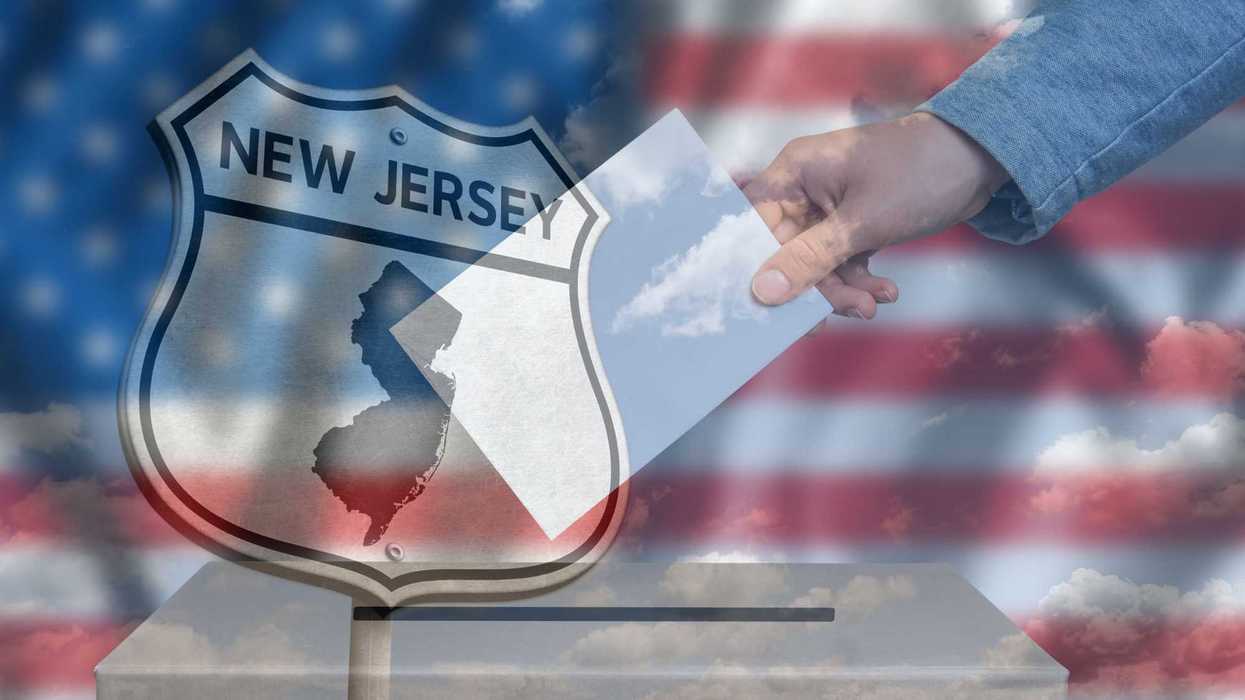

With American democracy in crisis amid national turmoil, neither political party is prepared to lead us out of the wilderness. However, here in New Jersey, voters can bring in outsiders through one legal strategy to overcome barriers: the ballot slogan system.
This year, New Jersey's primary elections are unusually open. Until recently, party organizations could manipulate voters' choices by the deceptive arrangement of candidate names, a system called the county line. This guaranteed that nominees would be the parties' handpicked choices.
But two years ago, that system was blocked in a landmark federal voting rights lawsuit. I should know - I was an expert witness in that lawsuit, and helped do away with that unfair rule. Now all candidates compete on a more level playing field.
But there’s still the problem of name recognition. How can we tell the difference between an establishment candidate and someone who can make real change? The answer is in the ballot slogan. Candidates in New Jersey are allowed to list a slogan of up to six words describing their views.
The ballot slogan can be used by individuals to express their views. There’s still the problem of whether someone is a serious candidate. A slogan like “free pizza and beer on Fridays” is, after all, six words. Such a slogan would not speak to problems well-suited to legislation.
But the slogan can take on new force, both by being serious - and by coordination between many candidates. Protest movements gain power in numbers. If a whole slate of candidates used the same slogan, that would show a unified front and a movement. For example, in the Democratic primary in every congressional district in New Jersey, imagine 12 candidates - one for each district, using “No Kings” in their ballot slogan. They could convey a message that harnesses the energy of protests across the Garden State. Such a slogan would support the kind of radical rescue operations that Democrats think are urgently needed.
We're living in a time when our institutions have failed us. Our parties, our elected officials, business, law, universities—all are weakening or caving out of fear. But one element of society has less to lose by speaking the truth and more to gain by saving the system: individual voters. The slogan system gives those voters a real say.
Democratic Party leadership is responding very slowly to the radical changes of the last 12 months. While their party base is becoming increasingly infuriated by the actions of ICE in Minneapolis and across the nation, their consultants are urging a more cautious approach. But ICE's aggression is just the beginning. Drastic changes to the administration of law, corruption at the highest levels of government, and the undermining of public health and science threaten to upend the prosperity and peace of the last 50 years. This is not even to mention the undoing of progress on civil rights and voting rights. In the face of this, Democrats would rally behind new leaders willing to do whatever it takes to save the nation.
Although entrenched party organizations may be afraid to call for necessary action, individual candidates are not similarly constrained. Their slogan can be free of any pressure from party elders. Think of a ballot slogan like "Abolish ICE. Prosecute crimes. No kings." With 46% of Americans in favor of abolishing ICE and 43% opposed, such a slogan starts with a natural advantage.
And since primaries are dominated by party activists, such a slogan could be galvanizing. Recall that Alexandria Ocasio-Cortez used the Democratic primary to oust a longtime veteran of Congress, Joseph Crowley. Amplify that to hundreds of districts nationwide. Such a message would resonate with rank-and-file voters all over the nation. New Jersey could lead the way.
The same path is available to Republicans. Members of Congress are largely voting in lockstep with the Trump Administration - even as that Administration takes ever more extreme actions. If they are dismayed by the radicalism that has gripped their party, they can express a slogan that points toward a better way. Imagine Republican outsiders running under the slogan “Restore the Fed, NATO, and integrity.” Old-school Republicans and conservatives who want to, well, conserve, would find their home at last.
The candidate filing deadline is March 23. For any candidates who can gather signatures by that date, a path is open to expressing the rage of Democrats, the uneasiness of Republicans, and the millions of independents who have no home in either party. Through the ballot slogan system, the banner is ready for a new generation of candidates to pick up.
Sam Wang is a professor of neuroscience at Princeton University and a leading expert on statistical analysis in public policy. He is the founder of Fixing Bugs in Democracy where he covers topics related to democracy, data analysis, and potential reforms.








The President Invited Iran to Bomb My Home