
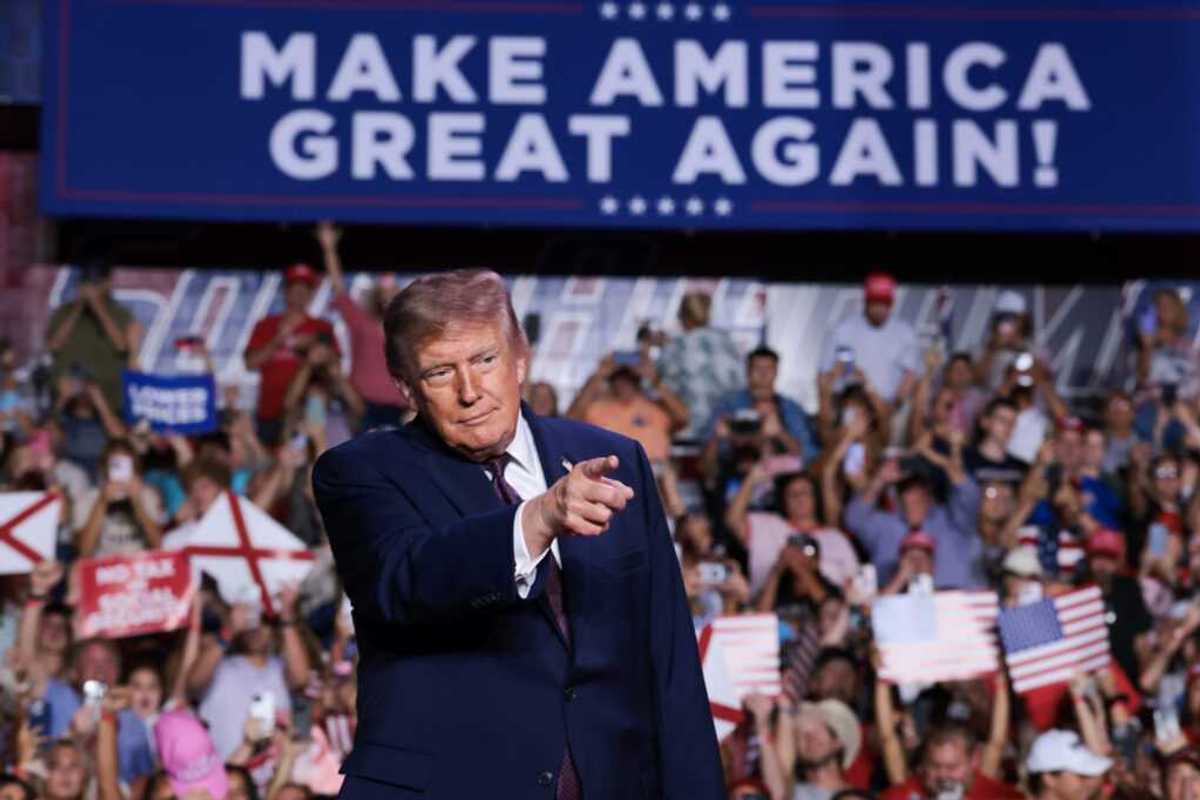




“Have you no sense of decency, sir, at long last?” With those words in 1954, Army lawyer Joseph Welch took Senator Joe McCarthy to task and helped end McCarthy’s destructive un-American witch hunt. The time has come to say the same to Donald Trump and his MAGA allies and stop their vile perversion of our right to free speech.
American politics has always been rife with misleading statements and, at times, outright falsehoods. Mendacity just seems to be an ever-present aspect of politics. But with the ascendency of Trump, and especially this past year, things have taken an especially nasty turn, becoming so aggressive and incendiary as to pose a real threat to the health and well-being of our nation’s democracy.
The slide into a more aggressive misinformation campaign began during Obama's presidency. Republicans such as Sarah Palin, Rush Limbaugh, and yes, Donald Trump, promoted outrageous claims against Obama—and many Republicans believed them. A CBS/New York Times poll in 2011 found that 25% of all Americans and 45% of Republicans thought that Barack Obama was not a U.S. citizen. The health care reform debate was hijacked by fears that the law would create “death panels” and that it contained “Hitler-like” policies. The silly fear that the reform legislation posed the threat of creeping socialism was, by comparison, quaint.
During Trump's campaigns and his time in office, the misinformation became bigger, more all-encompassing. He could be seen as following Nazi propaganda chief Joseph Goebbels' theory of the "big lie": tell a lie big enough, often enough, and people will come to believe it as truth. Hence, we have Trump calling all truthful, legitimate news "fake" news, compared to his own false statements, which he presents as the truth. It started during the first campaign with his outrageous claims about the criminality of undocumented immigrants and has been an aspect of just about every topic he's addressed.
These claims are all incredulous positions that fly in the face of the facts. Why then do so many Americans, not just a small radical fringe, hold these beliefs so adamantly?
The answer is clear … they respect Trump or people such as Rush Limbaugh and Sarah Palin, and so they have been fodder for the extreme demagoguery that Trump and others have used to create a rabid, angry, believing voter block. As for the Republican members of Congress, who have either repeated these charges or remained quiet, there's no way of knowing how much of their complicity is a product of their fear of Trump and how much is having come to believe his lies.
If actors on the political scene are so ready to pervert the truth, if they feel no ethical constraints, if they have no shame, we have reached a point where the American people need a Truth in Politics law to protect them.
To this suggestion, both liberals and conservatives will no doubt react with indignation and raise the flag of the Constitution’s 1st Amendment right of free speech. But the right of free speech is not absolute.
The Supreme Court has long recognized that there are limits to free speech. Perhaps the most relevant is the Truth in Advertising law that protects consumers from deceptive advertising. Specifically, under federal law, advertising must be truthful and non-deceptive; there must be evidence to back up any claims made; and it cannot be unfair. The law is enforced by the Federal Trade Commission.
Why is this exception made to the Constitution’s right of free speech? The reasoning behind this, and other consumer protection laws, is that the consumer is at a disadvantage vis a vis the businesses that cater to them … in this instance, because they don’t have the ability to reasonably determine for themselves the truthfulness of advertising claims and they therefore might make purchase decisions that either actually cause harm or are not in their best interest.
If consumers can be protected from false and deceptive advertising, surely the general public should be protected from false and deceptive claims in political statements and advertising that are likely to mislead and distort the voting process. Free speech advocates will say that citizens have the opportunity to learn the truth; that public debate exposes all falsehoods. That is the myth.
That was, at one time, true. But because of the advent of cable channels that cater to misinformation, the polarized nature of the populace, and the power of social media, not only do incendiary charges go viral within minutes, but people don't have the disposition to question what people they believe in say. Charges can be publicly refuted, but that has no impact.
The danger here is twofold: first, citizens will cast their vote or take other action in ways they wouldn’t if they knew the truth, acting contrary to their interests – such misinformation is thus another type of fraud used to alter election outcomes and policy decisions; second, these incendiary falsehoods have created an emotional, angry, polarized electorate making meaningful substantive debate on the issues impossible, thereby stifling the lifeblood of American democracy – the marketplace of ideas. Much of today’s debate appeals to the emotions; reasoned thought is a scarce commodity.
Much as it goes against my grain and the grain of most Americans, we have reached that point where to save our democracy, we must enact a Truth in Politics law. We can no longer depend on ethics or rational thought to save us from the demagogues.
Ronald L. Hirsch is a teacher, legal aid lawyer, survey researcher, nonprofit executive, consultant, composer, author, and volunteer. He is a graduate of Brown University and the University of Chicago Law School and the author of We Still Hold These Truths. Read more of his writing at www.PreservingAmericanValues.com








The President Invited Iran to Bomb My Home