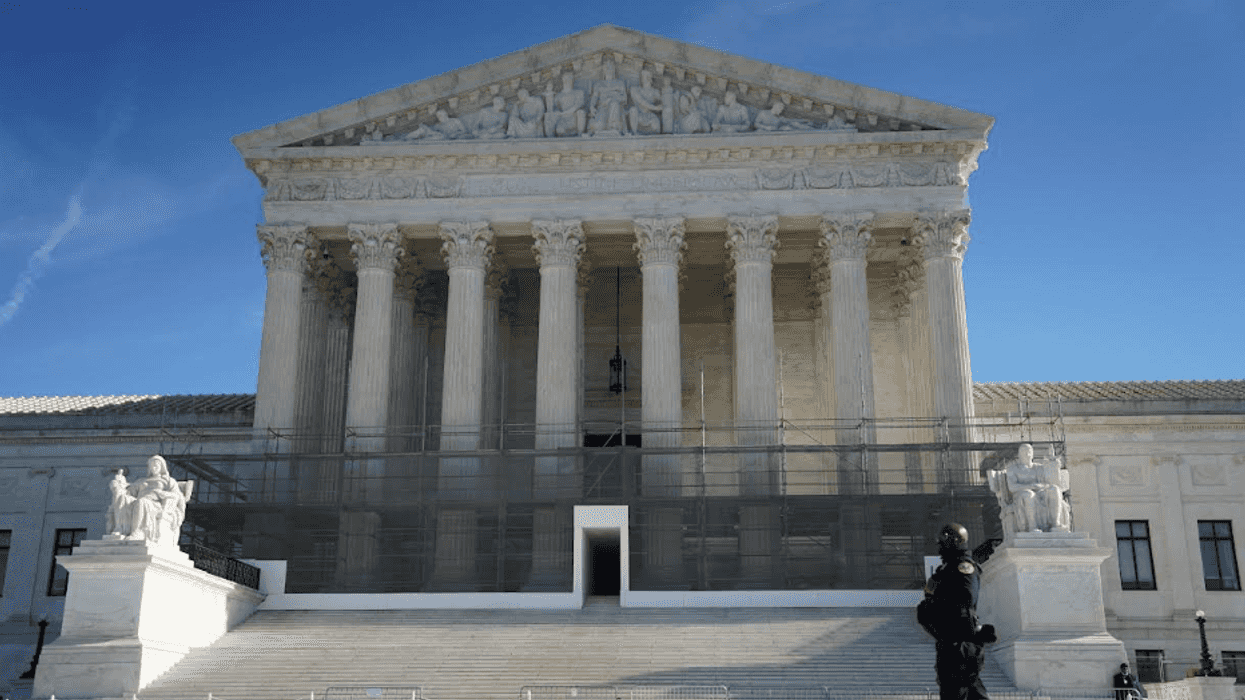

WASHINGTON – A dispute over a missed court filing deadline landed before the U.S. Supreme Court on Feb. 24, but legal scholars warned the decision could reshape whether federal or state courts get to decide the fate of major energy projects, and whether states retain meaningful power to enforce their own environmental laws.
The case, Enbridge Energy, LP v. Nessel, asks whether federal courts have the authority to waive a 30-day deadline for removing a case from state to federal court. While the case is procedural, the flexibility Enbridge requested could allow companies to pick the court they prefer.
At a time when the Trump administration has weakened many environmental protections and some states are beginning to step in to safeguard their environments, the case could determine whether companies can sidestep state environmental laws by moving their cases to federal court, even if they missed deadlines to do so.
“As the federal government backs off of a lot of its environmental statutes and regulations, you do see states stepping in to fill some of those gaps,” said Justin Pidot, law professor at the University of Arizona and former General Counsel for the White House Council on Environmental Quality. “So in the future, there could be more controversies where you have sort of these split federal state issues, and what happens here might have ramifications for that future.”
He said the same could be true in countless disputes between states and companies that have nothing to do with environmental law.
THE BACKGROUND OF THE CASE
At its core, the litigation is about Line 5, a 645-mile pipeline stretching from Superior, Wis., to Sarnia, Ontario, that carries up to 23 million gallons of crude oil and natural gas liquids daily. Michigan Attorney General Dana Nessel filed suit in state court in June 2019, seeking to shut the pipeline down because of the risks for her state’s environment and people. According to the Sierra Club, the 80-year-old pipe has spilled 29 times and poses significant risks to neighboring farmland, pristine natural areas, valuable freshwater sources, and tribal lands it crosses.
Enbridge waited more than 2 years before seeking to transfer Nessel's lawsuit to federal court, well beyond the 30-day window Congress specified. The 6th U.S. Circuit Court of Appeals ruled in 2024 that the deadline was mandatory and remanded the case to the state court. Enbridge appealed to the Supreme Court, arguing that the deadline is nonjurisdictional and represents “the backdrop of American law.”
The Supreme Court weighed in because Enbridge makes “strong claims around national interest” superseding a state’s interests, according to Robert Weinstock, director of the Environmental Advocacy Center at Northwestern University Pritzker School of Law.
WHY DOES A CHOICE OF COURT DETERMINE THE FATE OF LINE 5?
Both sides are seeking the court they believed would likely rule in their favor, according to legal experts. Michigan filed in state court under state law, which Nessel views as a friendlier forum.
“I think that parties understandably will choose the forum that they think is the best advantageous forum for them. And everybody does it, and it's perfectly rational to do so, and where the law allows that kind of choice, there's nothing wrong with it,” said Scott Dodson, professor at University of California College of the Law.
However, experts warned that the industry tactic of forum-shopping can reduce local and state governments’ ability to seek relief for climate change damages in state courts.
“If this strategy works, we may well see more maneuvers by industry designed to move their cases to friendlier courtrooms,” Debbie Chizewer, Managing Attorney at Earthjustice, wrote in a statement.
Pidot said the “forum picking” fight in the Line 5 case is somewhat unusual in environmental law. Federal environmental claims typically begin in federal court, he said. These jurisdictional battles do not arise as often in this field, but when they do, they tend to carry especially high stakes.
INSIGHTS FROM THE COURTROOM
John J. Bursch, a lawyer representing Enbridge, told the justices on Tuesday that the 30-day deadline is a non-jurisdictional filing rule that is subject to exceptions, and granting one in Enbridge’s rare “unicorn” case would not encourage copycats. He also commented that federal courts are uniquely qualified to decide federal common law issues in foreign affairs.
“All we're asking you to do is to declare that the presumption applies, that it hasn't been rebutted by the clearest command, and to reverse,” said Bursch.
Attorneys siding with Enbridge argued that the Supreme Court should allow the case to proceed to federal court.
“Otherwise, the Attorney General of Michigan is undermining the foreign policy and foreign affairs powers of the executive branch with this lawsuit,” Zac Morgan, attorney at Washington Legal Foundation, said in an interview.
Justice Sonia Sotomayor challenged Enbridge’s argument that the state has a right to be heard in federal court.
“You call it a right to have a federal court try the case, but I don't know that that's a right. You have a right to have recovery for a loss or a potential loss, and the forum where that right is adjudicated is not lost,” said Sotomayor.
Justice Samuel Alito stressed the national interest by quoting a friend of the court brief: “Shutting down Line 5 would result in a massive shortage of gas, diesel, and jet fuel in both Ontario and Quebec, not to mention end thousands of Canadian jobs,” he said.
Yet the attorney representing Michigan, Ann Sherman, argued that the gravity of those consequences was simply not relevant to the procedural question.
“None of those considerations are at play here because we trust state courts to adjudicate issues to even federal questions,” said Sherman.
IMPLICATIONS FOR THE FUTURE
Legal scholars said the procedural arguments could be relevant beyond environmental outcomes.
“I think a lot of people are interested in this because it involves pipelines. But really, this case has nothing to do with pipelines,” said Alexander Volokh, professor of law at Emory University. “It's really about a very general rule of time limitations that are going to be applied in hundreds of different cases.”
Weinstock said, if the Supreme Court moved the case to federal court as Enbridge requested, the decision could ripple across future infrastructure projects, changing “the dynamics of how these infrastructure projects would get developed and considered and ultimately approved.”
Weinstock said large companies increasingly litigate in multiple courts simultaneously “as a way to try to get a decision they want, or just as a way to exhaust their opponents’ resources, because often the people challenging these decisions are nonprofit organizations or individual citizens, and they don’t have the sort of legal resources that major international companies do.”
Both sides pointed to tangible stakes in the case.
A decision for Enbridge could hurt the Anishinaabe peoples, who consider the Straits of Mackinac sacred and depend on fish from the Straits, according to Chizewer
“If the Court rules in Enbridge’s favor, the company’s underhanded procedural tactics will be rewarded with an escape to a more favorable venue at the expense of Tribal voices,” said Chizewer.
Enbridge, however, said that without Line 5, Michigan and the surrounding region would face immediate shortages of transportation fuels and propane.
Regardless of the Court's decision, expected in June, Michigan officials reiterated the state’s commitment to pursuing the case. “Attorney General Nessel will continue to fight for the people of Michigan on these vital issues concerning the Line 5 pipelines in the Straits,” said Danny Wimmer, Nessel’s press secretary, in a statement.
Dasha Dubinina covers business for Medill on the Hill.