

Skip to content
Search

Latest Stories

Follow Us:
Top Stories

July 4th and the American Faith We’ve Watched Slip Away

A presidency defined by personal gain shows how far the country has drifted from its shared expectations

Opinion

July 4th and the American Faith We’ve Watched Slip Away

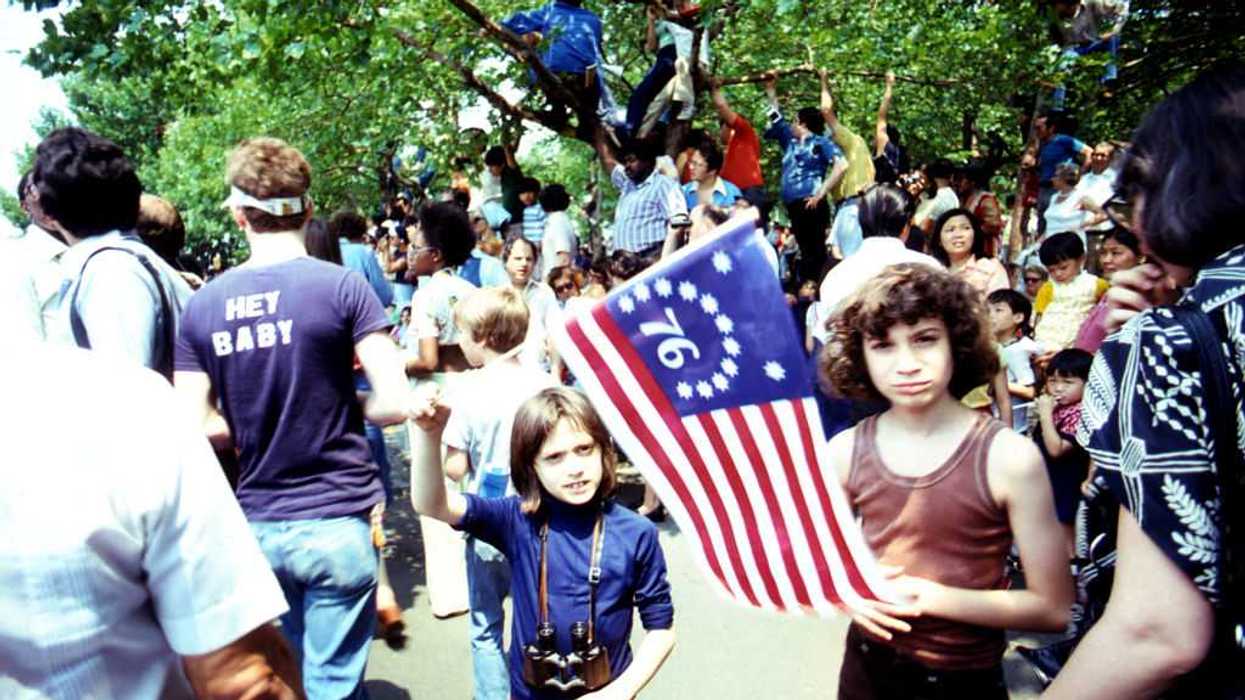
Kids and families celebrate the US Bicentennial near the New York Harbor in Lower Manhattan. Taken on July 4, 1976 in New York City, New York.

(Photo by David Attie/Getty Images.)

I was a girl in Philadelphia in the summer when America turned 200. The birthplace of America was electric in a way I've never forgotten — crowds stretching from the art museum steps down to the Delaware River, each city block corded off for parades, cookouts, celebrations, and the kind of noise that felt like belonging.

It was also, I know now, a particular kind of American moment — one that required something beyond good weather and a long weekend. It required a belief that the country and its highest office still belonged to all of us.


Back in 1976, we were not, by any measure, a country at ease. Unemployment hovered near 7.5 percent. Inflation had only recently retreated from double digits. The man who'd held the presidency before Gerald Ford had resigned in disgrace two years earlier.

We had every reason to feel hollowed out. And yet. There was something unbroken in that crowd. Whatever people thought of their government, and plenty thought very little of it, they believed the country was still theirs.

That feeling had a name. It was civic trust, the quiet, background assumption that whatever failures or corruptions touched the men in office, the office itself still pointed toward something larger than any one man's ambition.

On the eve of this Fourth of July, I find myself back in that memory, and I cannot shake the distance between then and now.

The surface numbers are, in some ways, better than in 1976. Unemployment currently sits at around 4.2 percent. Inflation, while persistent, is nowhere near the double-digit nightmare of the late seventies.

But numbers have never been the whole story, and this year the story underneath is one I don't know how to celebrate around.

Since taking office, President Donald Trump's personal wealth has grown by at least $1.4 billion. He accepted a Boeing 747 worth roughly $400 million from the Qatari government. He launched a cryptocurrency venture that, according to a House Judiciary Committee report, generated as much as $11.6 billion in holdings — while his administration was quietly dismantling federal oversight of the industry.

And then, last month, he did something that may be without precedent in the history of American self-dealing. Trump sued his own Internal Revenue Service (IRS) over the unauthorized release of his tax returns — and then, before the case could even be heard on the merits, his Justice Department settled it on his behalf.

The price of settlement: a Department of Justice (DOJ) addendum declaring the federal government “forever barred and precluded” from auditing any tax return filed by Trump, his sons, his family, or more than 500 affiliated business entities before May 18, 2026.

An ongoing IRS audit that could have resulted in a $100 million penalty against the Trump Organization simply vanished. Legal experts called it unprecedented. Senate Democrats called it a potential violation of federal law.

When asked about his family's financial entanglements, Trump told the New York Times: “I found out nobody cared, and I'm allowed to.”

In 1976, that sentence would have ended a presidency. It ended one —in fact, just two years before—though the crime was different.

What Richard Nixon understood, to his ruin, was that there were still lines. That the office did not belong to the man who held it. Gerald Ford, whatever his failures, knew this. Jimmy Carter, who would take the oath six months after that Philadelphia summer, put his peanut farm in a blind trust.

The question of self-dealing was essentially rhetorical, because the expectation that a president served the country — not himself — was foundational.

What's been taken from us isn't a policy position. It's not something the next election can simply restore, though elections still matter enormously.

What's been taken is the assumption of good faith — the idea, however naïve it may now seem, that the person holding the most powerful office on earth was pointed, even imperfectly, toward the public good rather than his own balance sheet.

The fireworks will still go up on the 250th birthday. Family, friends, and neighbors will gather. There will be plenty of flags flying.

But I keep thinking about that girl in Philadelphia, pressed into a crowd of strangers who all felt, despite everything, like they were celebrating something they shared.

I'm not sure I know what we share now, except, perhaps, the grief of knowing what we've lost, and the long work of getting it back.

Lynn Schmidt is a columnist and Editorial Board member with the St. Louis Post-Dispatch. She holds a master's of science in political science as well as a bachelor's of science in nursing.


Read More

Protestors holding flags that read, "Trump 2020," and recording on their phones inside the U.S. Capitol.

A pro-Trump mob enters the Rotunda of the U.S. Capitol Building on January 6, 2021 in Washington, DC. Congress held a joint session today to ratify President-elect Joe Biden's 306-232 Electoral College win over President Donald Trump.

Win McNamee / Getty Images

MAGA’s Get Out of Jail Free Card

We have never lived through a better era to be a criminal, provided your political fealty is directed toward the right person. If you are an executive facing fraud charges or a perpetrator of violent offenses, the standard calculations of the penal code may no longer apply as long as you support Donald Trump. If you’re Team Trump, the machinery of the state will actively dismantle itself to protect you. If not, good luck to you.

The Trump regime’s message is now unmistakable: rules do not apply to MAGA. Consider the recent saga of the U.S. Army pilots who took two AH-64 Apache attack helicopters on an unauthorized detour to perform a low-altitude flyby of washed-up rocker and MAGA ally Kid Rock’s Nashville home. As a former military helicopter pilot and aircraft commander, let me be clear: this is exactly the kind of stunt we are taught never to do. If I had pulled something like that, there would have been legitimate grounds to take my wings away. Instead, when the Army suspended the crew pending a standard safety and regulatory review, as is the proper procedure, Defense Secretary Pete Hegseth intervened personally, bypassing standard military discipline to announce on X: “Thank you @KidRock. @USArmy pilots suspension LIFTED. No punishment. No investigation. Carry on, patriots.” Their rule breaking was catalogued as patriotic.

Keep Reading Show less
Democracy Awards Honor Bipartisan Excellence in Congressional Service
white concrete building under cloudy sky during daytime
Photo by Harold Mendoza on Unsplash

Democracy Awards Honor Bipartisan Excellence in Congressional Service

Now in their ninth year, the Democracy Awards are the Congressional Management Foundation’s (CMF) flagship program recognizing excellence in non-legislative achievement on Capitol Hill. Founded in 1977, CMF is the premier bipartisan 501(c)(3) foundation dedicated to strengthening the First Branch by providing Members of Congress and their staff with hands-on, actionable support and essential resources that help them govern effectively, better serve constituents, and strengthen the institution. Across seven categories, these bipartisan awards honor Members of Congress and their staff for outstanding public service and contributions to strengthening the First Branch.

Each year, following an open self-nomination season, one Democratic office and one Republican office are recognized in each award category, along with four recipients of the Chief of Staff of the Year award. Applications for the 2026 season opened in late January, and throughout the spring, CMF conducted 47 interviews across 45 congressional offices from a pool of 154 applications. Winners were selected by an independent panel in May and will be honored at both a Winner’s luncheon in June and a formal ceremony in Washington, D.C. in July. Through this process, the Democracy Awards shine a light on the exceptional work taking place on Capitol Hill that too often goes unnoticed.

Keep Reading Show less
The Iranian regime does not fear Trump

U.S. President Donald Trump speaks during a signing ceremony for the “Secure America Act” in the Oval Office of the White House in Washington, D.C., on June 10, 2026.

(Ken Cedeno/AFP via Getty Images/TCA)

The Iranian regime does not fear Trump

Back in 2012, President Barack Obama issued a statement at a press conference that would change his presidency and his legacy forever.

It was a year into what would become Syrian leader Bashar al-Assad’s brutal and protracted war on his own people, a war that would cost hundreds of thousands of lives, empower Iran and Russia, and destabilize much of the region.

Keep Reading Show less
Welcome to Trump’s lame duck presidency

President Donald Trump speaks to the press in the Oval Office of the White House in Washington, D.C., on June 3, 2026.

(Mandel NGAN/AFP via Getty Images/TCA)

Welcome to Trump’s lame duck presidency

It's been a while since we saw a lame duck presidency — long enough in politics to maybe forget what one looks like.

In October 2014, President Barack Obama hit his lowest approval rating yet at 40%. The midterm elections were an absolute bloodbath for Democrats — Republicans expanded their majority in the House by 13 seats and took control of the Senate with a gain of nine seats.

Keep Reading Show less