



Skip to content
Search

Latest Stories

Follow Us:
Top Stories

Fire Pete Hegseth to help GOP in midterms

Opinion

Fire Pete Hegseth to help GOP in midterms

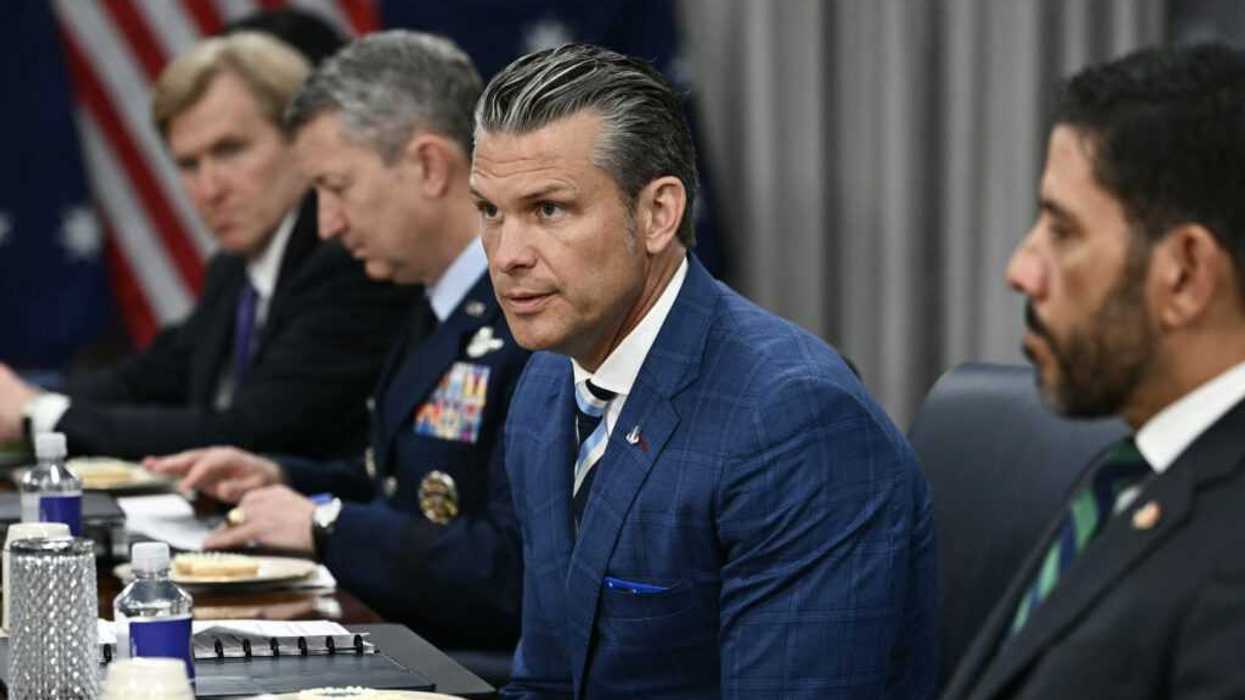
Secretary of Defense Pete Hegseth speaks during a meeting with Australia's Deputy Prime Minister and Minister for Defense Richard Marles at the Pentagon in Washington, D.C., on Sept. 2, 2026.

(Kent Nishimura/AFP via Getty Images/TCA)

“Muscles, dudes in dresses, testosterone.”

That’s how one European defense official described the priorities of Defense Secretary Pete Hegseth, according to a bombshell new report from CNN on the growing concern inside the U.S. military over Hegseth’s leadership.


Hegseth might not disagree with the characterization. He’s made it his mission to focus his attention on the culture wars, wokeism, DEI, and what soldiers look like, and it’s creating “turbulence” inside the military he oversees.

Recent high-profile resignations and firings by Hegseth have also brought increased scrutiny at the Pentagon, with Army Secretary Dan Driscoll abruptly announcing he was leaving this week.

“You’re taking away three of the most seasoned combat leaders of a generation who are in a unique position to articulate battlefield requirements,” a former Army official said of Hegseth’s “forced exits” of Army Chief of Staff Randy George, former head of U.S. Army Europe and Africa Gen. Christopher Donahue, and former commander of U.S. Army Transformation and Training Command Gen. David Hodne.

This all comes against the backdrop of what is perceived as an increasingly unwinnable and also unendable Iran war, which is losing support by the day.

In March, opposition to the war was at 47.3%, and now, six months later, it’s at 55.7%.

None of this is helpful for Republicans who are campaigning in tight and uphill contests all over the country. They are already having to defend President Trump’s tariffs and burgeoning trade war with Canada, his impolitic comments about affordability “hoaxes,” and the sense that his priorities — building ballrooms and hosting UFC fights — are out of whack with voters.

The never-ending war in Iran is the last thing they want to be talking about.

Hopes that Trump can effectively wind the war down before the midterms have been whittled down to a nub — prediction markets don’t have peace talks occurring until 2027.

But he could make a move that improves the politics of this quagmire for him and Republicans in time for elections: fire Hegseth.

Hegseth’s net approval is at a miserable -22 — well below other Trump cabinet officials, including Health and Human Services Secretary Bobby Kennedy Jr.

His own commanders are publicly voicing their concerns about his leadership. Reports of critical shortages of missiles and other materials are bringing into question our military’s readiness. And stories of hellish conditions aboard the USS Abraham Lincoln, including attempts by multiple sailors to jump overboard, are dogging Hegseth’s tenure. Not to mention earlier scandals over legally questionable drug boat strikes and improper use of Signal chats.

A change in leadership would have the practical effect of restoring order to the Defense Department, and the political effect of changing the narrative for Trump and Republicans at a crucial time, just two months before midterm elections.

Hegseth doesn’t want to do this job anyway, it appears. Despite being busy prosecuting a war that’s disrupted the global economy, killed and injured hundreds of U.S. troops, and made the region far more dangerous for our allies, he’s been seen on the campaign trail, stumping for candidates in Iowa and Kentucky — explicitly partisan, political moves that other Pentagon leaders have always avoided.

“We’re restoring the warrior ethos inside our department because that matters. We need guys like this man right here having our back in Congress,” he said of Rep. Zach Nunn in August.

As long as I’ve known him, Pete has wanted to run for president, and he’s reportedly said as much to friends and colleagues.

So Trump should do him, Republicans, and all Americans a favor, and cut him loose so he can go back to Fox News and focus on the things that matter to him: muscles, dudes in dresses, and testosterone.

S.E. Cupp is the host of "S.E. Cupp Unfiltered" on CNN.

Read More

THE POLITICS OF EXCLUSION: When Abuse of Power Pushes Communities Out of the American Story

An opinion essay traces America's cycle of welcoming immigrants and communities of color for labor, then excluding them once they gain power.

Westend61/Getty Images

THE POLITICS OF EXCLUSION: When Abuse of Power Pushes Communities Out of the American Story

The politics of exclusion is the deliberate use of power to push certain communities out of the American story through fear, cruelty, erasure, and unequal treatment. It is what happens when leaders abandon constitutional ideals and replace them with grievance, retaliation, and division.

The late John McCain warned that we weaken our greatness when we confuse patriotism with tribalism. Liz Cheney cautioned that no one should support a leader who uses fear and division to hold onto power. Adam Kinzinger called it authoritarianism. Mitt Romney said plainly, “He has caused fear and division.” Alexandria Ocasio-Cortez observed that “the cruelty is the point,” and the late John Lewis reminded us that “democracy is not a state; it is an act.” Together, these voices describe the elephant in the room. America is confronting a pattern bigger than corruption and bigger than authoritarian drift. It is the social, racial, and moral dimension of democratic erosion — lying, cheating, cruelty, intimidation, erasure, and exclusion masquerading as patriotism.

Keep Reading Show less
Trump and Carney standing next to American flag

U.S. President Donald Trump welcomes Canadian Prime Minister Mark Carney to the White House on Oct. 7, 2025 in Washington, D.C.

(Chip Somodevilla/Getty Images/TCA)

Trump’s war on Canada a pitiful own goal

This summer, America played host to one of the biggest international events on the planet, the World Cup, drawing millions of foreigners to our cities and towns, our stadiums and our national parks, where many of them had never been before.

The consensus was, America is awesome — visitors from Bolivia, Scotland, Uzbekistan, and everywhere in between marveled at the sheer size of our great nation, the diversity of our topography, the deliciousness of our foodstuffs, and, perhaps most importantly, the kindness of our people. (Not to mention, our eighth wonder of the world — Buc-ee’s.)

Keep Reading Show less
The Sleeping Giant Woke Up. Trump is Asleep.

U.S. Marines wait for the arrival of U.S. President Donald Trump before a Freedom 250 Grand Prix showcase on West Executive Avenue between the West Wing of the White House and the Eisenhower Executive Office Building on July 13, 2026 in Washington, DC.

Andrew Harnik/Getty Images

The Sleeping Giant Woke Up. Trump is Asleep.

After Senator Lindsey Graham died in office, South Carolina’s governor appointed his sister, Darline Graham, to serve out the remainder of his term. Just over a month later, campaigning for a full term of her own, when asked at a debate whether Taiwan and the South China Sea are national security issues for the United States, she said she was “not that informed on national security.” The President has endorsed her candidacy. Call me old-fashioned, but I want a Congress that is informed on national security. The founding fathers seemed to agree: Article I, Section 8 of the Constitution hands Congress the power to declare war, “raise and support Armies,” “provide and maintain a Navy,” and “make Rules for the Government and Regulation of the land and naval Forces.” That’s the job description, and I want a president who doesn’t endorse someone for that job who can’t handle that responsibility.

Our Commander-in-Chief and Secretary of Defense have turned away from Taiwan and the South China Sea. When I was a Navy pilot, the spoken and unspoken adversary of our future was China. I don’t mean to make a judgment about whether that was the right call, but just to say that in my 14 years affiliated with the Navy, of every potential adversary we discussed, China was always the most formidable. As I trained to be a mission commander, most of the simulations I flew and the scenarios I hashed out on oral boards revolved around the South China Sea. That’s the fight we trained to fight. Then, a few months after I separated from the Navy, Secretary Hegseth announced our priorities were shifting away from the Pacific to “restore U.S. military dominance in the Western Hemisphere.” That didn’t stop us from starting a war with Iran we can’t seem to get out of, but the promise to take focus away from the Pacific does seem to have held.

Keep Reading Show less
A crowd of people at a military base with President Trump speaking in front of them.

U.S. President Donald Trump speaks during a visit to the Fort Bragg U.S. Army base on February 13, 2026 in Fort Bragg, North Carolina.

Nathan Howard/Getty Images

Reagan’s Strength vs. Trump’s Retreat: U.S. Alliances at Risk

How a country treats its allies and its adversaries says everything about what it believes strength means — a question that was already on my mind the night I sat in a movie theater watching "The Brink of War" when news broke.

The film reconstructs the 1986 Reykjavik summit, where President Ronald Reagan and General Secretary of the Communist Party of the Soviet Union Mikhail Gorbachev spent a tense weekend negotiating over the fate of the world's nuclear arsenals.

Keep Reading Show less