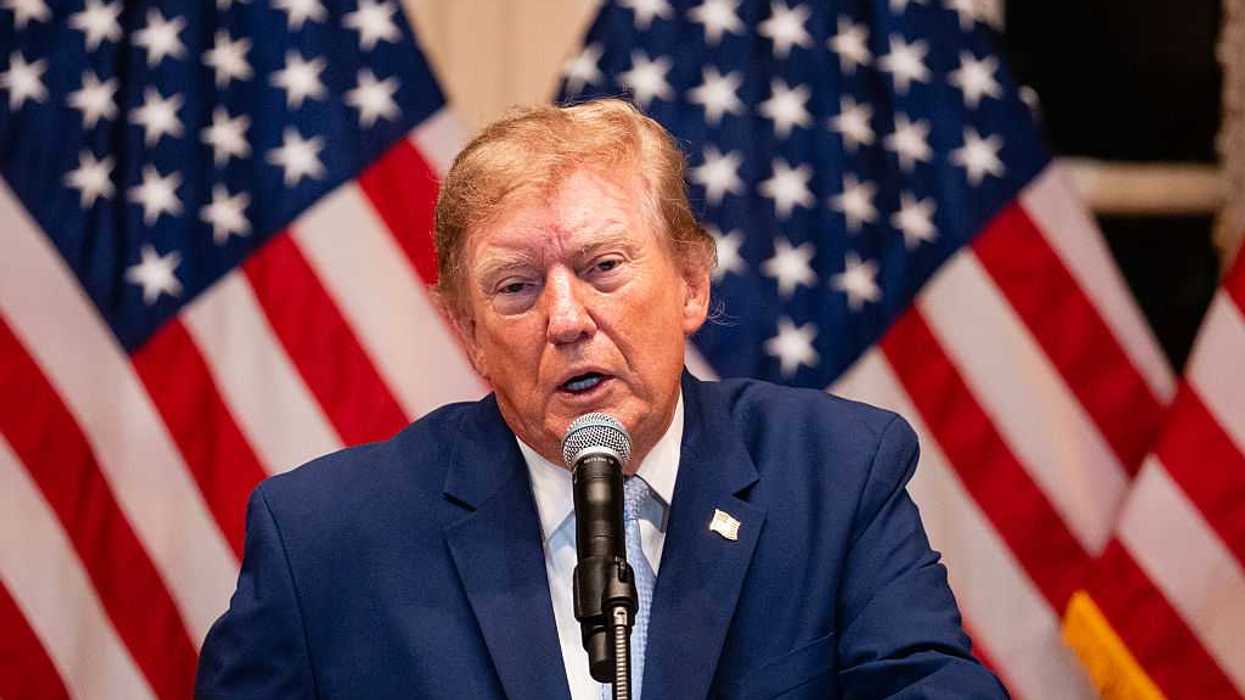

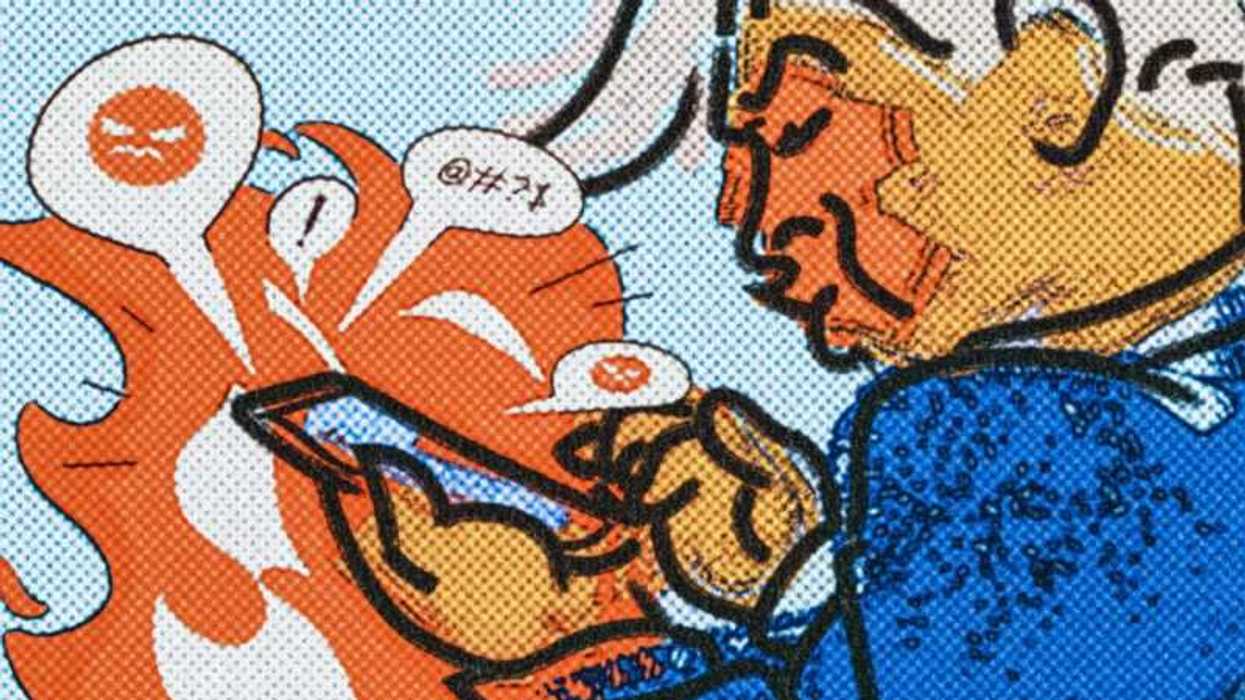

Donald Trump posted a video online depicting the Obamas as apes.
This isn’t shocking—or at least it shouldn’t be. Trump has built an entire political career out of saying the quiet racist part out loud and then daring the country to do something about it.
From housing discrimination in the 1970s and the Central Park Five ads to birtherism and comments about “shithole countries,” the man has been running the same racist playbook for decades. This is the same man who told congresswomen of color to go back where they came from and warned that immigrants are “poisoning the blood” of the nation. At this point, treating any of this as shocking requires a kind of practiced amnesia.
Depicting the first Black president and first lady as apes is racist, dehumanizing, and offensive in ways that aren’t exactly subtle or remotely original.
Still, the current president of the United States sharing this video matters—even if he ultimately deleted it.
And what happened next matters more.
Where’s the pushback?
This latest episode, which occurred in the first week of February, is not just another entry in America’s long, ugly scrapbook of anti-Black dehumanization. It’s a stress test—a very simple one, really, of how much open anti-Black cruelty American institutions can sustain while still pretending this is a democracy.
History suggests the answer is “quite a lot.”
To be fair, a handful of Republicans objected to Trump’s racist AI slop. Eleven Republican members of Congress by my count, managed to locate both their conscience and a microphone. Some of them even managed to say the word “racist,” which in modern Republican politics is akin to setting yourself on fire.
But here’s the problem: Nothing happened next. Nothing changed.
As with so many past examples of outrageously deviant behavior by the chief executive, this moment was brushed aside as simply another example of Trump being Trump—filed away as background noise rather than as a political event with political consequences.
But the relevant question after Trump posted the offensive video was never whether a few people could locate their conscience for long enough to issue a press release. The real question was whether any of it would produce consequences that meaningfully altered Trump’s standing inside the GOP.
It did not.
The mainstream media behaved as if a few Republicans who registered their disapproval became evidence that our democracy is healthy. We saw headlines about Republican “pushback” and stories about internal tension.
The New York Times described an “unusually strong and public outcry,” as though a few sentences of disapproval from a tiny fraction of the GOP was meaningful. Al Jazeera called it an “outpouring of bipartisan condemnation,” which seems hyperbolic when 97 percent of Republican officials said nothing.
Republican leaders absolutely know the imagery Trump shared is racist. They are not confused. They are not misinformed. They are making a calculation. And the calculation is simple: angering Trump’s base is more dangerous than tolerating Trump’s racism.
So they tolerate it. Again and again.
By the time you read this, the media will have likely moved on. After all, every day in the Trump administration brings a fresh hell and even open racism struggles to hold the public’s attention. Trump is historically extreme in both cruelty and contempt for the political norms that once constrained even the most harmful presidents. So why am I even writing about it? Shouldn’t I just move on?
No. Because this is how normalization actually works. Not through silence, but through consequence so weak it barely registers. A little dissent. A few headlines. Some sternly worded tweets. And, in this case, a defiant president who once claimed he could shoot someone on Fifth Avenue and not lose any voters actually being forced to delete a racist post (after first defending it and trying to shuffle the blame onto a White House aide).
And then everybody goes back to pretending the restraints that once limited this behavior still hold.
They do not.
Cruelty is no longer bad politics
Take former President Ronald Reagan. In 1971—nine years before he assumed the presidency—he was recorded on tape laughing with President Richard Nixon and describing a United Nations delegation from Tanzania as “monkeys.” The remark remained hidden for decades.
The National Archives eventually released the tape in 2000, but the racist language was redacted. When the full remarks were finally released in 2019, Reagan’s daughter, Patti Davis, tearfully took to the pages of the Washington Post to defend her father, claiming that the language was an aberration rather than evidence of how power actually spoke behind closed doors. (I beg to differ.)
Evidently, past presidents who used racist language were clearly forced into apology, distance, or damage control. Trump mostly avoids these pressures, beyond deleting a post and refusing to apologize for it.
So, yes, everyone understands that depicting the Obamas as apes is racist. And still, only 11 congressional Republicans could be bothered to condemn it. Trump hasn’t lost any standing in the GOP as a result of it.
That’s where the real danger lives—not in Trump’s cruelty, and not even in his contempt for rules or law, but in the steady erosion of the political norms that once made certain behavior disqualifying for any politician, much less for the president. American institutions have now demonstrated a willingness to treat even this level of norm violation as politically survivable.
Racist leaders make racist policies
Once cruelty becomes politically survivable, the consequences do not remain confined to spicy internet discourse and barbs thrown between elected officials. They migrate into policy—and eventually into law.
For decades, civil-rights law has recognized a basic reality: Discrimination doesn’t always announce itself with a slur or a white hood. Sometimes it shows up as a “facially neutral” policy—one that does not mention race on its face—that just so happens to keep producing racially unequal outcomes. This is known in legalese as “disparate impact.”
The Supreme Court established the concept of disparate impact in Griggs v. Duke Power in 1971, which concerned the legality of requiring written intelligence-and skills-based tests that effectively precluded Black employees from advancing beyond low-level jobs. (Yes, there was actually a time the Supreme Court behaved as if it understood how racism works.)
Trump has now taken aim at that doctrine. In April 2025, he issued an executive order that tells federal agencies to stop enforcing disparate impact liability wherever possible. An executive order can’t magically erase statutes or Supreme Court precedent. But it can signal how aggressively—or whether at all—the law will be enforced.
Taken together with Trump’s assault on school and workplace diversity, equity, and inclusion (DEI) initiatives—which he tried to outlaw in a January 2025 executive order—a pattern begins to emerge. If Trump’s policies on disparate impact liability become reality, Black plaintiffs—facing the kind of housing or employment discrimination that is rarely confessed out loud—will struggle to prove discriminatory intent in court.
This has obvious disadvantages for Black people. And it has a corollary advantage for white people, because white plaintiffs can point to diversity or equity programs as affirmative evidence of intentional discrimination against them. The result is a civil-rights framework turned inside out, one that makes inequality harder to challenge and white grievance easier to vindicate. Meanwhile, Trump and his allies insist this inversion is what fairness actually looks like.
This is what consequence-free racism looks like once it moves from speech into the law. And it becomes harder to fight once it gets there.
Reconstruction rides again
This isn’t an abstract legal debate. It’s happening right now. Reconstruction-era civil-rights statutes—written to guarantee Black Americans the same rights as white citizens—are now being used in ways that make it easier for inequality to continue against Black Americans.
Examples include legal efforts to shut down programs intended to remedy racial exclusion, such as the successful legal challenges to investment programs like Fearless Fund, created to address the historic exclusion of Black women entrepreneurs from venture capital, as well as the recent prosecution of Black journalists covering protest, like Don Lemon.
Laws designed to dismantle white supremacy are being repurposed to police the people still targeted by it. Because in the United States, even the laws designed to fight white supremacy can eventually be repurposed to defend it, provided you wait long enough and hire enough lawyers.
None of this is unprecedented, of course. After Reconstruction, the Constitution technically promised equality, while Jim Crow and the KKK made a mockery of it. American history is full of moments where rights existed on paper while disappearing everywhere else.
What feels different during Trump’s presidency is not necessarily the racism. It’s the shrug.
A meaningful slice of the electorate keeps rewarding his racist behavior. Political leaders keep accommodating it. Media institutions keep normalizing it. And democracy—supposedly—keeps functioning.
Which brings us to the uncomfortable truth at the center of all this: American democracy has always depended on voluntary restraint. On powerful people choosing not to do the worst thing they were technically allowed to do.
What the Trump era has revealed is how fragile that arrangement really is.
Because once abandoning restraint and trafficking in open racism carries no real consequence, the guardrails don’t fail dramatically. They just stop existing. And when the guardrails are gone, the law does not remain neutral. It reorganizes itself around the new reality. If that new reality is old racism, the question stops being whether the system is once again bending toward white supremacy.
The question is whether anything in the system still exists that can bend it back.
Trump’s Racism Carries No Consequences—And That’s Scary was originally published by Rewire News Group and is republished with permission.
Imani Gandy is Co-Chief Content Officer for Rewire News Group.