


Skip to content
Search

Latest Stories

Follow Us:
Top Stories

Illinois House Passes Bill to Restrict Construction of Immigration Detention Centers in Communities

News

Illinois House Passes Bill to Restrict Construction of Immigration Detention Centers in Communities

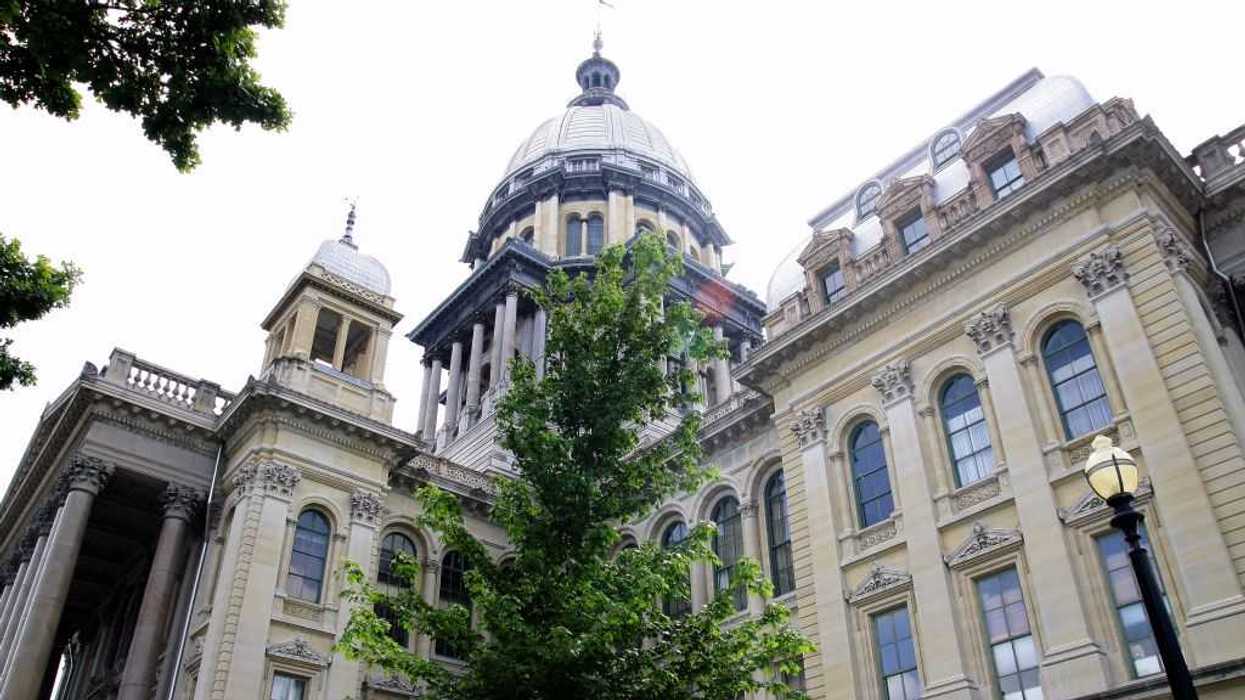
The Illinois State Capitol Building, in Springfield, Illinois on MAY 05, 2012.

(Photo By Raymond Boyd/Michael Ochs Archives/Getty Images)

The Illinois House passed a legislative proposal in a 72-35 partisan vote that would restrict where immigration detention centers can be built, located or operated in the state.

House Bill 5024 would amend state code so that an immigration detention center cannot be located, constructed, or operated by the federal government within 1,500 feet of a home or apartment complex, as well as any school, day care center, public park, or house of worship. Current detention facilities in the state would not be affected by the legislation.


The bill was introduced by House Speaker Emmanuel 'Chris' Welch in response to what he described as federal actions involving the Broadview detention facility.

“This is not an abstract policy debate for me — this is personal, and it is deeply local. The Broadview detention facility sits in the heart of the district I represent. And during Operation Midway Blitz, the people who live in and around that community did not just witness aggressive federal activity — they lived through trauma,” Welch said in a press statement.

“This bill says something very simple and very reasonable: detention facilities do not belong in the middle of our neighborhoods. They should not be next to schools. They should not be near day care centers. They should not sit beside parks, public housing, places of worship, or private homes. Because when a detention center is dropped into the middle of a residential community, it doesn’t just affect the people inside that building — it affects every child walking to school, every senior looking out their window, and every family trying to live in peace,” he continued.

One of the most notable witnesses on the bill was Broadview Mayor Katrina Thompson, who testified in March in support of the legislation.

Appearing via Zoom, Thompson voiced support for the measure, highlighting concerns about how Immigration and Customs Enforcement activity at the village’s detention center has impacted residents.

Those concerns follow Operation Midway Blitz, which began in September 2025 and led Gov. JB Pritzker to create the Illinois Accountability Commission in response to federal immigration enforcement actions.

“In Broadview, we have residents who live as close as 600 feet away from the ICE facility,” Thompson told committee members. “That is not a statistic; those are people, families, children, individuals whose daily lives are directly impacted by what happens around that facility.”

House Republicans voiced concerns about the legislation, including Rep. Patrick Windhorst, who said the bill reflects ongoing conflict between Illinois Democrats and the federal government.

“The result of this effort to not work together with the federal government to resolve the issues, particularly related to immigration and enforcement of our laws, has resulted in huge problems in our state that the majority party attempts to blame the current presidential administration for,” Windhorst said, according to WQAD 8.

“But we need to take a hard look at what we're doing as a state to make sure we're fulfilling our obligations to protect our citizens and to enforce the laws, including the federal laws of our country,” he continued.

In Illinois, privately owned detention centers have been banned since 2019, with the enactment of the Private Detention Facility Moratorium Act, which prohibits state and local government agencies from contracting with or paying private prison companies for detention purposes, including federal immigration detention.

The bill is currently in the Senate Assignments Committee. If passed and signed by Gov. Pritzker, it would take effect immediately.

Angeles Ponpa is the Managing Editor of Latino News Network Midwest, overseeing Illinois Latino News, Wisconsin Latino News, and Michigan Latino News. She is based in Illinois.


Read More

An ICE agent monitors hundreds of asylum seekers being processed upon entering the Jacob K. Javits Federal Building on June 6, 2023 in New York City. New York City has provided sanctuary to over 46,000 asylum seekers since 2013, when the city passed a law prohibiting city agencies from cooperating with federal immigration enforcement agencies unless there is a warrant for the person's arrest.(Photo by David Dee Delgado/Getty Images)
An ICE agent monitors hundreds of asylum seekers being processed.
(Photo by David Dee Delgado/Getty Images)

The Power of the Purse and Executive Discretion: ICE Expansion Under the Trump Administration

This nonpartisan policy brief, written by an ACE fellow, is republished by The Fulcrum as part of our partnership with the Alliance for Civic Engagement and our NextGen initiative — elevating student voices, strengthening civic education, and helping readers better understand democracy and public policy.

Key Takeaways

  • Core Constitutional Debate: Expanded ICE enforcement under the Trump Administration raises a core constitutional question: Does Article II executive power override Article I’s congressional power of the purse?
  • Executive Justification: The primary constitutional justification for expanded ICE enforcement is The Unitary Executive Theory.
  • Separation of Powers: Critics argue that the Unitary Executive Theory undermines Congress’s power of the purse.
  • Moral Conflict: Expanded ICE enforcement has sparked a moral debate, as concerns over due process and civil liberties clash with claims of increased public safety and national security.

Where is ICE Funding Coming From?

Since the beginning of the current Trump Administration, immigration enforcement has undergone transformative change and become one of the most contested issues in the federal government. On his first day in office, President Trump issued Executive Order 14159, which directs executive agencies to implement stricter immigration enforcement practices. In order to implement these practices, Congress passed and President Trump signed into law the One Big Beautiful Bill Act (OBBBA), a budget reconciliation package that paired state and local tax cuts with immigration funding. This allocated $170.7 billion in immigration-related funding for the Department of Homeland Security (DHS) to spend by 2029.

Keep ReadingShow less
Towards a Reformed Capitalism
oval brown wooden conference table and chairs inside conference room

Towards a Reformed Capitalism

Despite all the laws and regulations that apply to corporations, which for the most part are designed to make corporations more responsive to the greater good, corporations have wreaked great harm on our environment, their workers, their customers, and the general public. Despite all the rules, capitalism can still pretty much do what it wants.

The problem is not that the laws and regulations are not enforced, although that is partly true. The problem is more that the laws and regulations are weak because of the strong influence corporations have on both Congress (this is true of Democrats as well as Republicans) and those responsible for regulating.

Keep ReadingShow less
Families of Americans Overseas Wrongfully Detained Bring Advocacy to Capitol Hill

The Bring Our Families Home campaign brought together loved ones of Americans wrongly detained overseas to display portraits in the Senate Russell Rotunda on Wednesday, May 6.

(Jacques Abou-Rizk, MNS)

Families of Americans Overseas Wrongfully Detained Bring Advocacy to Capitol Hill

WASHINGTON – American journalist Reza Valizadeh visited his elderly Iranian parents in March 2024 for the first time in 15 years. Valizadeh’s stories for Voice of America and other U.S. government-funded outlets often criticized the Iranian regime. So before traveling, he sought and received confirmation that he would be safe from a high-ranking commander in the Islamic Revolutionary Guard Corps, a branch of Iran’s armed forces. However, in September that same year, the Islamic Revolutionary Guard Corps arrested Valizadeh, and Tehran’s Revolutionary Court sentenced him to ten years in prison for “collaboration with a hostile government.”

In the Rotunda of the Senate Russell Building last week, the Bring Our Families Home campaign set up portraits of Valizadeh and 12 other Americans currently wrongfully detained overseas. The group, family members of illegitimately detained Americans, appealed to Congress to push for their safe return. Each foam poster board included the name, home state, and country of detainment. The display also included portraits of the 33 people released after advocacy by the James W. Foley Foundation.

Keep ReadingShow less
DHS Funding During the Shutdown
Getty Images, Charles-McClintock Wilson

DHS Funding During the Shutdown

When Congress failed to approve funding for the Department of Homeland Security for the remainder of this fiscal year in February, almost all of its employees began to work without pay. That situation changed, however, on April 3, when President Donald Trump issued a memorandum ordering the DHS secretary and director of the Office of Management and Budget to “use funds that have a reasonable and logical nexus to the functions of DHS” to pay its employees and issue back pay.

Trump shifted money to avoid the political embarrassment that would be caused by the collapse of airport security screening through the actions of disgruntled agents and the disruption to air travel that would ensue. But it’s legally dubious.

Keep ReadingShow less