



Illinois has joined a growing number of states drafting legislation to regulate data centers. The proposed POWER Act, introduced on Feb. 6, aims to regulate the growth of data centers by forcing operators to pay any energy-related costs and disclose water use.
The bill, introduced by State Sen. Ram Villivalam (D-Ill., 8th District) and co-sponsored by State Rep. Robyn Gabel (D-Ill., 18th District), ensures minimal impact of data center development on Illinois residents.
Government relations firm MultiState recently reported that more than 300 state data center legislation bills have been filed across 30 states during the first six weeks of 2026. States such as Virginia and Georgia are reconsidering data center tax incentives, while New York and Oklahoma have introduced moratorium bills to pause construction and further study the environmental and utility bill impacts.
Across the United States, a boom in data center development is reshaping local economies and impacting energy and water systems as companies race to support the rise of artificial intelligence and the global growth of digital information. As policymakers grapple with managing the industry’s demand for water and electricity, concerns are driving a wave of proposed legislation nationwide.
The Midwest has emerged as an increasingly attractive region for the industry due to its central location and more affordable real estate. Still, opposition has fueled a desire for regulation.
“This legislation is centered on ensuring that there’s transparency, accountability, and that the utility bills of our constituents don’t face the brunt of it from these data centers,” Villivalam said. “We’re protecting and putting in standards for water use to ensure that one of our most valuable resources is protected.”
Opponents of the bill say that it could hinder economic growth in Illinois and make data center development incredibly challenging. They claim that the facilities are integral to workforce development and economic investment, particularly in terms of tax revenue.
“In its current form, the POWER Act would make getting a data center project off the ground in Illinois very, very complicated,” said Brad Tietz, director of state policy for the Data Center Coalition. “Some of these things might be unattainable in terms of the information you’d have to collect and gather. It would create this maze of a regulatory framework that applies to no other industry.”
The coalition is the trade association for the data center sector and advocates for public policy and investments in the data center industry.
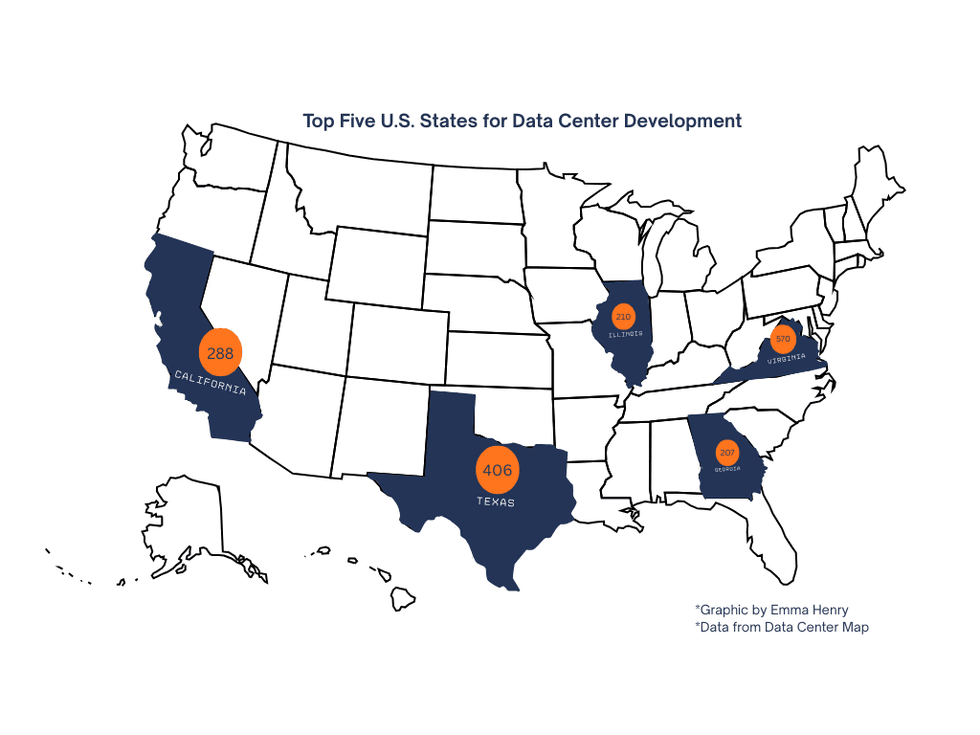
Illinois has emerged as a major hub in the data center industry, ranking among the top four states nationwide behind Virginia, California, and Texas, with roughly 210 facilities currently in operation as listed by Data Center Map.
According to the Pew Research Center, many states are vying for a spot in the data center race due to financial incentives, often through job development, tax revenue and business opportunities. But as the speed of the data center boom outpaces regulatory efforts, the industry has gone largely unchecked.
Recent studies have also concluded that industry promises of job creation and economic growth often fall short, particularly after the construction phase. The Brookings Institution claims that developers often treat data centers with an “out-of-sight, out-of-mind approach.
“The faster the firms have sought to scale, the faster they have needed to strike deals with communities to build massive computing facilities, often in the face of increased local concerns about electricity use, noise issues, and other side effects,” Brookings reported.
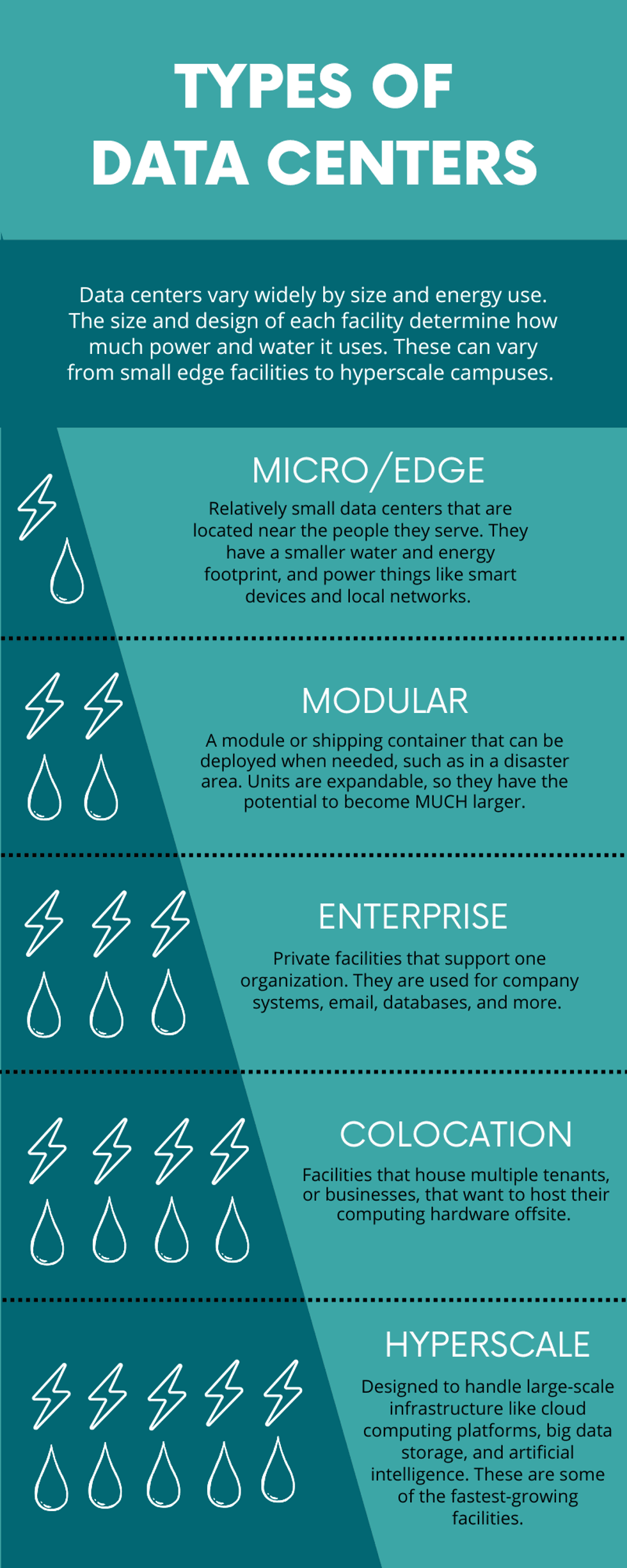
Most opposition to the data center boom comes from environmental advocacy and justice organizations, and often community members themselves, who cite the large quantities of electricity and water these facilities require. By 2030, electricity consumption in U.S. data centers is expected to more than double, with current centers accounting for around 4% of the nation’s total electricity consumption in 2024.
Hannah Flath, Climate Communications Coordinator for the not-for-profit Illinois Environmental Council, said that of the currently proposed new data centers in Illinois, the total energy needed to power them is expected to be around 44 gigawatts.
“One gigawatt powers the entire city of Orlando, Florida. So that means there are 44 Orlandos waiting to connect to the Illinois grid,” Flath said. “I don’t think I need to tell you what that would do to our capacity.”
(Graphic by Emma Henry)
Construction of data centers in the state has already come under fire from residents in Pekin, Lisle, Naperville, and other Illinois cities where they are proposed for development due to concerns over noise pollution, impacts on local waterways, and concerns over increased electricity and water bills. People’s World reported that the downstate Tazewell County Data Center Opposition Facebook group had an estimated 2,200 members by late January. The group has grown to nearly 5,000 members as of Feb. 24.
While current estimates of data center power demand vary by center size, the Associated Press reported in 2025 that recent research showed that 70% of the increase in electricity prices from the previous year was due to data center demand. In June of last year, Illinois’ Citizens Utility Board said that ComEd and Ameren customers were hit with price spikes, likely due to the rise of data centers.
Tietz argues that price increases are a natural response to the changing energy market and the country’s failure to update the power grid at a large scale.
“We were always going to have to invest in modernizing our grid and bringing on more generation and transmission,” he said. “The biggest cost drivers of the increased electricity prices have been the fixed cost for hardening and modernizing our grid.”
As hesitancy increases across the state, Illinois Gov. J.B. Pritzker called for a two-year pause on the state’s tax credit program for data centers
Emma Henry is a freelance journalist based in Chicago and a graduate student at Northwestern's Medill School of Journalism.