


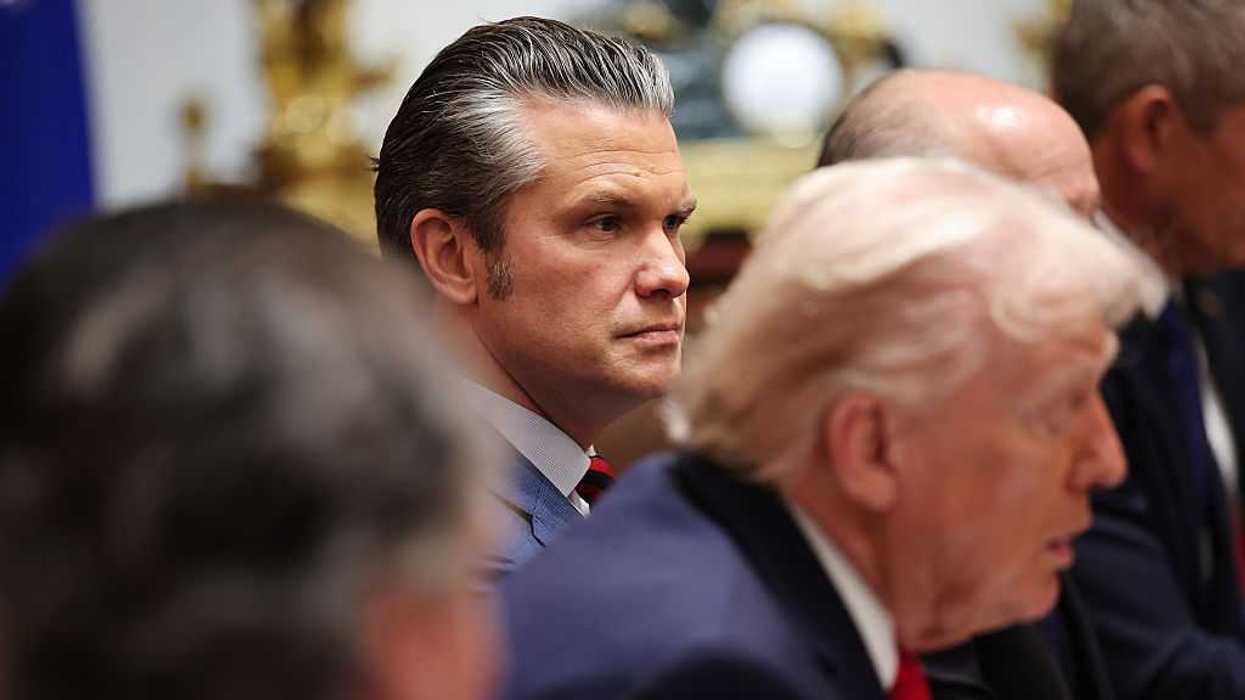
Pete Hegseth’s attacks on Senator Mark Kelly represent such an astonishing threat to the foundation of our democracy that over forty-one retired high-ranking military leaders have come together to sound off in protest.
While the Trump Administration was conducting Caribbean boat strikes of questionable legality, Kelly posted a video wherein he and other lawmakers reminded servicemembers that they should feel empowered to refuse to follow an unlawful order. He didn’t mention the strikes; he was correct on the law, yet Secretary Hegseth wrote in a letter of censure that Kelly’s speech “bring[s] discredit upon the armed forces,” “prejudices good order and discipline,” and amounts to “conduct unbecoming an officer,” threatening him with a demotion and cuts to his benefits. These antics are so un-American that King George would be tickled.
As outlined in the amicus brief submitted by the Vet Voice Foundation along with dozens of Admirals and Generals, no retired servicemember can lawfully be sanctioned for making factual statements. But while Hegseth’s arguments have no basis, a bogus claim could still set a dangerous precedent if Kelly loses, which would, as the venerable veterans articulated in their brief, make it “unclear what constitutional protection would remain for veterans wishing to express public disagreement with a present Administration…” In other words, if a veteran can get punished for this, what just happened to freedom of speech?
As a prior Lieutenant Commander in the Navy, I took an oath to support and defend the Constitution. I felt proud to defend the doc that holds our Bill of Rights. Similarly, as I learned to fire hellfire missiles and rockets, I was comforted by the constant reminder of my obligation to disobey unlawful orders. When Admirals lectured us on judgment and ethics, I could detect the checks and balances in the subtext of their speeches and felt reassured. This is not the message the Secretary of War is sending today. Hegseth’s subtext says something more like: shut up and don’t you dare challenge us.
When political discourse is dominated by voices loyal to men over laws, critical conversations are gagged. Plus, isn’t it backwards that a soldier could return to the civilian world and discover the freedom of speech he fought for only applies if the administration likes what he has to say? As Janessa Goldbeck, Marine Corps veteran and the CEO of Vet Voice, writes, “When veterans speak…[on] military orders, the use of force, or the conduct of those in power, they do so not as partisans but as witnesses with lived experience.” Shouldn’t a veteran get to weigh in on these things? Speech cannot be free if it is disallowed. It cannot be free if even a re-statement of the rules is against the rules. Veterans put their lives on the line to defend the Constitution and the freedoms it guarantees. If the government can muzzle these heroes, the Constitution’s promise is meaningless. Ironically, the solemn oaths we take become meaningless then, too.
But if veterans have it bad, imagine the limited liberties afforded to those still on active duty. Military personnel already voluntarily give up many freedoms, including speech, when they don the uniform, but now they may forgo asking questions, even to clarify the rules, for fear of retribution. That’s the chilling effect, and your blood should run cold at the thought. I am a Core Team Member of Women in the Service Coalition, Inc., a veterans group advocating for active duty folks because we know restrictions under the UCMJ, federal law, and Supreme Court precedent (see: Parker v. Levy, Greer v. Spock, and Brown v. Glines) already make internal advocacy exceedingly difficult. Veterans are crucial allies for those in uniform. Cutting the tongues of veterans will censor the troops, too, creating an environment ripe for authoritarianism.
On that note, veterans are risking their reputations and benefits every day to speak out for the rule of law. The fact that so many military dignitaries felt called to stand up in this case underscores the salience of this moment; their actions reveal how grave the danger is. Vet Voice and these distinguished retirees came to the aid of a veteran being unjustly punished despite the risk that doing so could bring unjust punishments upon themselves, a remarkable act of bravery. In doing so, they stand as guardians of our constitutional freedoms.
We can come to their defense, too. As the administration attempts to suppress the voices of veterans and active duty personnel, we can make a greater effort to lend an ear, listen, and support. In fact, we must. Our freedom of speech depends on it.
Julie Roland was a Naval Officer for ten years, deploying to both the South China Sea and the Persian Gulf as a helicopter pilot before separating in June 2025 as a Lieutenant Commander. She has a law degree from the University of San Diego, a Master of Laws from Columbia University, and is a member of the Truman National Security Project.









The President Invited Iran to Bomb My Home