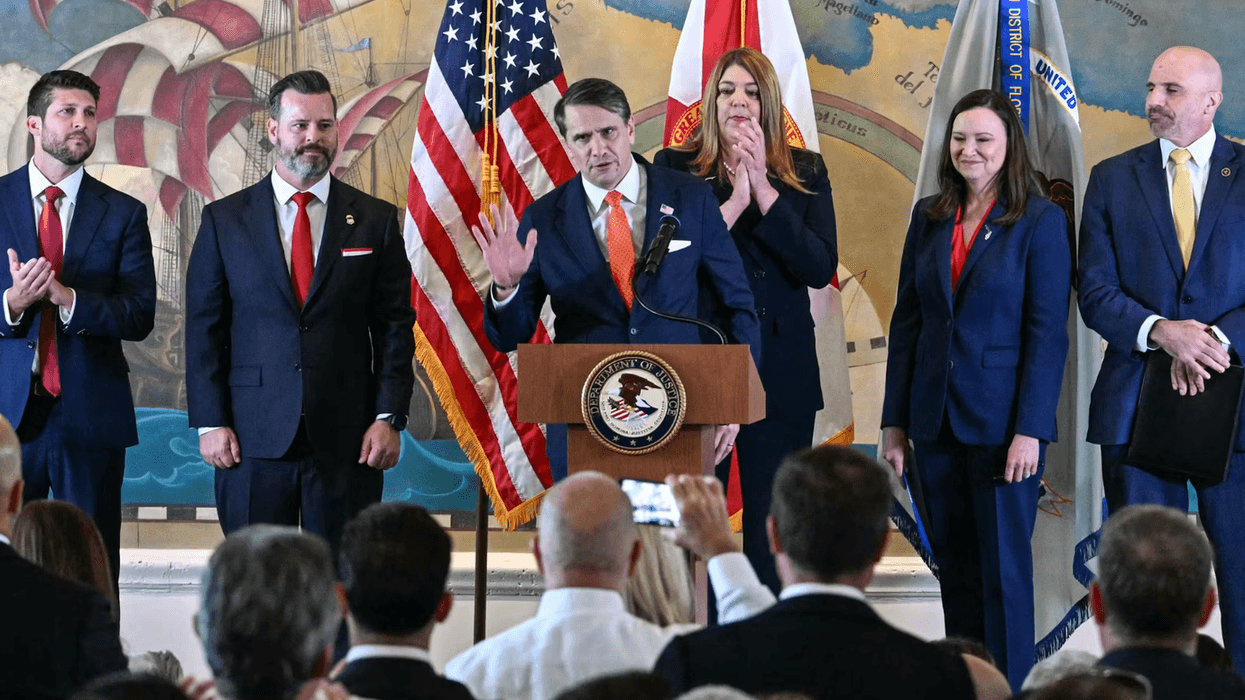

The Trump administration on May 20, 2026, indicted former Cuban President Raúl Castro for murder, based on the downing of two planes near the Cuban coastline in 1996 that killed four people.
As a historian of Latin America and U.S. foreign policy, I believe the indictment may be the prelude to direct U.S. military action against Cuba.
Before Castro, the last U.S. indictment of a Latin American leader occurred in January 2026, when a U.S. attorney appointed by President Donald Trump charged Venezuela’s Nicolás Maduro with narco-terrorism. Those charges were promptly followed by U.S. military strikes on Venezuela and the abduction of Maduro.
Since January, the U.S. has ended the flow of Venezuelan oil to Cuba and has used economic and military pressure to prevent other nations from trading with the island. And Trump recently threatened a “friendly takeover” of Cuba.
I believe that what’s missing from most recent analysis of this situation is the history of U.S. aggression against Cuba. This is essential context for understanding the Trump administration’s recent escalations.
‘Striking at Cuba constantly’
In 1823, U.S. Secretary of State John Quincy Adams identified Cuba as “an object of transcendent importance to the political and commercial interests of our Union.” The 1959 Cuban Revolution that overthrew U.S.-backed dictator Fulgencio Batista and replaced him with Fidel Castro, brother of Raúl, directly challenged those interests by asserting political autonomy and expropriating private property.
State Department officials observed that “the majority of Cubans support Castro” because of the government’s redistributive measures and its “real honesty, courtesy, and idealism.” One official warned “that if the Cuban revolution is successful other countries in Latin America and perhaps elsewhere will use it as a model and we should decide whether or not we wish to have the Cuban revolution succeed.”
They decided quickly. By December 1959, President Dwight Eisenhower’s CIA director had approved plans to overthrow the Castro government. U.S. policy thereafter included direct sponsorship and safe haven for Cuban paramilitary groups.

An American plane is shot down on Playa Girón during the Bay of Pigs invasion in April 1961. Keystone-France/Gamma-Keystone via Getty Images
The CIA-led Bay of Pigs invasion in April 1961 is only the most famous episode. The U.S. trained 1,400 Cuban exiles to invade Cuba, hoping to ignite a nationwide rebellion. Instead, Cubans rallied behind the government.
Though U.S. analysts often criticize the invasion because it failed, it was also a major crime under international law. Several hundred Cubans were killed.
Fear of a repeat invasion also led Soviet premier Nikita Khrushchev to send nuclear missiles to Cuba, precipitating the Cuban missile crisis of October 1962 that nearly led to nuclear war.
Longtime CIA official Richard Helms later testified that in the early 1960s, “We had task forces that were striking at Cuba constantly. We were attempting to blow up power plants, we were attempting to ruin sugar mills, we were attempting to do all kinds of things during this period. This was a matter of American Government policy.”
In 1976, Luis Posada Carriles and Orlando Bosch, two Cuban exiles, planned the bombing of a Cuban civilian airliner near Barbados that killed all 73 people aboard.
“The C.I.A. taught us everything,” Posada Carriles said later. “They taught us explosives, how to kill, bomb, trained us in acts of sabotage.”
Both men were given refuge in the United States for the rest of their lives.
The Bay of Pigs invasion and the airline bombing violate the core principles of international law, including prohibitions on the unprovoked “threat or use of force” and collective punishment. The U.S. government itself defines “international terrorism” as “violent acts” intended “to influence the policy of a government by intimidation or coercion” or to “intimidate or coerce a civilian population.”
By that definition, its Cuba policy qualifies.
By ‘every possible means’
Another U.S. method of striking at Cuba was through economic sanctions, first imposed on the country in 1960. That year, a State Department official wrote that “every possible means should be undertaken promptly to weaken the economic life of Cuba” so as “to bring about hunger, desperation and overthrow of government.” The logic of collective punishment was clear: make Cubans suffer enough that they rebel against Castro.

Images of Cuban President Miguel Díaz-Canel, Raúl Castro and Fidel Castro adorn the state building in Havana, Cuba, on May 20, 2026. AP Photo/Ramon Espinosa
This policy is now more aggressive than ever. The tightening of U.S. sanctions since Trump’s first term has reduced Cuba’s income from tourism, remittances and overseas medical missions. Now, by choking off the supply of fuel, the U.S. has critically weakened the healthcare and sanitation systems that depend on electricity.
Medical professionals and United Nations observers have described scenes of ventilators and incubators left without power, pharmacies empty and healthcare workers forced into “horrible decisions” about who lives and dies. A recent medical study reported a 148% increase in infant mortality between 2018 and 2025, meaning that about 1,800 infants died who otherwise would have lived.
‘I was trained as a terrorist by the United States’
The focus of the recent U.S. indictment against Raúl Castro was the incident on Feb. 24, 1996, when the Cuban military, which was headed by Castro, shot down those two planes.
The planes were operated by Brothers to the Rescue, an anti-Castro group of Cuban exiles who said they were aiding Cuban emigres trying to reach Florida. The group’s head, and one of the surviving pilots that day, was José Basulto, a veteran CIA asset and participant in the Bay of Pigs invasion.
In 1962, Basulto fired a cannon and machine gun “16 times” at a Cuban hotel, he later recounted. “I was trained as a terrorist by the United States,” Basulto once told an interviewer.
Basulto’s plane had entered Cuban airspace on Feb. 24, as a U.S. customs service specialist later testified. Correspondence from the day shows that Basulto did so knowingly. The previous July, he had told a TV audience, “We want confrontation.”
While the Cuban military could have deescalated the situation more carefully that day, Cuba had been trying for months to stop the violations of its airspace.
I believe indicting Cuban officials over the incident is disingenuous, given the provocations by Brothers to the Rescue and U.S. actions against Cuba, which are in direct violation of international and U.S. laws that prohibit threats, nondefensive violence and collective punishment.
US Indictment of Raúl Castro Comes Amid a Long History of American Aggression Against Cuba was originally published by The Conversation and is republished with permission.