



“No Money shall be drawn from the Treasury, but in Consequence of Appropriations made by Law” (Appropriations Clause, Article I, Section 9, Clause 7, U.S. Constitution). Congress’s “Power of the Purse” means the President cannot spend money or authorize expenditures unless Congress has passed a specific law funding it (Congress.gov).
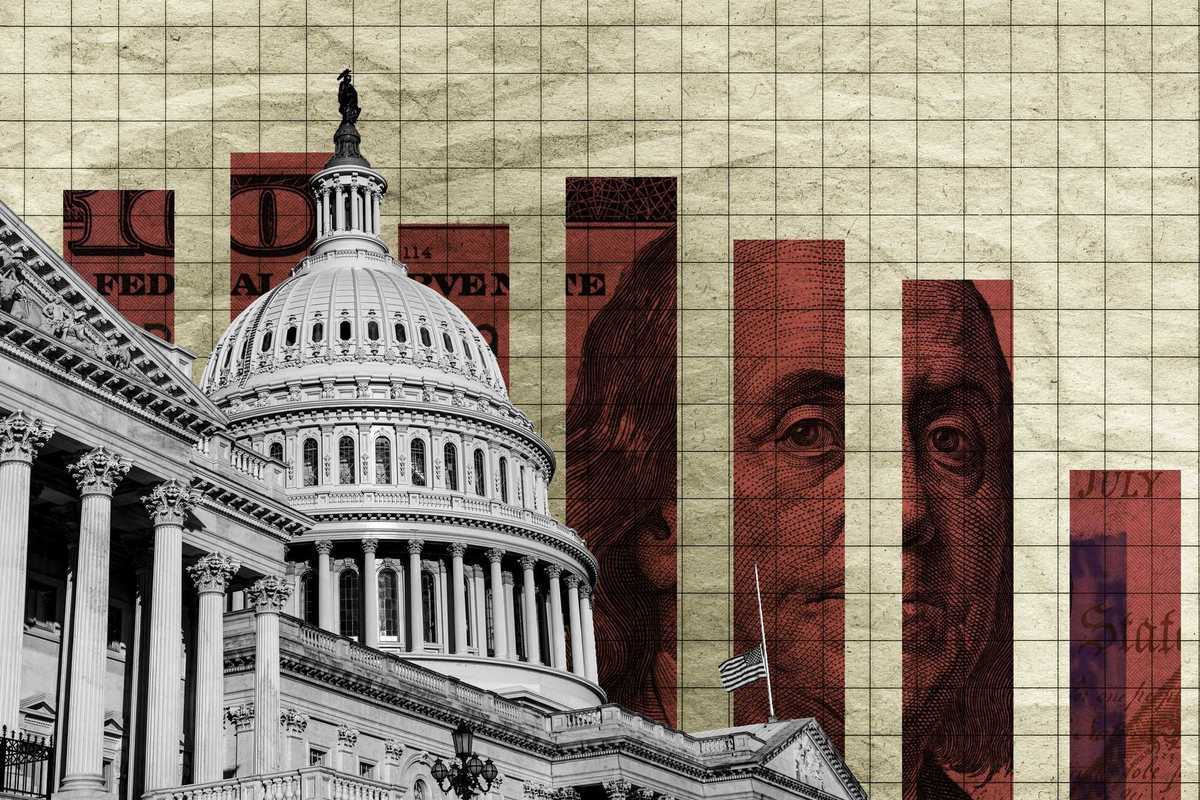
According to the Congressional Budget Office (CBO) and the non-partisan Committee for a Responsible Federal Budget, the total federal debt held by Americans is on track to hit $40 trillion by the end of 2026. Currently, every resident in America carries a $122,642 share of this debt.
When the USA’s 48th president takes office on Jan. 20, 2029, the federal debt is projected to reach approximately $44-$45 trillion. Should this hold true, the publicly held debt will be 107% of gross domestic product (GDP). This will surpass the highest debt-to-GDP ratio in American history, which was set in 1946 immediately following the massive mobilization of World War II.
Drivers of accelerated debt
A significant portion of America’s debt is driven by long-term and mandatory spending, such as Social Security, Medicare, and historically high net interest payments. However, the CBO and budget trackers note specific policy choices from the Trump 1.0 and 2.0 administrations have actively accelerated the USA’s debt.
Here’s the percentage increase in national debt for each of the last seven presidents: 188% for Reagan, 42% for G.H.W. Bush, 40% for Clinton, 101% for G.W. Bush, 88% for Obama, 40.3% for Trump, and 30.5% for Biden (us-debt-clock.com). When Donald Trump leaves office in Jan. of 2029, the federal debt will at least be $44 trillion, an increase of 21.8% since Joe Biden’s presidency ended.
The drivers of Donald Trump’s spending increases include:
1 - The 2025 Reconciliation Act (One Big, Beautiful Bill Act) will add a net $4.2 trillion to the deficit over the next 10 years (CBO).
2 – Recent CBO projections note that the administration’s immigration and enforcement actions added roughly $500 billion to projected long-term deficits (Feb. 11).
3 – Arms Control Association reports Trump’s Iran War -- not authorized by Congress – has already incurred more than $100 billion in direct military costs. President Trump has put forward an $88 billion supplemental war spending request to Congress in addition to his record $1 trillion military budget request.
4 – President Trump’s 2.0 administration spent $10 billion of taxpayer money to buy equity stakes in 14 private and 14 publicly-held companies, in what the conservative Cato Institute identified as “creeping socialism” (Center for Strategic and International Studies, Feb. 12, and Cato Institute).
5 - The White House East Wing ballroom is projected to cost $500 million, plus an additional $1 billion in security funding. Clark Construction has revealed that $293 million of the cost is being drawn from public funds (USA Today).
6 – The Lincoln Memorial reflecting pool’s renovation initial work cost – awarded in a no-bid contract to vendors with personal ties to Mr. Trump -- was in the $14.7-$16.3 million range. Now that Trump’s beautification project has failed, an additional $1.7 million will be spent to fix the structural issues, all at taxpayer expense.
7 – The Trump administration maintains that DOGE saved upwards of $200 billion. Despite the Trump administration bragging about it being “the most transparent in U.S. history,” the White House announced it has no plans to issue a DOGE financial disclosure report. However, the Partnership for Public Service, a nonpartisan watchdog, estimated DOGE resulted in a staggering $135 billion cost to taxpayers (CBS News), while University of Michigan experts and independent economists note that when it is all said and done, an estimated $500 billion of lost tax revenue occurred from DOGE (Chatham House).
8 – The Government Accountability Office determined the Trump administration illegally impounded $825 million of funds approved for America’s Head Start Program, which is dedicated to early childhood education for low-income families.
9, 10, 11 & 12 – Congress has not authorized or appropriated: A) $15 million for President Trump’s 250-foot Independence Arch, nicknamed “Arc de Trump” (CBS News), B) $40 million for Trump’s construction of the National Garden of American Heroes (ABC News), C) $400 million to overhaul Qatari-gifted Air Force One (Wall Street Journal) or D) $600 million to renovate the 106-year old East Potomac Golf Links course in Washington, D.C. (Golf Digest).
MIA: Congressional oversight and authority
Suffice it to say, Congress has been `Missing in Action’ in its fiscal oversight role during the presidencies of Reagan, G.H.W. Bush, Clinton, G.W. Bush, Obama, Biden, and Trump.
Tuesday, Nov. 3, can’t come soon enough for the truly conservative, conscientious, and fiscally responsible registered voters to kick the incumbents out who are not watching America’s pocketbook. It’s high time to clean house and vote for legislators who will honor the “Power of the Purse,” the constitutional authority to control government spending and taxation.
Steve Corbin is a professor emeritus of marketing at the University of Northern Iowa and a non-paid freelance guest columnist contributor to 158 newspapers and 47 social media platforms in 44 states.












The President Invited Iran to Bomb My Home