

I was recently catching up with an old friend from my Navy Reserve Officer Training Corps days who told me about some young sailors he knew in Bahrain tasked with intercepting hostile drones. Critically, as highly disciplined professionals, they have become extraordinarily good at it. My friend and I, with over twenty years of active duty service as military officers between us, discussed the extent to which their competence and vigilance are keeping them, and other Americans deployed in the area, alive, all while their leadership in Washington treats war with an increasingly terrifying callousness.
As brave servicemembers risk their lives on the front lines, Trump brags about how much money he’s making as president. It is true that for those invested in the types of industries that thrive during armed conflict, this war in Iran is a windfall. Trump himself invested between $9.7 million and $24.3 million in arms manufacturers and Pentagon contractors in 2025. Why would he end the war?
War and the defense industry go hand-in-hand, and Trump wants a cut of the action. Consider the military’s recent contract with Powerus, a defense startup that pivoted to military production earlier this year just as hostilities with Iran escalated. The Air Force just agreed to purchase an undisclosed number of interceptor drones from Powerus: their first-ever military contract. Just prior, Donald Trump Jr. and Eric Trump had joined the team, acquiring significant equity stakes just as it prepared to go public via corporate merger. Those sailors in Bahrain may use Powerus interceptor drones one day without realizing the Trump family is selling them. And though interceptors may act like fire extinguishers against Iranian fire, it is important to understand the Trump family has a clear financial incentive in stoking the fire.
Trump’s renewed bombing campaign against Iran may have been an elaborate effort to get Europe to join in his grift, too. Trump wanted European members of NATO to contribute 5% of their GDP to defense, likely because American defense companies would get more business. He may have crumbled a ceasefire and provoked a country into pledging a “crushing response” just to intimidate our allies into buying more from his buddies. American national security interests are not advanced, and servicemembers will be the first to pay the price.
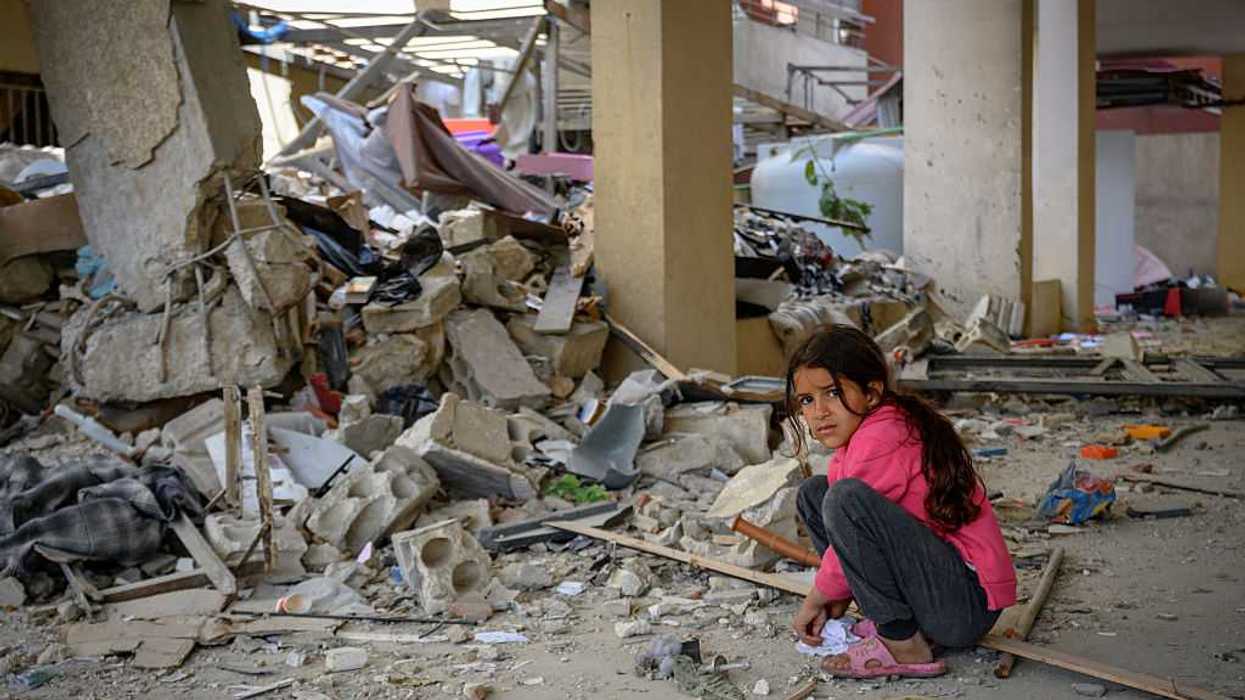
Trump has created and sustained geopolitical crises because, for a network of defense contractors, connected insiders, and crypto-billionaires, it’s profitable. Meanwhile, thousands of innocent civilians are dead while American servicemembers are left holding the line. It is almost unconscionable to consider, but the president may just not care. The human cost of war may simply be lost on a commander-in-chief so blasé about war crimes that after the U.S. torpedoed the IRIS Dena, he admitted they sank it instead of capturing it because it would be “more fun.” On Feb. 28, 2026, the U.S. struck a girls’ school in Minab, Iran, killing at least 168 children. When questioned at a G7 press conference about this indiscriminate tragedy, the worst civilian casualty incident caused by the U.S. military since 1991, the president shrugged it off, stating, “Mistakes are made. War is nasty.”
This disregard for human life abroad is mirrored by a disregard for human life at home. A foreign war is treated as a bottomless line item while human suffering is treated as the unavoidable cost of doing business. This April, Trump said at an Easter luncheon, “It’s not possible for us to take care of day care, Medicaid, Medicare, all these individual things…We have to take care of one thing: military protection. We have to guard the country.” In other words: no money for kids, families, healthcare here at home. That money is for weapons to bomb other kids, apparently. War is nasty.
If we can’t take care of day care because we’re fighting wars, then blame Trump’s war in Iran for why America's children are in crisis. For years now, the United States has suffered from the highest child poverty rate of any wealthy nation. Now, Trump has dismantled the Department of Education, ignored the epidemic of school gun violence, left youth mental health to plummet, and his "One Big Beautiful Bill Act” slashed funding for the Supplemental Nutrition Assistance Program (SNAP), stripping food benefits from vulnerable households across the nation. While we spend billions bombing foreign nations “back to the Stone Age” and deplete our domestic arsenals, our own foundation is rotting.
We are told we cannot afford to feed, educate, or protect our children because we must maintain our global military dominance. We let children go hungry to pay for wars in which the price of war has included the additional deaths of hundreds of children. Not to mention the deaths of American service members, each of whom is also someone’s child. What kind of a nation starves its children to feed its war machine? A hollow one.
Unfortunately, this goes way beyond Trump. An entire system has normalized putting the military-industrial complex above our domestic interests, and we have been complicit. It is time to demand more from our government. This country, and the service members who defend it, deserve leaders who prioritize the public good over their bank accounts. We need to stop letting war-hungry hawks treat our kids as disposable while they fortify their own ballrooms. But if we don’t want our tax dollars to be a venture capital fund for the elites, we need to have some hard conversations.
We will never achieve the exceptional outcomes young Americans deserve until we decide as a society that they are worth investing in. That conversation can’t happen honestly without addressing our priorities, which means addressing the way we think about war. The conversation has to happen though, and soon. It is high time we ended the war in Iran. It is high time we ended wars.
Julie Roland was a Naval Officer for ten years, deploying to both the South China Sea and the Persian Gulf as a helicopter pilot before separating in June 2025 as a Lieutenant Commander. She has a law degree from the University of San Diego, a Master of Laws from Columbia University, and is a member of the Truman National Security Project.