

Skip to content
Search

Latest Stories

Follow Us:
Top Stories

Defending Democracy Through the Founders’ Principles

Upholding the Founders’ vision requires accountability, vigilance, and public engagement.

Opinion

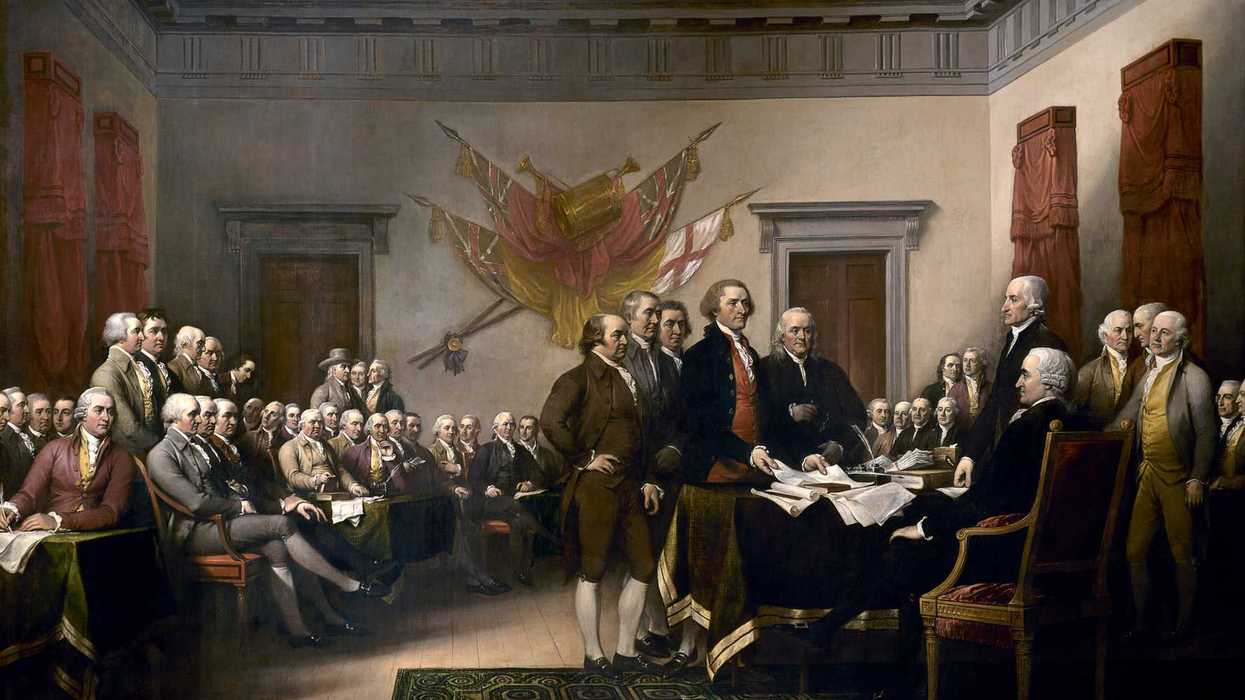
Painting by John Trumbull made in 1818 depicting the Committee of Five (Adams, Livingston, Sherman, Jefferson, and Franklin) presenting their draft of the Declaration of Independence.

Painting by John Trumbull made in 1818 depicting the Committee of Five (Adams, Livingston, Sherman, Jefferson, and Franklin) presenting their draft of the Declaration of Independence.

Gwengoat/Getty Images

As we have been celebrating the 250th anniversary of our country's founding, America is faced with its biggest challenge probably ever, save the Civil War. While there is much to celebrate in the 250 years of our existence, this moment is fraught with danger—not just for our democracy but for our founding principles of equality and the people's right to life, liberty, and the pursuit of happiness.

Unfortunately, most people don't understand the critical role that our country's structure, democracy, and the rule of law play in their efforts to live their lives and pursue happiness. People think, "So what, these issues don’t impact my life."


But the balance of power created by the Founding Fathers and the rule of law are in fact essential. Our founders were very aware of the vanity and desire for power that reside in many people, and they were aware of how those qualities in a government or politician can destroy a government's foundational purpose to protect the people and their rights. And so they created a system that depended on the concept of the balance of power. This system was designed to prevent any branch of government from creating such a power center or displaying such vanity that the government would cease focusing on its role of protecting the people and instead turn its focus to protecting themselves or the rich and powerful.

Lawyers have a duty to fulfill their oath to uphold the Constitution by not just bringing cases against unconstitutional government actions, but by educating the public about the meaning of our founding principles as stated in the Declaration of Independence. Lawyers also have a duty to educate the public about the people's role in upholding the Constitution by holding politicians accountable when they act in ways that diminish our founding principles—the equality of all and our right to life, liberty, and the pursuit of happiness.

"We the people" is not just a good-sounding phrase; it is the essence of American democracy. It is all about the people and supporting their right to pursue their lives as they wish, to follow their dreams. The government's purpose as stated in the Declaration is to secure people's rights. Promoting industry and the economy, our defense, protecting the environment and clean water and air—all are appropriate government actions, but only if the purpose is to secure people's right to life, liberty, and the pursuit of happiness or promote equality for all.

As Lincoln stated, America's government was created to be "of the people, by the people, and for the people." Our mission must be to continue to secure that aspiration.

For example, anything the government does that promotes or increases inequality is contrary to the government's purpose. Anything the government does that promotes or increases the power of persons or corporations or government over the people is contrary to the government's purpose. Anything that the government or a politician does that is self-serving is contrary to the government's purpose.

Join LDAD's initiative, Meeting the Moment, and share the uplifting spirit of the Declaration of Independence and the role we all must play in protecting the people and their rights.


This series from Lawyers Defending American Democracy connects the words of the Declaration of Independence and the Constitution to current events that threaten democracy and the justice system. Each piece highlights the unique responsibility lawyers carry—through their oath, professional obligations, and roles in their communities—to help the public understand what’s at risk and to speak out when democratic principles are under threat. LDAD’s call to action is straightforward: as the Founders once did, we must recognize threats to constitutional values, demand accountability, and act to defend them.

Ronald L. Hirsch is the author of We Still Hold These Truths - An American Manifesto, a volunteer with Lawyers Defending American Democracy, and the author of the blog www.PreservingAmericanValues.com


Read More

How an 1876 Massacre of Black Men in South Carolina Turned Racial Terror Into Political Power

This statue on the grounds of the South Carolina State House honors violent segregationist Ben Tillman, who also served as governor and U.S. senator.

How an 1876 Massacre of Black Men in South Carolina Turned Racial Terror Into Political Power

As the U.S. celebrates its 250th anniversary, its citizens commemorate a democracy more diverse, free and inclusive than it’s ever been. The path to this milestone was imperfect and paved in blood and suffering. Still, few of the revelers will likely pay heed to the anniversary of another historic event: the 150th anniversary of the July 1876 Hamburg massacre.

The massacre, which took place in Hamburg, South Carolina, began as a dispute between a local Black militia and two white citizens over whether the latter could cross the group’s centennial Fourth of July parade. The militia leader, Doc Adams, was later charged with blocking a public highway.

Keep ReadingShow less
A crowd of supporters holding signs behind Senate candidate Dr. Abdul El-Sayed as he stands and speaks at a podium outside in front of a crowd.

The crowd cheers as Senate candidate Dr. Abdul El-Sayed speaks during the "People vs. the Powerful" rally in Lansing, Michigan, on July 19, 2026.

Rosem Morton for The 19th

Who Is Electable? Michigan’s Senate Primary Asks a Familiar Question.

DETROIT — Rep. Jim Clyburn of South Carolina, a top Black House Democrat, was making the case for a moderate politician running on boosting jobs and manufacturing. Six years ago, it was to crowds in his home state, arguing that Joe Biden was the best positioned to win in a general election. This time, it was on a stage in Detroit, for a candidate in one of 2026’s most hotly contested Senate primaries.

“I know what it takes to energize Democratic voters. I know she has what it takes to energize Democratic voters, and we need that,” Clyburn said alongside Rep. Haley Stevens, a candidate for U.S. Senate in Michigan, at a Teamsters hall in Detroit on Friday before the two rallied alongside Gov. Gretchen Whitmer.

Keep ReadingShow less
Voter receives a pen from poll worker at polling station.

A civic petition calling for constitutional restraint, civil discourse, bipartisan cooperation, and equal justice to strengthen American democracy and national unity.

SDI Productions/Getty Images

A Contemporary Olive Branch Petition

To the President of the United States, the Leaders of the Congress, and Our Fellow Americans Entrusted with the Powers of Government:

When, in the ordinary course of a free republic, disagreements arise among citizens concerning the proper exercise of power, it is neither unusual nor dishonorable that earnest convictions should differ. Such diversity has long been the strength of our nation, for liberty has never depended upon unanimity of opinion, but upon mutual respect under a common Constitution.

Keep ReadingShow less
Close-up shot of a Black woman's hands receiving a mail-in ballot to vote in a USA Presidential, Senatorial, Congressional, or local election

Federal investigators spent eight months reviewing the Allied Pilots Association election, examining ballot secrecy, observer rights, election records and transparency before allowing the results to stand.

Jeremy Poland/Getty Images

What a Federal Investigation of a Union Election Can Teach Us About Democratic Trust

For eight months, federal investigators examined allegations involving ballot secrecy, observer rights, election records and reporting procedures in a contested union election before allowing the result to stand.

Following a disputed election within the Allied Pilots Association (APA), complaints led to a formal review by the U.S. Department of Labor's Office of Labor-Management Standards. Investigators spent months going through election records, audit logs, witness testimony and technical documentation before reaching their conclusion.

Keep ReadingShow less