

Skip to content
Search

Latest Stories

Follow Us:
Top Stories

Let’s help millions escape from voter registration limbo

Opinion

Voter registration

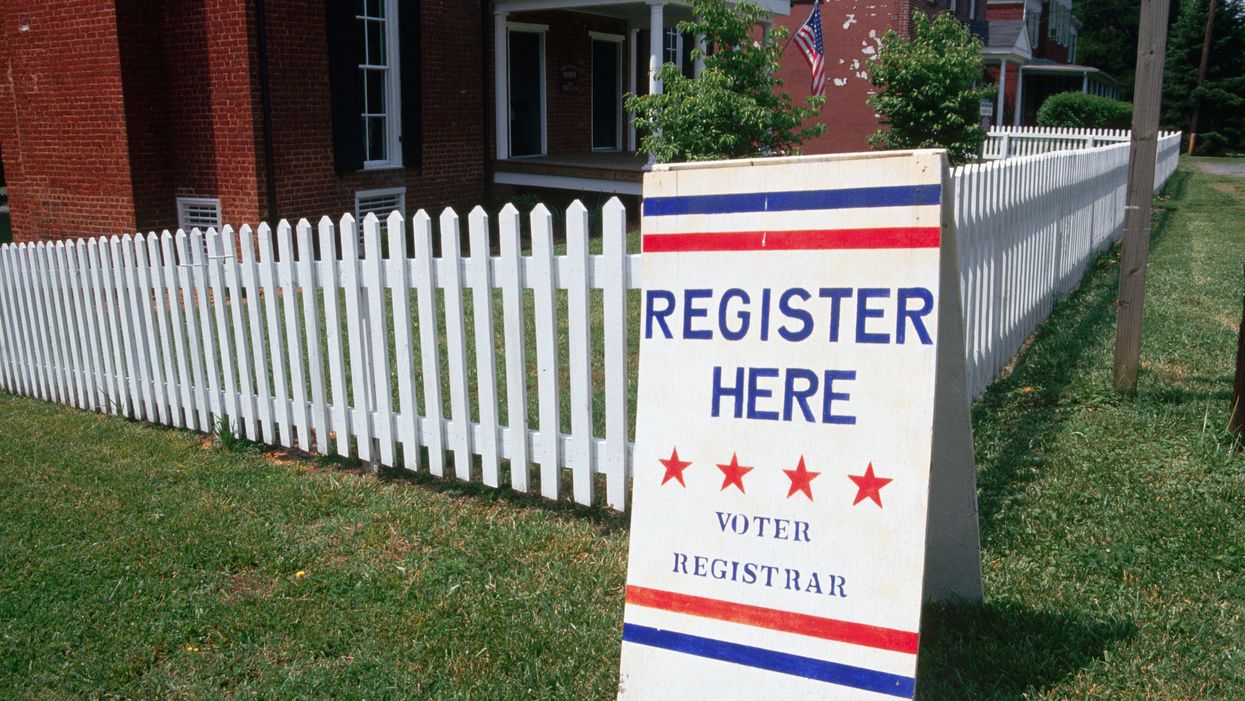
Tuesday is National Voter Registration Day.

Joseph Sohm/Getty Images

Miller is executive director of Nonprofit VOTE, which works to help other nonprofits across the nation boost civic engagement and voter turnout among their allies.


Since the start of the coronavirus outbreak, we've seen a collapse in the number of voter registrations collected or updated because government offices were shuttered and in-person campaigns to find and sign up new voters were put on hold.

We're talking about millions of non-registrations here. It's not a small number. And as the pandemic has persisted the problem has been compounded by the large-scale displacement of people who have had to move, not only the millions in struggling families facing evictions because of the economic downturn but also the millions of students who've moved back home since their universities went fully virtual.

Election Day is in just six weeks. So what do we do to ease this urgent challenge to our democracy?

First and foremost, we need to make sure as many Americans as possible can register, or update their registration to reflect their current address, before their states' deadlines.

This is absolutely essential for voters who wish to take advantage of this year's wave of expanded availability of voting by mail. There is no way to receive an absentee ballot — or in many states even an application to vote remotely — if it's sent to your old mailing address and the Postal Service knows you don't live there.

Today is National Voter Registration Day — a major rallying call to register voters across the nation, which they can do on the National Voter Registration Day website. Started in 2012, it acts as a coordinated day of action between national and local organizations both executing live (and virtual) voter registration events and promoting the importance of being #VoteReady for the November election.

The deadlines for new registrations vary by state. None are in September, but 15 states have cutoffs during the first week of October and 11 more will stop signups a week after that.

The good news is that 19 states and Washington, D.C. are allowing same-day registration this year — meaning eligible people can show up at a place that allows in-person early voting, or to local polling places on Election Day, sign up to vote (or update their registration) and then immediately proceed to cast a ballot. The only downside, this time, is this option means an in-person experience in the face of potential health risks.

So what about voters who are not able to update their voter registration in time for the election? In many cases, they can still exercise their right to vote if they were previously registered elsewhere and their registration is just out of date — but it gets a little more complicated.

If a voter only moves across town, or within the same congressional district, but did not update his or her voter registration, that person can still vote thanks to protections provided by a 1993 federal law. However, they will likely have to go to their former polling location or a central voting site and vote in person. Voting files are often updated in the process to reflect the new address.

Voters who move to a different congressional district within the same state will have a tougher time. There are no federal laws that guarantee their right to vote if they don't register first. Some states do in fact let you still vote, but rules vary from state to state. In these cases, it's best to contact your local elections office or call the national Election Protection hotline.

Finally, voters who move to a different state within 30 days of the election might find the state they just moved to has a registration deadline or residency requirement that prevents them from registering and voting there.

These voters are effectively cast into registration limbo — but there is a way out, in part at least. They can contact their former state's elections office to request a special ballot that will allow them to at least vote in the presidential race.

Again, registering to vote at one's current address is the surest way to ensure you can vote, but if you do miss the deadline, don't give up. It may take longer or require a special trip, but in many cases you can still vote.

With so many rules to navigate, it's important that all of us committed to a vigorous civic life — nonprofits, libraries, universities, businesses and election officials alike — help the communities we serve understand the rules. Our democracy will be stronger for it.


Read More

Postal Service Changes Mean Texas Voters Shouldn’t Wait To Mail Voter Registrations and Ballots

A voter registration drive in Corpus Christi, Texas, on Oct. 5, 2024. The deadline to register to vote for Texas' March 3 primary election is Feb. 2, 2026. Changes to USPS policies may affect whether a voter registration application is processed on time if it's not postmarked by the deadline.

Gabriel Cárdenas for Votebeat

Postal Service Changes Mean Texas Voters Shouldn’t Wait To Mail Voter Registrations and Ballots

Texans seeking to register to vote or cast a ballot by mail may not want to wait until the last minute, thanks to new guidance from the U.S. Postal Service.

The USPS last month advised that it may not postmark a piece of mail on the same day that it takes possession of it. Postmarks are applied once mail reaches a processing facility, it said, which may not be the same day it’s dropped in a mailbox, for example.

Keep ReadingShow less
The Many Victims of Trump’s Immigration Policy–Including the U.S. Economy

Messages of support are posted on the entrance of the Don Julio Mexican restaurant and bar on January 18, 2026 in Forest Lake, Minnesota. The restaurant was reportedly closed because of ICE operations in the area. Residents in some places have organized amid a reported deployment of 3,000 federal agents in the area who have been tasked with rounding up and deporting suspected undocumented immigrants

Getty Images, Scott Olson

The Many Victims of Trump’s Immigration Policy–Including the U.S. Economy

The first year of President Donald Trump’s second term resulted in some of the most profound immigration policy changes in modern history. With illegal border crossings having dropped to their lowest levels in over 50 years, Trump can claim a measure of victory. But it’s a hollow victory, because it’s becoming increasingly clear that his immigration policy is not only damaging families, communities, workplaces, and schools - it is also hurting the economy and adding to still-soaring prices.

Besides the terrifying police state tactics, the most dramatic shift in Trump's immigration policy, compared to his presidential predecessors (including himself in his first term), is who he is targeting. Previously, a large number of the removals came from immigrants who showed up at the border but were turned away and never allowed to enter the country. But with so much success at reducing activity at the border, Trump has switched to prioritizing “internal deportations” – removing illegal immigrants who are already living in the country, many of them for years, with families, careers, jobs, and businesses.

Keep ReadingShow less
Close up of stock market chart on a glowing particle world map and trading board.

Democrats seek a post-Trump strategy, but reliance on neoliberal economic policies may deepen inequality and voter distrust.

Getty Images, Yuichiro Chino

After Trump, Democrats Confront a Deeper Economic Reckoning

For a decade, Democrats have defined themselves largely by their opposition to Donald Trump, a posture taken in response to institutional crises and a sustained effort to defend democratic norms from erosion. Whatever Trump may claim, he will not be on the 2028 presidential ballot. This moment offers Democrats an opportunity to do something they have postponed for years: move beyond resistance politics and articulate a serious, forward-looking strategy for governing. Notably, at least one emerging Democratic policy group has begun studying what governing might look like in a post-Trump era, signaling an early attempt to think beyond opposition alone.

While Democrats’ growing willingness to look past Trump is a welcome development, there is a real danger in relying too heavily on familiar policy approaches. Established frameworks offer comfort and coherence, but they also carry risks, especially when the conditions that once made them successful no longer hold.

Keep ReadingShow less
Autocracy for Dummies

U.S. President Donald Trump on February 13, 2026 in Fort Bragg, North Carolina.

(Photo by Nathan Howard/Getty Images)

Autocracy for Dummies

Everything Donald Trump has said and done in his second term as president was lifted from the Autocracy for Dummies handbook he should have committed to memory after trying and failing on January 6, 2021, to overthrow the government he had pledged to protect and serve.

This time around, putting his name and face to everything he fancies and diverting our attention from anything he touches as soon as it begins to smell or look bad are telltale signs that he is losing the fight to control the hearts and minds of a nation he would rather rule than help lead.

Keep ReadingShow less