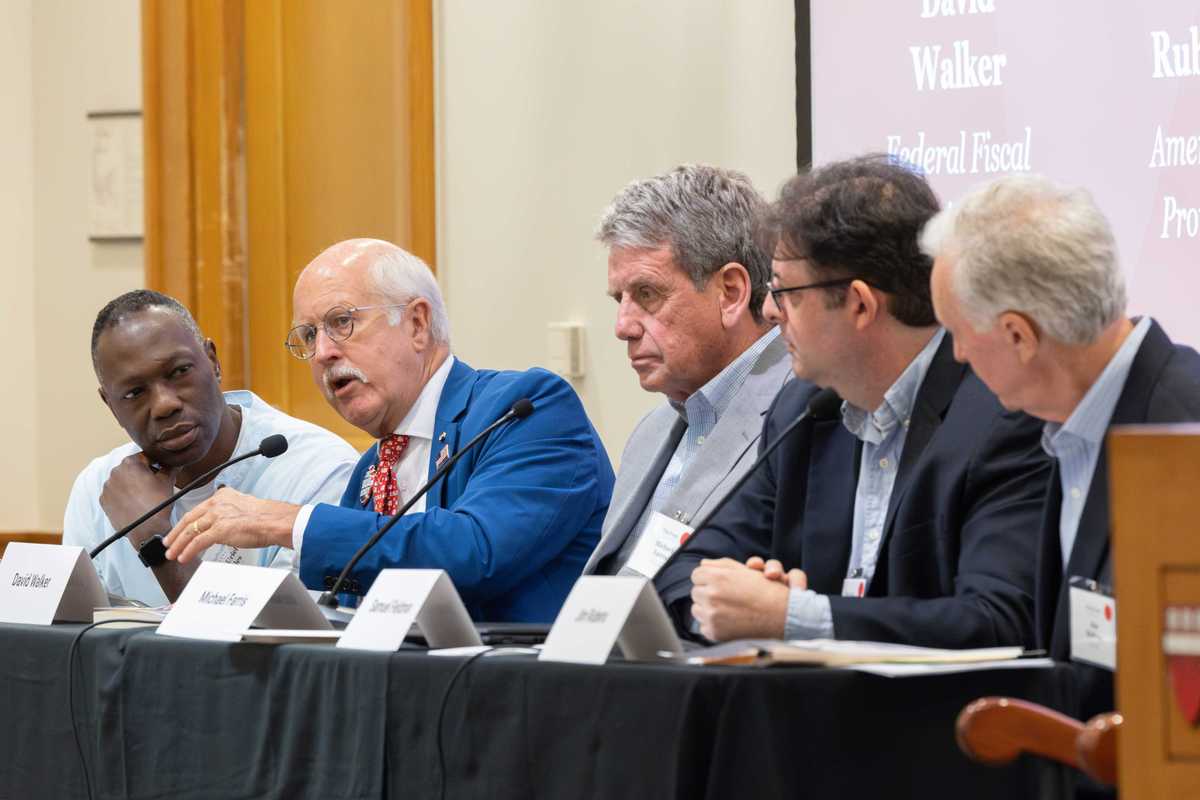



Andy Moore, Executive Director of the National Association of Nonpartisan Reformers (NANR), joins host T. J. O’Hara on Deconstructed to discuss that organization’s progress toward attaining nonpartisan reform. Mr. Moore serves as an entrepreneur-in-residence with Price College of Business at the University of Oklahoma, and he is also the founder of Let’s Fix This, which is focused upon building civic engagement and power for political reform.
Site Navigation
Search
Latest Stories
Start your day right!
Get latest updates and insights delivered to your inbox.
Top Stories
Latest news
Read More

People draped in an American flag and a Ukrainian flag join a march toward the United Nations.
Alexi Rosenfeld/Getty Images
Ukraine Kept Its Word. The World Did Not.
Dec 09, 2025
In my work as a homeowner advocate and civic voice, I’ve come to believe that honesty and integrity aren’t just personal virtues—they’re the foundation of every meaningful relationship, every credible institution, and every lasting peace. When those values are compromised, trust erodes—and with it, so does the social fabric that holds communities and nations together.
This isn’t just a local lesson. It’s a global one.
In 1994, Ukraine surrendered the world’s third-largest nuclear arsenal. It did so voluntarily, trusting that the United States, the United Kingdom, and Russia would honor their word. The Budapest Memorandum offered security assurances in return: a promise to respect Ukraine’s sovereignty and territorial integrity.
Ukraine kept its word. The world did not.
When Russia annexed Crimea in 2014 and launched a full-scale invasion in 2022, those assurances proved tragically insufficient. The signatories expressed concern, imposed sanctions, and offered aid—but none intervened militarily to uphold the sovereignty they had pledged to protect. The message was clear: political commitments and absent enforcement are fragile shields.
Now, as Ukraine faces the prospect of new negotiations, the question arises: Why would it trust another set of guarantees—especially from the same actors who failed to uphold the last?
This is not a call for cynicism. It is a call for clarity.
If the United States aspires to lead by example, it must reckon with the legacy of broken promises. It must offer more than rhetoric. It must craft agreements that are enforceable, transparent, and rooted in accountability. That’s not just good policy—it’s a moral imperative.
Because when nations fail to honor their word, they don’t just lose credibility; They weaken the very norms that underpin global cooperation. They teach smaller nations that survival depends not on diplomacy but on deterrence. And they risk a future where trust is replaced by fear.
The Fulcrum exists to elevate voices committed to strengthening democracy. That work begins with restoring faith in our institutions, our commitments, and our word. Honesty and integrity are not luxuries. They are the bedrock of a functioning democracy and a peaceful world.
The world is watching. Ukraine is watching. And history will remember not just what we said—but what we did.
Bruce Lowe is a homeowner advocate and community leader in Lubbock, Texas. He writes about civic integrity, public health, and principled reform. His book, "Honesty and Integrity: The Pillars of a Meaningful Life", explores how ethical leadership can strengthen families, uplift communities, and create a better life for all.
Keep Reading
Show less
Recommended

U.S. Secretary of Defense Pete Hegseth speaks during a cabinet meeting hosted by President Donald Trump in the Cabinet Room of the White House in Washington, D.C., on Tuesday, Dec. 2, 2025.
(Andrew Caballero-Reynolds/AFP/Getty Images/TNS)
You can’t hide from war crimes by calling them ‘fake news’
Dec 09, 2025
Since September of this year, the United States military has been blowing up boats allegedly trafficking drugs in the Caribbean.
Whether these attacks are legal is hotly debated. Congress hasn’t declared war or even authorized the use of force against “narco-terrorists” or against Venezuela, the apparent real target of a massive U.S. military build-up off its coast.
The Trump administration has simply unilaterally designated various — alleged — drug traffickers as “terrorists” or members of “terrorist organizations,” and then waged war upon them. The administration’s internal legal finding supporting all of this hasn’t been publicly released. But whatever their case in private is, it was sufficiently weak that the British government announced in early November it would no longer share intelligence with the U.S. relevant to the Caribbean operation over concerns about its lawfulness.
On Friday, the Washington Post dropped a bombshell report about the first of these operations back in September. During the strike, the Navy not only took out a suspected drug-trafficking boat — as had been reported previously — but when survivors were spotted clinging to the wreckage, the special operations commander overseeing the operation ordered a second strike on the survivors, in order to comply with Defense Secretary Pete Hegseth’s order to kill everyone involved.
“Hegseth gave a spoken directive, according to two people with direct knowledge of the operation,” the Post reported. “ ‘The order was to kill everybody,’ one of them said.”
Whatever you think about the broader Caribbean operation, it is a simple fact that shooting survivors at sea is war crime, under American and international law. Of course, as some suggest, since this operation is not a legal war, maybe it’s not a war crime, just a crime-crime.
Later Friday, in a lengthy social media post, Hegseth attacked the Washington Post’s report as an instance of the “fake news … delivering more fabricated, inflammatory, and derogatory reporting.”
What Hegseth didn’t do was directly deny the report. Instead, he insisted that “we’ve said from the beginning, and in every statement, these highly effective strikes are specifically specifically intended to be ‘lethal, kinetic strikes.’ ”
Declaring your intent was to kill everybody on the first try isn’t a legal excuse to finish off unarmed survivors.
Hegseth offered follow-up posts that were boastful or childish, but did not deny the charge.
With even Republican members of Congress expressing grave concerns, the official story changed from “fake news” to an actual denial. Trump said that Hegseth told the president that he did not give any such illegal order, “and I believe him, 100%,” adding that he “wouldn’t have wanted that. Not a second strike.”
So it now appears the White House has confirmed there was a second strike on the survivors, and conceded that it would at least be against the president’s policy. Whether the White House will concede the strike was unlawful remains to be seen. Indeed, exactly what happened remains murky. It surely seems like someone gave an order for a second strike. And if it wasn’t Hegseth, whoever that person was could be looking at a court-martial — or given who the commander-in-chief is, a pardon.
But I don’t want to get ahead of the news.
Instead, I’ll make a few points.
First, a minor gripe: This administration and its defenders need to be more selective in their use of the term “fake news.” I have no problem calling a false story “fake news.” But if you know that a story isn’t false, calling it “fake news” just sets you up to look like even more of a liar or hypocrite down the road when you end up admitting the truth and defending actions you once pretended were slanderous.
More importantly, the whole Caribbean strategy is constitutionally and legally dubious. As a matter of foreign policy, it looks more and more like a pretext for some kind of regime change gambit in Venezuela. If the administration has evidence that justifies its actions, they should share it with Congress and ask for permission to wage war.
Even more important: illegal orders cannot be justified. When a half-dozen Democratic members of Congress released a video saying that the military shouldn’t follow “illegal orders,” the president and many of his defenders became hysterical. Trump lamented that America has become so “soft” that such “seditious behavior” isn’t punished by death anymore.
More sober critics of the Democrats complained that the video sowed confusion in the ranks and hurt morale. I’m actually sympathetic to that argument.
But you know what else sows confusion and hurts morale? Issuing illegal orders – or even appearing to do so.
Jonah Goldberg is editor-in-chief of The Dispatch and the host of The Remnant podcast. His Twitter handle is @JonahDispatch.
Keep Reading
Show less

Getty Images, Bogdan Okhremchuk
What Washington’s Humble Grave Reveals About American Exceptionalism and the Rule of Law
Dec 04, 2025
If you want to understand what makes the United States exceptional on an emotional level, take an in-person or virtual trip to both Mt. Vernon, Virginia, and Paris, France. At Mt. Vernon, you can tour the preserved and reconstructed plantation of George Washington, viewing what the tour claims is the first compost bin in the nation and reading about the particular way he organized his gardens.
The most important part, though, is his grave. The first President of the most powerful nation on Earth rests in a modest brick mausoleum about ten feet high, built into a hillside. The plain white room containing the sarcophagi of Washington and his wife is barely larger than the two coffins themselves.
The French have a very different tomb dedicated to the founder of their modern nation. Emperor Napoleon rests in a stone sarcophagus on a raised dais in a huge domed building. To American eyes, the building looks like one of our state capitals, complete with columns, domes, Greco-Roman reliefs, and multiple entrances. The room containing the sarcophagus is opulent, with detailed carved statues of Roman figures, golden trim, ornate hanging lamps, large windows, and a large second-story balcony. It is less a grave than a temple, deifying the person of the Emperor.
This striking difference tells you much of what you need to know about why the United States has done so well for so long. The father of our nation and his contemporaries did not believe in deifying their leader. Washington was keenly aware of setting a humble precedent by everything he did, from limiting himself to two terms to adopting the title “Mr. President.” His legacy to all of us was not in his personality, but in the processes and structures he built that lived on after he did. By his design, we pay respect to our founder by operating the wondrous democratic machinery he first showed us how to operate.
My opinion of Washington as the best American President is not unanimous. Many studies that rank the Presidents place Abraham Lincoln first, while Washington tends to appear somewhere in the top five. This always struck me as unfair. Lincoln was remarkable, to be sure, and ending the scourge of slavery guarantees his place forever as one of the best Presidents. Yet, he arrived on the scene with a particular existential problem to solve - a civil war that was clearly about to erupt over the slavery question. His capacity for greatness was amplified by exterior forces presenting him with a clear crisis.
Washington, more than any other President, arrived with a blank slate. His existential crisis had come years before, when he survived a war with Great Britain. By the time he came to office, the most serious existential dangers to the country came in the form of future risks. Washington’s challenge in office was not so much how to defeat an enemy in front of him, but how to build a system that could handle enemies in the future. It is harder to create than to destroy, and harder still to build a strong structure for a future you cannot fully predict.
Process theory suggests that the aim of a law should not be to obtain a particular substantive result, but to adopt and defend processes that tend to lead to good results. It isn’t hard to see the utility of this approach. People are going to disagree about what is good and what is bad and to what degree. Some such disagreements may be distant from the passions of most citizens, like what kind of crops to encourage farmers to grow or who to hire for a government construction contract. Others may be very close to the heart, such as whether to outlaw abortion or how immigration should work. In each case, because there are passions and well-reasoned arguments pulling in different directions, there has to be some process to decide what to do. A core function of government is helping mediate that outcome.
Washington wasn’t a process theorist exactly. In fact, he did not write much at all about the philosophy behind his governance. But his instincts were very process-based. He believed that a regular process was what distinguished the republic from the extremes of monarchy or mob rule. He strove to mediate carefully and fairly between the political divisions of the day among his own cabinet members and in his interactions with Congress. Even his more extreme actions, like putting down the Whiskey Rebellion (a major use of federal military force against citizens), came from a sense of duty to uphold duly enacted law rather than any sense of solving a problem by any means necessary. Washington left us with an example and a legacy of respect for the process and for the rule of law.
There will always be those who feel passionately in the correctness of their substantive position and who believe anyone who feels differently is evil. After all, if you believe you have the best interests of the country in mind and you’ve determined the right solution to a problem, doesn’t that mean anyone who disagrees with you must be treasonously acting against the country’s interests? This is a very natural trap to fall into, and some of the less successful Presidents did so. President Adams passed heavy-handed censorship laws based on this logic, called the Alien and Sedition Acts, which are now widely recognized as ineffective.
Thinking of anyone who has a substantively different opinion as evil is a mistake. We are all limited as human beings, impacted by our life experiences, knowledge, and skills. Indeed, the major benefit of the rule of law is as a way to mediate differing ideas, leading to better results than a single person’s judgment alone. A fair process must be respected and accepted to make this happen. To declare that the process should not stand in the way of one’s own passionately held belief is Napoleonic hubris.
Disregarding the rule of law to force through a result is also extremely dangerous. People are going to have disagreements no matter what processes are in place. If there is no agreed upon process for resolving those disagreements, the parties will decide the issue some other way. The most ancient method is physical violence. Without a respected legal process, if two neighbors disagree over how much water each is extracting from the stream, murderous action could end that disagreement. In addition to being morally abhorrent, that process does nothing to make sure the decision was made correctly.
Adherence to the established rule of law as a way of solving problems leads to better outcomes. Similarly, the idea of a single strong leader who cuts through the “red tape” of process to fix a problem is similarly flawed. A modern state is a massive, complex system. No single person understands its operation alone. Swift, decisive action simply results in faster bad decisions.
We best honor the legacy of George Washington and others responsible for the freedoms we enjoy by respecting the process that was their greatest legacy. None of us will always agree with the results of the process. But the last two hundred years of the United States becoming the leader of the world should give us powerful evidence that the rule of law is effective. Washington did not need a gaudy display of opulence to declare his successes, as the greatness of his hard work has thundered for hundreds of years.
Colin E. Moriarty is a partner at Moriarty Underhill LLC and a volunteer with Lawyers Defending American Democracy.
Keep Reading
Show less

white concrete building under cloudy sky during daytime
Photo by Harold Mendoza on Unsplash
They Want Power. We Need Accountability.
Dec 01, 2025
Americans are not confused. We are exhausted.
We’ve watched a Congress that no longer works, a Supreme Court that often ignores its own ethical obligations, and a Justice Department hesitant to enforce the laws it was created to uphold. Leaders promise to serve the people — yet spend their time serving donors, factions, and themselves.
And here is the question no one in Washington seems brave enough to ask:
How long can a democracy survive when its leaders stop listening — and when the citizens who elected them stop demanding accountability?
Families are paying more for groceries. Healthcare feels fragile. Schools struggle. Public trust in government is near historic lows — just 20% of Americans approve of Congress’s performance.
Yet many voters shrug when officials break the law, mislead the public, or abandon their constitutional duty. Some do not vote at all — then express outrage at the consequences of their own inaction.
Democracy cannot function when citizens tolerate corruption or remain silent.
Nothing illustrates this moral collapse more vividly than January 6 — the day the U.S. Capitol, the heart of our democracy, was attacked. Police officers were beaten. The peaceful transfer of power — our most sacred civic ritual — was threatened. Speaker Nancy Pelosi led the House through the crisis, while then‑Representative Mike Johnson reportedly worked behind the scenes with loyalists to keep President Trump in power. Some members of Congress minimized the attack; others defended the rioters. Millions of voters ignored who was responsible. The country watched in disbelief.
After his first impeachment, Senator Susan Collins said she believed President Trump had “learned his lesson.” But he hadn’t. He did it again — abused his power, incited violence, and continues to defy the rule of law.
And this time, he did so with the tacit support of the highest court in the country.
The Supreme Court has refused to enforce clear ethical standards, declined to recuse justices with glaring conflicts of interest, and delayed rulings that could have protected the integrity of our elections.
Meanwhile, those who tried to hold Trump accountable — leaders like former Rep. Liz Cheney and former Sen. Mitt Romney — were penalized. Cheney lost her leadership role and her seat. Romney chose not to run again, citing the toxic political climate.
Where was the courage to do the right thing?
Those who incited violence were later pardoned or had their sentences reduced. Their victims — the officers who were beaten, the staffers who hid in fear, the lawmakers who fled for their lives — were victimized again.
Our system of accountability is broken. And it is deeply frustrating.
Where are our checks and balances when the most powerful can lie, incite violence, and walk away untouched? Right now, Congress and the courts are failing to exercise those powers at all. Justices accept gifts from billionaires and refuse to recuse. Members of Congress skip votes and dodge oversight without consequence.
True service means listening to the people, conducting audits, acknowledging failures, and collaborating across party lines. Leaders must remember they legislate for Republicans, Democrats, and Independents alike — not for factions or donors. Transparency is not optional: budgets, proposals, and votes must be open to the public. Ethical standards must be enforced through codes of conduct, whistleblower protections, and independent oversight. Congress must use its checks and balances responsibly, safeguarding free and fair elections from interference. Leaders must cut out obstruction and partisan theater that wastes time and erodes trust. These are not radical demands — they are the basics of ethical leadership.
When citizens stop paying attention — or stop believing their voices matter — democracy suffers.
Trust collapses. Laws are bent. Courage is punished. And the people are left with leaders who serve themselves.
Accountability takes courage — and too many leaders lack it.
They fail to hold themselves accountable when they break promises, skip votes, or betray the public trust. They fail to hold each other accountable when colleagues lie, incite violence, or abuse power.
Instead of consequences, there are excuses. Instead of courage, there is complicity.
Accountability is not cruelty. It is clarity. It is the foundation of trust. And without it, democracy cannot survive.
Throughout my career in public education, accountability has made me stronger. Accepting responsibility for my failures was tough, but it paid off. It built trust. It built integrity. And it reminded me that leadership is not a performance — it’s a promise.
I wrote to my former representatives while they were still in office — urging them to vote in the best interest of our community. They didn’t. One knew she couldn’t run again — voters in our district had seen enough. Another lost public support for breaking promises. These were not partisan disagreements. They were failures of trust.
That’s why I check roll calls and track votes. I ask others to do the same — even family members in other states. But too often, they don’t. They complain, but they don’t engage.
This is how democracy erodes — not just through bad leadership, but through public disengagement.
Americans must not give up. We must pay attention. We must demand better — and reward those who lead with courage and conscience.
I understand why some people stay silent. In today’s climate, speaking up can be risky — especially in my state. Some threaten, intimidate, or try to silence voices that challenge power. But I write because this moment is too urgent to ignore.
I applaud my nephew in Georgia, who shows up at rallies, town halls, and meetings with leaders. He reminds me that courage is contagious. We don’t get discouraged. We know that our voices matter — for our children, our grandchildren, and the future of this country.
Silence is not an option.
Democracy demands participation. Accountability demands courage. And the future demands that we speak.
Call to Action
If you care about this country — speak up. Write your leaders. Check their votes. Share the truth. Hold them accountable. And never forget: democracy only works when we do.
Encourage leaders to compromise, collaborate, listen to the voices of the people, and hold themselves accountable for keeping their oath.
They want power. But it is time that Americans demand accountability.
Carolyn Goode is a retired educational leader and advocate for ethical leadership and health care justice.
Keep Reading
Show less
Load More