

Each day, the challenges in our nation pile up. In just recent weeks, there has been the ongoing war in Iran and the Middle East, and ongoing debates about the growing negative impact of the Internet, looming AI challenges, and the Epstein files. The anticipation of divisive, even ugly, midterm elections only adds more angst to our woes. It can feel like we have lost control over our present and our future.
Is there an antidote? Yes. But we must seize it together.
We need a civic response that calls us to our better selves, offers a sense of possibility and hope, and provides a practical path forward. Such a response must transcend politics and galvanize our fragmented, divided, hurting nation. And it must speak plainly to people’s yearning for a sense of common purpose, belonging, shared action, and healing.
For two years, I’ve crisscrossed our nation nonstop on my Campaign for the New Civic Path from Flint, MI, to Selma, AL, to Chicago, IL, to Philadelphia, PA, to Redding, CA, to rural Grundy, VA, tucked deep in Appalachia. People’s enthusiastic response proves that Americans crave an apolitical message from an apolitical messenger. I’ve only seen this hunger grow and deepen over time, and it cuts across typical divides like political affiliation, race, geography, and income.
This is a crucial year. None of us can afford to sit on the sidelines. We must not surrender to the negative forces consuming society today. That’s why I’m continuing to run this campaign through 2026. As we move forward, the shared civic response I have in mind is based on four principles:
- Addressing our “crisis of belief.” Our politics are broken; but at root, we face a crisis of belief—in our systems, institutions, leaders, even one another. We must act to restore our belief that we can get things done together. This is a cultural and human challenge. The good news? Addressing this crisis is doable and practical. Take Union County, OH, which is in Jim Jordan’s congressional district. Groups of leaders and residents there are growing people’s belief by coming together in new ways to produce needed change on what truly matters to people in their daily lives, like youth and healthcare.
- Harnessing America’s 250th to declare who we seek to become. This year provides a unique opportunity to examine who we seek to be as Americans and how we can make the next 250 years even better, for all of us, starting today. I take great inspiration from American history. It is in the stories of the abolition movement, the civil rights movement, and others that we might rediscover that change starts in our local communities and spreads nationwide. Through the determined actions of everyday Americans, we can strive to make this country live up to its founding ideals.
- Rallying around a new moral vision. Every day I hear Americans from all walks of life say they seek greater decency, dignity, belonging, and shared responsibility in society. And they’re ready to take action on a set of shared concerns—like youth opportunities, senior care, affordable housing, mental health, and others. Taken together, I believe this is the foundation of a new moral vision that transcends divisive politics and has the power to galvanize us.
- Getting on a new civic path. Only by getting on a new civic path can we restore our belief and reclaim our shared agency by building on what we can agree on and taking real action together—not as Republicans, Democrats, or Independents, but as Americans. Lest you think this is some utopian dream, I’ve witnessed firsthand how getting on a new civic path has transformed places like Reading, PA—once declared the poorest community in America—and Alamance County, NC—perhaps the most divided place I’ve worked in my nearly 40 years. It is possible. It is already happening.
I believe such a civic response to today’s crises is so important because politics alone cannot deliver what so many Americans are deeply yearning for.
Of course, each of us must vote. Debate issues. Speak out. This is part and parcel of the American experiment. Much is at stake.
Yet people across America are desperate for something that transcends politics and enables us to focus on what really matters, take shared action, and restore our belief in one another. The cure to our toxic politics can’t be to double down on the status quo. A new civic path can be the antidote. But it’s an antidote our politicians by definition cannot offer—it must be apolitical.
That’s why I plan to keep sounding this message. I hope you’ll join me.
We need each other. Let’s go together.
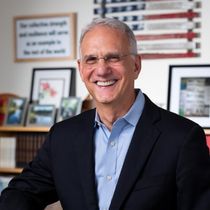
Rich Harwood is the president and founder of The Harwood Institute.










The President Invited Iran to Bomb My Home