


The prevailing narrative about the conspicuous absence of Gen Z from the No Kings protests is a classic case of facile pop psychology masquerading as political insight. According to this account, young people are "demoralized," "disillusioned," or "too online" to show up in the streets. But this interpretation is not only simplistic and evidently false: It is also self-serving. It absolves the older generations of responsibility for their political theater and, conveniently, places the blame for democratic decline on the very cohort that has the least power and the most at stake.
A more honest analysis begins with acknowledging what these protests really are: Carefully managed performances by comfortable Boomers who have profited handsomely from the status quo establishment and therefore have no intention of actually confronting let alone dismantle that establishment. That is why these rallies are organized with meticulous politeness, routed through predetermined corridors, and conducted under the watchful approval and protection of the same institutions they claim to oppose. They make noise, shout slogans, sing songs, but by design they do not disrupt anything. They are the political equivalent of a controlled burn on land that no one wants to risk letting catch fire.
Just as telling as their choreography is the absence of clear, actionable demands. The No Kings protests revolve around emotional grievance rather than political program. What bothers these protesters is not authoritarian power as such, but the way that power is being expressed: Too crudely, too boorishly, without the polite varnish that used to make the operations of the state feel lofty and dignified. In other words, they are not trying to stop domination. What they want is domination to return to its earlier style, where its anti-establishment challenges can be stifled by averting one’s eyes. They long for an erstwhile status quo that worked well for them, so long as it remained discreet.
Gen Z sees this perfectly clearly. Their absence from these protests is not evidence of apathy but of keen discernment. Gen Z refuses to be recruited into a movement whose entire purpose is to make the old order look and feel civil again. They will not help stage a tableau that presents mass dissent while asking for nothing other than the return of a mythical era of smooth civility.
When young people take to the streets, the contrast could not be starker. The Gaza protests and campus solidarity encampments made this abundantly obvious. Students and young activists articulated unambiguous demands: Divestment from companies supplying occupation and warfare, cessation of U.S. military aid to Israel, and university accountability for their financial and political entanglements. They did not gather simply to express "disapproval" or "discontent." They set conditions for change and they did not limit themselves to marches designed for quick dispersal. They built sustained physical presence. They disrupted business as usual: University operations, donor relations, administrative routines, and corporate partnerships. They imposed political and material costs on institutions that preferred to operate in quiet, polite complicity.
This dynamic was on full display in another arena as well: The series of interruptions at Kamala Harris' campaign and post-election book toor public appearances by young protesters denouncing her complicity in the ongoing Gaza genocide. These disruptions were not random outbursts; they were deliberate interventions insisting that powerful officials confront the consequences of their policies rather than glide on through events cushioned by decorum. But perhaps even more revealing than the protests themselves was the incandescent outrage of the Boomers and Gen Xers in the audience, those self-proclaimed lovers of free speech, lifetime warriors against racism, and defenders of democratic norms, who recoiled not at the endless images of slaughtered babies (such images and videos were nearly never shown on Rachel Maddow, their touchstone TV Show), but at the ‘crass incivility’ of those who protested and continue to protest against the genocide enablers. Their fury at these young people, their reddened faces and trembling indignation at the breach of etiquette, laid bare the truth: what they cherish is not democracy, but the performance of democracy. What offends them is not injustice, but the disruption of their comfort. Their reaction to those speaking truth to power shows just how thin their commitment is to a democratic order that claims to comfort the weak and disturb the powerful.
The same clarity and willingness to confront authority appears in the ways young people have resisted ICE. They have intervened in live deportation attempts, blockaded vans, mobilized neighborhood groups, and interrupted federal operations in real time. They have pushed back against masked federal troops kidnapping people from the streets without warrants or court orders, refusing to normalize the illegal militarization of their neighborhoods. These acts of resistance were not approved by city officials, nor were they scheduled for weekend convenience. They involved risk, improvisation, physical presence, and the assertion of moral authority against state power in its bluntest form.
By contrast, the No Kings protests ask nothing of the system except that it recover its old manners. They are acts of civic nostalgia, not resistance. They do not disrupt; they decorate. And Gen Z understands that showing up to these events would mean legitimizing a project with which they fundamentally disagree. They are not interested in being conscripted into a generational fantasy in which the restoration of civility is mistaken for the restoration of justice.
The story, then, is not that young people are too demoralized to protest. It is that they have already shown a far more sophisticated understanding of what protest must accomplish. They know that a march with no demands is a parade. They know that chanting through predetermined avenues changes nothing. They know that being permitted is not the same as being effective. Their absence from No Kings is not evidence of despair but of clarity: a refusal to help reinforce an illusion that well-behaved dissent is enough.



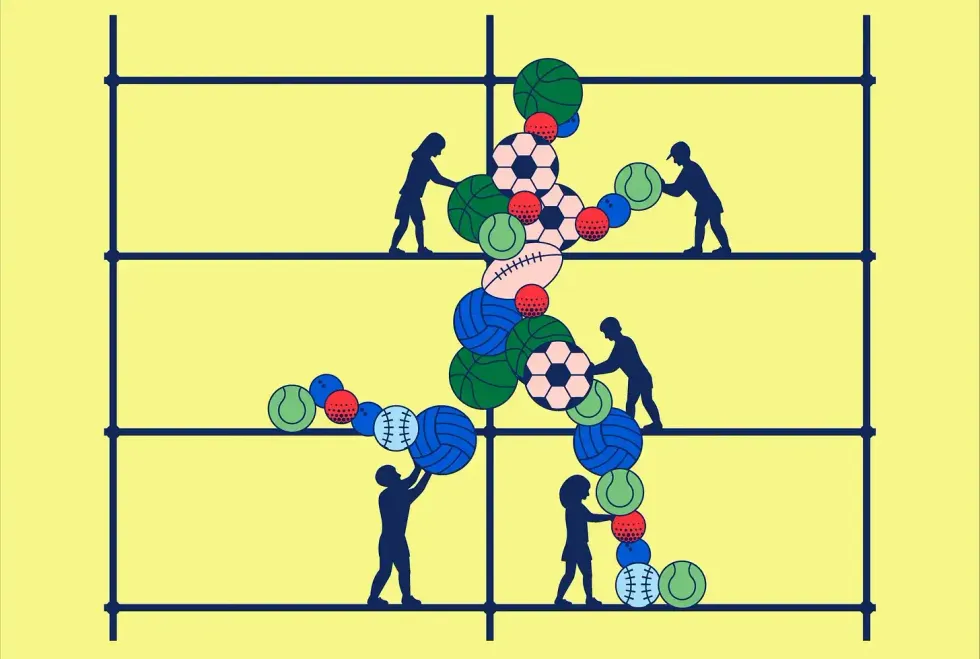 Following our HWF Civic Futures kickoff last week with Eric Liu, our design partners at Public/Official have created a unique visual to capture the “civic scaffolding” spirit of this conversation.
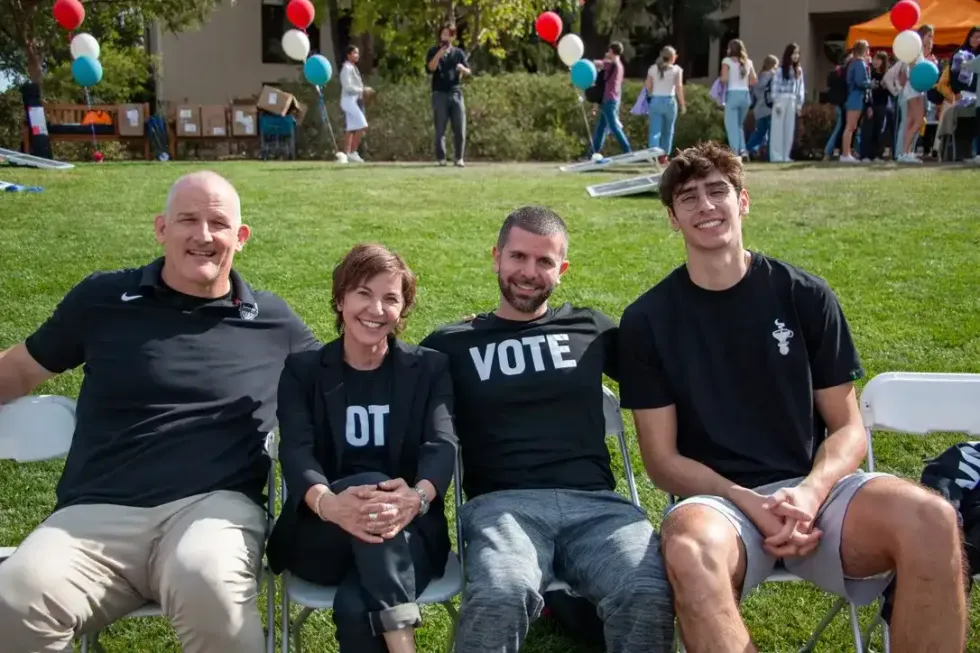 Lisa, Coaches Rev and Matt Elkin, and former Stanford Men’s Basketball star Maxime Raynaud at Stanford’s “All Vote No Play” Democracy Day, 2025