

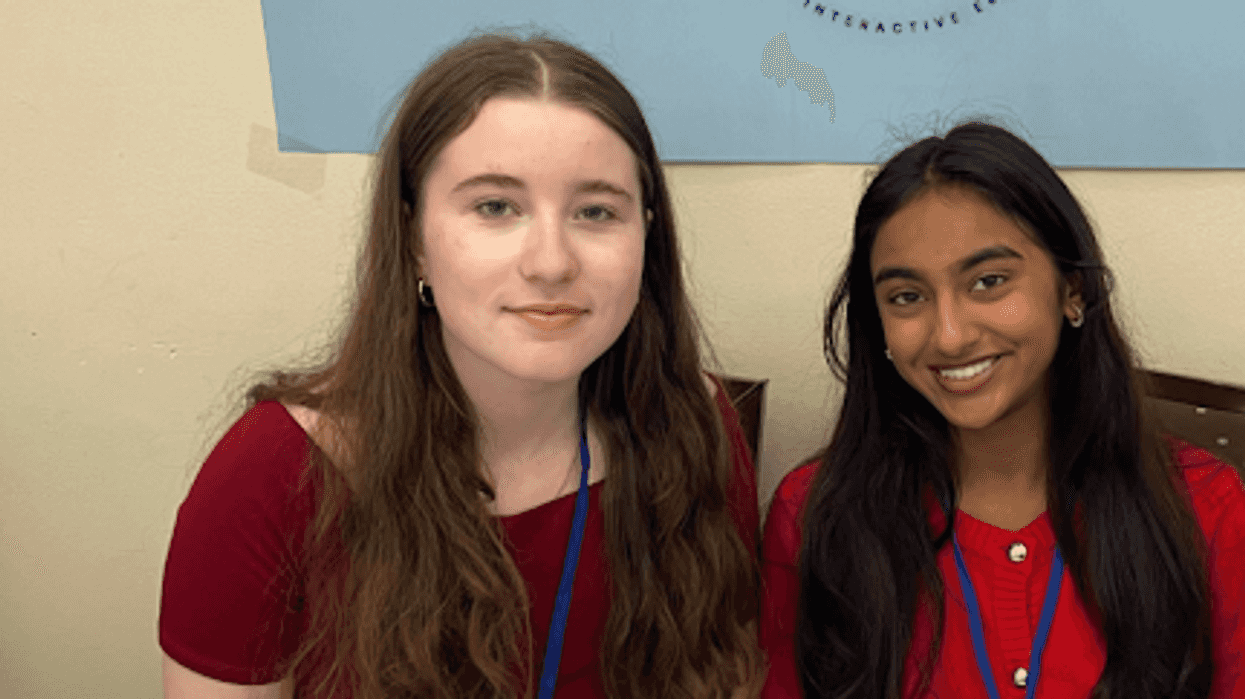
Emily Gorodetskiy and Anushka Kalyan both grew up in immigrant households, where language barriers and unfamiliarity with civic systems made voting feel overwhelming. When Gorodetskiy and Kalyan met in Civics Unplugged’s Civic Innovators Fellowship in 2024, the two, along with co-founder Jasmine Liu, bonded over their shared experiences as first-generation Americans and high school students who noticed that their peers also felt disconnected from the voting process.
After identifying this common interest in making the voting process more accessible to first-time voters, they launched VR’ing Democracy in April 2024, a virtual reality application built to make democratic participation less daunting, help citizens make informed decisions in elections, and alleviate the tech divide.
“Being first-generation Americans, we were united by the belief that democracy should be welcoming and accessible to everyone, not intimidating,” Gorodetskiy said. “We aimed to rethink civic education to meet people where they are. We use technology, storytelling, and hands-on learning to build confidence and promote inclusion.”
The project now exists in six U.S. states, California, New Jersey, Rhode Island, Virginia, New York, and Texas, plus Ghana and Pakistan. Each hub is led by a young person in their community who is passionate about harnessing technology to expand voter access.
After completing the Civic Innovators Fellowship, the team competed in a pitch contest hosted by CU, earning more than $2,000 for their project and gaining early validation of their concept. Then, in late 2024, the VR’ing Democracy team was named a recipient of the Civic Innovation Grant made possible by Civics Unplugged’s partnership with Macy’s. With this award, the team received $10,000 to expand their project.
“Participating with CU encouraged us to take a bold, creative approach to civic challenges,” Gorodetskiy said. She added that CU programming was particularly beneficial to the team as they got VR’ing Democracy off the ground.
“One of our biggest challenges was balancing our original goal of rapid expansion with the reality of limited funding, technical hurdles, and time constraints as student leaders. Instead of scaling too quickly, we shifted our focus to depth over breadth,” Gorodetskiy said.
“We strengthened local partnerships with organizations like the League of Women Voters, libraries, and schools. We addressed technical and accessibility concerns, such as sanitization, usability for elders, and visual adjustments, by listening closely to community feedback and changing our approach with the help of our mentors at CU. This shift allowed us to build trust, improve the experience, and create a sustainable grassroots model.”
As for growth and expansion, the VR’ing Democracy team plans to expand language offerings, improve state-specific simulations, and increase deployments at schools, libraries, and cultural events.
“Over the next one to two years, we aim to grow through a hub-based model. This will empower youth leaders across the country to run their own VRD programs with local content,” Gorodetskiy said.
“We also plan to develop new civic experiences, such as Know Your Rights modules and canvassing simulations. At the same time, we will strengthen partnerships with civic organizations, election offices, and universities to include VRD in long-term voter education efforts.
To Gorodetskiy and Kalyan, VR’ing Democracy is much more than a one-time technology project.
“VR’ing Democracy is a long-term community-driven effort to make democracy feel human, approachable, and inclusive,” Gorodetskiy said.
“Most importantly, VRD demonstrates what’s possible when young people combine lived experience with innovation to address systemic barriers. VRD is all about creating ripple effects that empower communities to participate confidently in shaping their future.”
VR’ing Democracy is actively looking for more team members, specifically Hub Leaders, a Social Media Manager, and a Web or App Developer. Interested applicants should email vringdemocracy@gmail.com.
This is the third in an ongoing monthly series highlighting the inspiring work of high school-aged civic innovators. Through the mentorship and guidance provided by Civics Unplugged, young people are provided the skills, mentorship, and community needed to create impactful solutions to the problems that matter most. Since Civic Unplugged’s founding in 2020, they have graduated more than 5,000 Fellows worldwide from our tuition-free programs and provided $1.5 million in direct funding to Fellows’ initiatives. To learn more, please visit civicsunplugged.org.









The President Invited Iran to Bomb My Home