





Constitution Day is September 17. In her Constitution Day Conversation with Fulcrum Contributor Rick LaRue, NYU School of Law professor and commentator Melissa Murray shares her appreciative yet critical perspective on the national government’s founding document. The interview has been edited for length and clarity.
Rick LaRue: Why do you think the Constitution matters today?
Melissa Murray: I read constitutional law’s underlying thread as: How do we create a government that is strong enough to be effective, but not so strong that it runs roughshod over the people and their rights? Even the original Constitution is a hedge against the prospect of government tyranny.
For example, my career started with family law, which involves constitutional provisions such as due process and equal protection. Two Supreme Court cases from the 1920s fascinated me because, while about parents’ rights, particularly in immigrant families, they highlighted a kind of pluralism conducive to democracy. These decisions surprised me given the nativism then prevalent in the country. They suggested that pluralism was an important hedge against tyranny. If citizens have different sources of allegiance and values, they may be skeptical when the state peddles its own orthodoxies. Such skepticism is essential to democracy.
RL: What compelled you to write your book, The U.S. Constitution: A Comprehensive and Annotated Guide for the Modern Reader?
MM: We live in a moment where we’ve divested civics education from our public schools, which seems inconsistent with the whole project of what the Constitution was meant to be about. We were supposed to be able to understand and grapple with it, which we can’t do if we’re not reading it.
I think the ultimate questions are: What’s the point of a constitution? Why was it written down? We have the longest surviving written constitution. A big part of why it was written down is that it was supposed to be read, debated, and grappled with by the people. In 2024, I talked with young people about the presidential election. Several women were angry about the current presidential administration. They were mad that Joe Biden had not done enough to curb police brutality, but ultimate control over law enforcement lies with local government. Separately, the rapper Luke Campbell was also attacking Joe Biden for things the president was not authorized to do under the Constitution’s Article II. So, it struck me that we had a whole generation of people who did not seem to understand how this document worked—through no fault of their own. That’s why I wrote this book.
“Almost from the start, the Constitution was determined not to be obsolete, but to be incomplete.”
RL: You highlighted the Populist Era. Can you elaborate on its relationship to constitutional change?
MM: Almost from the start, the Constitution was determined not to be obsolete, but to be incomplete; the Bill of Rights was ratified within a few years to remedy the document’s deficiencies in not providing explicitly for individual rights. The Reconstruction Amendments were spearheaded by the Reconstruction Congress after the American Civil War. Through judicial review and interpretation, the Supreme Court has changed the meaning of the Constitution. These recognized actors shape constitutional meaning, but we, the people, can do the same.
That is the most important lesson of the Populist or Progressive amendments. The 16th through 19th amendments were all driven by grassroots lobbying and activism. The 16th Amendment was born of an 1895 Supreme Court decision declaring a federal income tax to be unconstitutional. Because the Supreme Court said that Article I of the Constitution forbade Congress from levying a direct tax, the people—who wanted a progressive income tax to effectively counter regressive tariffs—began lobbying and working to amend the Constitution to allow it. They succeeded.
Then the people looked to the Senate, whose members were appointed by state legislatures. The people wondered why they could pick their representatives but not their senators. At the time, there was widespread corruption, with Senators being solicitous of the corporate interests that fed state legislatures. The people, drawing on that skepticism I mentioned, agitated, worked together, and ultimately succeeded in enacting and ratifying the 17th Amendment, which provides for the direct election of Senators.
The 19th Amendment involved the people playing the long game. Feminists were fighting before the Civil War to have women included in the Constitution. It didn’t work, but they didn’t give up. They ultimately enfranchised women through the 19th Amendment, the largest expansion of the electorate in this country's history.
RL: There are numerous constitutional challenges confronting us today. Is there one you think deserves wider public attention?
MM: Some might argue we have no shortage of constitutional crises at this moment. But what we do have is a shortage of lay constitutional scholars who are grappling with this document and asking questions—of the people who represent them, and about the Supreme Court’s defense of the Constitution.
There are big questions about people’s voices, minority rule, and the Supreme Court's role in a representative democracy. The question of the Electoral College warrants extensive discussion. Also, does partisan gerrymandering, for example, require a statutory fix or a constitutional amendment? We have no shortage of constitutional questions.
RL: Speaking of crises, if you agree that the nation confronts them, what makes today’s situation rise to a crisis level or levels?
MM: What sets this period apart, and indeed makes it a serious constitutional crisis, are not still-vital questions about voting rights or military deployments, for example. Rather, the crisis or crises stem from the structural considerations that make it easier for a single branch of government to exercise outsized power. When the Framers were drafting the Constitution, the idea was to divide the power of the federal government among the three coordinate branches, each with the authority to check the others, so that no single branch could become too powerful or tyrannical. Right now, we have a Congress that is relatively supine and may even be facilitating some of the most excessive impulses of the other branches. We have a Supreme Court that, for example, is using the shadow docket to decide many cases without transparency or explanation. This situation is not what the Framers had in mind. They saw the federal government as marked by constant tension among the different branches. If one branch pushed, the other branches would resist. We’re not getting that resistance.
That doesn’t mean there aren’t substantive issues that are or may be at crisis levels. The rolling back of voting rights is one because it limits the electorate. I think, too, the Framers would be quite concerned to see the National Guard being deployed to American cities for immigration enforcement.
RL: Can we amend the Constitution again?
MM: It’s hard to amend the Constitution. The two methods in Article V, only one of which has been used, are both difficult by design. If the people, acting as the nation, really care enough about foundational constitutional commitments to write them down, it should be hard to change them. If you think about what happened in the dark days after 9/11, when we were prioritizing public safety, we might have changed many things regarding civil liberties that would have gone against foundational principles. But we couldn’t, in part because it was hard.
And it is doubly hard now because of the electoral distortion in the landscape. For example, the fact that state legislatures are significantly gerrymandered makes it a lot harder to get 38 states to ratify something. We also tend to have amendments in bursts. The Bill of Rights addressed the deficiencies in the original Constitution's rights protections, the Reconstruction Amendments addressed the rupture caused by the Civil War, and the Gilded Age amendments addressed the rise of populism. Then we have the 20th Century amendments, many of which were spurred by episodic incidents that, like the Bill of Rights, revealed deficiencies in the original document. Our current period may become a moment that sparks interest in some form of amendment process, leading to a burst of civic attention to constitutional meaning, assuming we reach the other side of it.
RL: In terms of prospective amendments, which ones might top your list?
MM: It is hard to think about what would address the electoral distortions in the landscape while also preserving the Constitution without changing it all the time. My immediate go-to is the Electoral College. We should eliminate it and have a popularly elected president. If John Kerry had won the Electoral College but lost the popular vote in 2004, which would have occurred if he had won the state of Ohio, that could have spurred the appetite for amendment. I think DC statehood and Puerto Rico statehood are possible candidates, especially for DC. An amendment gave DC residents representation in the House, but by a non-voting delegate, and its citizens do get to vote in the presidential election. There should probably be an amendment that goes further to make it possible for DC to be fully represented, i.e., via statehood.
RL: So, Constitution Day. When and how did you first observe it?
MM: I was 12 before I realized there was a Constitution. I had seen “Schoolhouse Rock” I knew how a bill became law. I knew there were three branches of government, but I didn’t know there was a document that established them. In 1987, I became aware of Constitution Day and the Constitution because of its bicentennial. That big anniversary is how and why I learned about both. I was a 7th grader, and I knew there had been a bicentennial about the Declaration of Independence, but what was this one all about? There were all kinds of contests at school, and I actually won second prize in an essay contest about the document.
Such anniversaries are always moments of teeth-gnashing: Should we be more celebratory? Should we be more reflective? As we sit here at the 250th anniversary of the country’s founding, we’re weighing: Who are we? Where have we been? Where are we going? And maybe we’re not entirely sure of or satisfied with our answers. But I don’t remember that kind of angst around the Constitution's anniversary. It just seemed to be about our having done something, and despite the document’s imperfections, despite its flaws and gaps, it survived, and it got better because we made it better. If the 250th anniversary of the founding is only a reflection of how we are doing, and whether we are doing it right, maybe in 11 years, assuming we get there, we will be in a position to say, “Wow, we really made it. We made it to 250 years of this idea of limited government of, for, and by the people.”
RL: Thanks, Melissa. That’s a great way to close. Happy Constitution Day!
Melissa Murray’s book is available from 37INK, a Simon & Schuster imprint.
Rick LaRue writes about constitutional structure and amendments at Structure Matters.










 Scenes from Favela Rocinha, Brazil - (R-L) Rows of brick homes, Hugo Balta on a motorcycle taxi, and steep, winding roadsHugo Balta

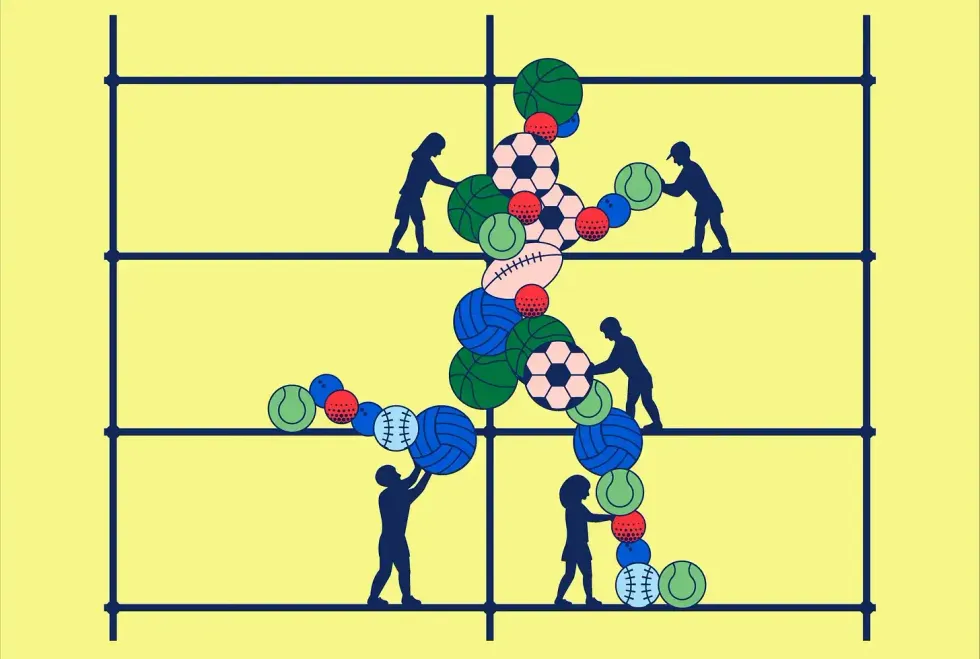 Following our HWF Civic Futures kickoff last week with Eric Liu, our design partners at Public/Official have created a unique visual to capture the “civic scaffolding” spirit of this conversation.
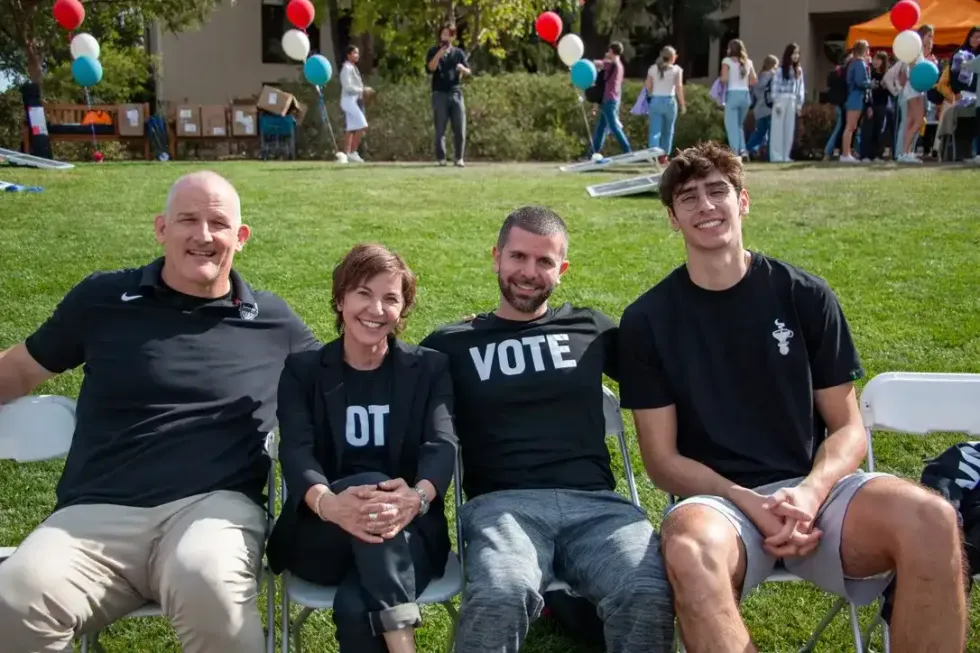 Lisa, Coaches Rev and Matt Elkin, and former Stanford Men’s Basketball star Maxime Raynaud at Stanford’s “All Vote No Play” Democracy Day, 2025