


Amid the political and military standoff among the United States, Israel, and Iran, it is civilians — the people with no say in these decisions — who bear the fear, disruption, and uncertainty of every strike and escalation. This week, The Fulcrum’s executive editor, Hugo Balta, reports from Israel with a single aim: to humanize the war by focusing not on the spectacle of Operation Epic Fury, but on the ordinary lives being reshaped by it.
JERUSALEM — In the heart of Jerusalem, and in Tel Aviv’s bustling Carmel Market, the sound of Spanish often mingles with the call to prayer, the chatter of vendors, and the hum of daily life. These are two of the most visible crossroads of Israel’s Latino diaspora — a community of more than 100,000 people whose presence is increasingly felt, even as many remain socially or legally invisible.
Often described as an “invisible community” due to rapid integration and limited political representation, Latin Americans in Israel are emerging as a cultural and linguistic bridge between the Jewish state and the Spanish‑speaking world. But beneath the surface of this vibrant mosaic lies a stark divide: while Jewish immigrants arrive with pathways to citizenship, thousands of non‑Jewish Latin Americans — including undocumented workers, asylum seekers, and trafficking survivors — navigate life in Israel without legal status, stability, or protection.
The Latino presence in Israel has deep roots. Since 1948, waves of Jewish immigrants from Argentina, Brazil, Mexico, and beyond have arrived seeking safety, economic opportunity, or a new “hogar.” Today, their children and grandchildren are revitalizing the community through grassroots initiatives. One such initiative is Kehila Latina, founded in Jerusalem in 2021. Born out of the isolation of the COVID‑19 pandemic, the group has hosted Spanish‑language Shabbat dinners, cultural events, and support networks for new immigrants (olim). For many newcomers, it became a “home away from home,” helping them navigate the complexities of Israeli bureaucracy, housing, and employment.
But Kehila Latina’s gatherings also revealed another reality: not everyone in the room has the same rights, the same security, or the same future.
The October 7, 2023, attacks by Hamas — a group responsible for severe harm, loss of life, and human rights violations — reverberated deeply across the Latino community. At least 15 Argentines were among those taken hostage, creating a painful and direct link between Latin America and the front lines of the war. “For the Jewish Latino community, this is personal,” said Rabbi Peter Tarlow, executive director of the Center for Latino‑Jewish Relations. “You can go to cities in Israel and hear lots of Spanish. Lots of people have relatives here.”
For undocumented workers and asylum seekers, the war that followed the attack brought a different kind of fear: not only rockets, but the risk of detention, deportation, or abandonment by employers.
A Hidden Workforce Under Strain
Since the 1980s, thousands of non‑Jewish migrants from Colombia, Ecuador, Peru, and the Dominican Republic have come to Israel, often through recruitment agencies that place them in domestic caregiving roles. Many arrive legally but fall out of status due to changes in employers, contract violations, or bureaucratic hurdles. Their stories rarely make headlines — yet they form the backbone of Israel’s elder‑care system.
One of them is a woman from Colombia who has lived in Israel for 4.5 years. She asked not to be named due to her undocumented status, but she agreed to share her experience. “The job opportunity and the economic situation in my country led me to live here in Israel for four and a half years,” she told The Fulcrum. “The experience has been very beautiful; I’ve learned a lot. But in the beginning, it was very hard. The cultural shock is huge, and I didn’t know the language.”
Like many caregivers, she entered a household where she was responsible for an elderly patient around the clock. “It was even more difficult for me because I don’t speak English. Getting used to living with a family where they leave all the responsibility for the patients to you, 24/7, sometimes without any rest — it was very, very hard.” She worked as a metapel — a live‑in caregiver — for three years before quitting. “Honestly, I never got used to it. The company we come with leaves us alone; we don’t have real support or a true safety net. Everything depends on what the family says, and they leave all the responsibility for their father or mother to us. It shouldn’t be that way, but well… that’s how it is.”
Her story echoes those of many undocumented Latin American workers who face long hours, isolation, and limited legal protections.
According to Sigal Rozen, Public Policy Director at the Hotline for Refugees and Migrants, the situation for migrants, asylum seekers, and trafficking survivors has deteriorated sharply since October 7. “The number of legal migrant workers doubled to 230,000 since the beginning of the war,” Rozen explains. “You probably found it already, but if you didn’t, you can read about the infractions of the workers’ rights in Kav LaOved’s excellent report Spare Parts.”
“Spare Parts” is a research and advocacy project by Kav LaOved that documents how migrant workers in Israel’s caregiving sector are treated as disposable labor, often denied basic rights, protections, and dignity. The project highlights the experiences of workers who care for elderly and disabled Israelis but face exploitation, excessive workloads, illegal recruitment fees, and a system that prioritizes employers’ needs over workers’ humanity.
But the most urgent crisis, Rozen says, unfolded inside Israel’s detention system. “The immigration authority refused to release migrants detained for deportation even though there were no flights and no possibility to deport them,” she says. “They had no shelters in the prisons, and they were risking their lives.” Despite repeated appeals during both the first and second war with Iran, Rozen says, the policy never changed. “They refused to consider the release of those migrants under any conditions until their deportation becomes possible.”
Labor exploitation has also intensified. Kav LaOved’s Spare Parts report details widespread violations, including illegal recruitment fees, withheld wages, and unsafe working conditions. Access to services collapsed as well. “Just like all of us, Israelis, migrants also suffered from the fact that the vast majority of services were closed or not functioning,” Rozen notes.
With government support limited, migrant communities organized their own survival networks. In southern Tel Aviv — home to thousands of asylum seekers and migrant workers — residents faced the longest war in Israel’s history with no shelters. “While one could hide from Hamas and Hezbollah’s missiles in a staircase during the two wars with Iran, this was not possible,” Rozen explains. “It was clear that it was not safe.”
A Filipino‑led grassroots group, UCI (United Children of Israel), stepped in. Caregivers transformed the massive underground shelter beneath Tel Aviv’s Central Bus Station into a livable space. They cleaned it, brought equipment, and built a makeshift “tent city” where families could sleep safely during missile barrages. It was one of the only large‑scale protection efforts available to migrants.
Rozen says the government’s response has been inconsistent. On one hand, there were moments of recognition: “We were pleased to discover that foreigners whose houses were demolished by a missile were evacuated exactly like their Israeli neighbors,” she says. “Those who were injured were taken to a hospital. And the families of foreigners who were killed by missiles were treated like the families of Israeli victims.” But beyond these emergency measures, she says, the broader needs of migrants and asylum seekers remain unmet. “The needs of all Israelis, as well as the needs of foreigners, have been badly neglected during these long years of war.”
Despite these challenges, the Latino diaspora — documented and undocumented, Jewish and non‑Jewish — continues to shape Israel’s cultural and diplomatic landscape. Organizations like ILAN (Israel + Latin American Network) and Fuente Latina are working to amplify the community’s voice, recognizing the growing influence of Hispanic populations worldwide, especially in the United States. They see Latin Americans in Israel as potential ambassadors who can strengthen ties between Israel and the Spanish‑speaking world.
As Israel moves into 2026, the Latino diaspora remains a vibrant, complex, and often overlooked part of the national mosaic. Their stories — from Shabbat dinners in Jerusalem to 24‑hour caregiving shifts in Tel Aviv to makeshift shelters under the Central Bus Station — reveal a community that is deeply rooted, resilient, and increasingly essential to the country’s social fabric. Their voices, once quiet, are now beginning to be heard.
Hugo Balta is the executive editor of The Fulcrum and the publisher of the Latino News Network.
Coverage of this report was made possible in part with support from Fuente Latina.
Latin America in Israel: A Diaspora Tested by Conflict was first published on Latino News Network and was republished wirh permission.










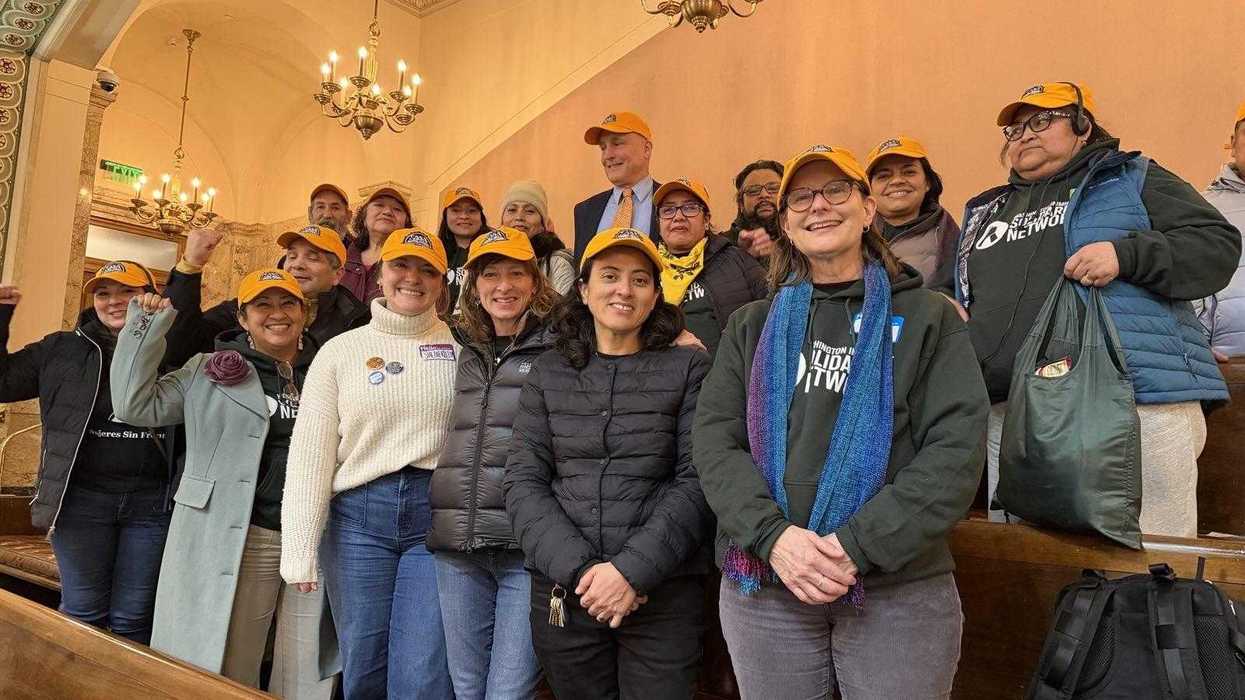
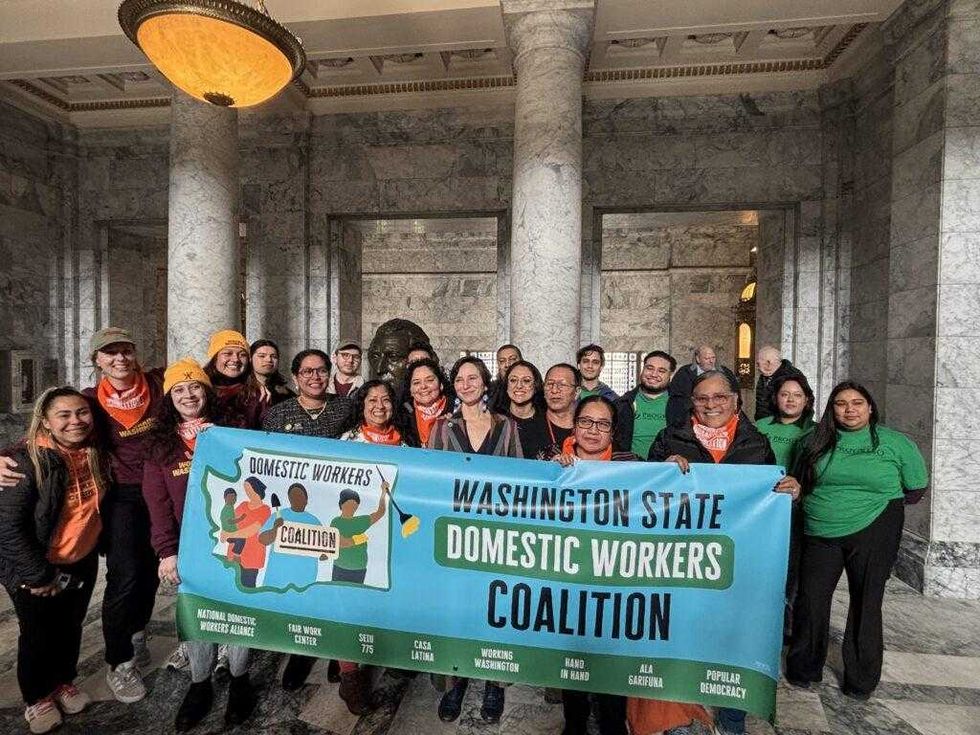 State Sen. Rebecca Saldaña, center, stands with members of the Washington State Domestic Workers Coalition at the state Capitol on Feb. 28, 2026. The Domestic Workers Bill of Rights passed in the House that day, before being signed into law in March. (Photo courtesy of Casa Latina)