



At first glance, 2025 was not a very good year for the movement to end the death penalty in the United States. The number of executions carried out this year nearly doubled from the previous year.
High-profile killings, like those of Rob Reiner and his wife, made the question of whether the person who murdered them deserves the death penalty a headline-grabbing issue. And the Trump Administration dispensed its own death penalty by bombing boats of alleged drug smugglers.
But if we look beneath the surface, we can see developments in 2025 that signal trouble for America’s death penalty. We can see signs of what I call a democratic erosion in this country’s attachment to capital punishment.
To put it another way, the death penalty is dying from the bottom up, democratically.
It has long been recognized that the death penalty and democracy are incompatible. Democracy, so the argument goes, is more than majority rule. As I have argued elsewhere, “Demands allegiance to ideals of human dignity and equality that are its animating purposes. In my view, any decision that violates those principles is incompatible with democracy….(which) demands that citizens and their government respect the inherent equal worth of each person.”
Fifty years ago, Supreme Court Justice William Brennan said, “a punishment must not be so severe as to be degrading to the dignity of human beings.” The death penalty, he wrote, treats “members of the human race as nonhumans, as objects to be toyed with and discarded….(It is) thus inconsistent with the fundamental premise…that even the vilest criminal remains a human being possessed of common human dignity.”
A long time before Brennan wrote those lines, as I explained, the philosopher John Dewey argued that democracy “Is more than a form of government: it is primarily a mode of associated living, the conjoint communicated experience…. Democracy,” he continued, ”is a way of life controlled by a working faith in the possibilities of human nature.”
The death penalty is a betrayal of that faith.
It assumes we can know with certainty the value and worth of any human life. And when the state sentences someone to death, it claims to know that the condemned person, and no future version of that person, can be worthy of redemption. If Dewey is correct, a person cannot lose or forfeit her worth through indecent conduct or even the most reprehensible behavior.
If we look at what happened to the death penalty in 2025, it seems that Americans are coming around to that view.
The Death Penalty Information Center’s end-of-the-year report offers compelling evidence for that proposition. It acknowledges the spike in executions but points out that “Public support for the death penalty has fallen to a five-decade low (52%) and recent Gallup polling reveals that less than half of U.S. adults ages 18 through 54 now support the death penalty.”
As the DPIC notes, “Support for the death penalty…has been declining since 1994, when support reached a high of 80%. This year’s number is the lowest since 1972…. Gallup also found that 44% of Americans now oppose the death penalty — the highest level of opposition recorded since May 1966. Opposition to capital punishment has been increasing since the 1990s, and has more than tripled since 1995, when only 13% of Americans opposed the death penalty. “
Most importantly, “just 41% of people 18 to 34 years old now support the death penalty. This difference marks a significant drop in support over the past 15 years. For example, Gallup’s 2011 poll found 62% of people 30 to 49 years old and 52% of young adults 18 to 29 years old favored the death penalty.”
These findings suggest that in the future, as older people whose attachment to the death penalty may be rooted in an earlier era die, the public’s overall attachment to capital punishment is likely to weaken. As it does, political leaders will have even more room than they do today to curb or end it.
Jury verdicts offer another important indicator of the death penalty’s democratic decline in 2025. Jury service offers citizens the opportunity to make their voices heard in a direct way.
As Professor Maxwell Chibundu explains, “The jury process affords citizens an unparalleled opportunity to participate directly in the process of self-governance. In the courtroom and its precincts, an otherwise indifferent citizen is made to confront the responsibility of evaluating the conduct of her fellow citizens, familiarizing herself with the legal rules and norms of our society, gauging governmental conduct, and ultimately calling the parties to account for their conduct.”
Because juries are drawn from a cross section of the population, “the composition of the jury and its verdict are…microcosms of the larger society.” That is why what juries do helps gauge the extent and depth of popular support for the death penalty.
And what did juries in capital cases do in 2025?
As the DPIC reports, “Fewer than half of the more than 50 capital trials that reached the sentencing phase this year resulted in a death sentence. “ The total number of new death sentences was 22.
Those new death sentences were handed down in just five states. 2025 is, the DPIC says, “the fifth year in a row with fewer than 30 people sentenced to death in a single year and the eleventh year in a row with fewer than 50 new death sentences, demonstrating the growing reluctance by juries to impose death.”
It highlights the fact that “in the two states where prosecutors most often sought the death penalty, Alabama and Florida, juries were markedly reluctant to reach a sentence of death. In Alabama, only one-fifth (4/20) of death-qualified juries recommended death sentences. In Florida, half (6/12)2 of death-qualified juries recommended death sentences.”
When Americans are asked to do the work of deciding whether a particular defendant convicted of a capital crime should be executed, they are increasingly likely to say no. This is all the more significant as a way of registering democratic dissatisfaction with the death penalty because only people who have no conscientious objection to capital punishment can serve on juries. That means that opponents of the death penalty do not get to serve on capital juries.
The more that people see the death penalty up close, the less likely they are to endorse its use. That is why jury verdicts provide indicators of an erosion of the death penalty in this country, rooted in democratic practices.
Whatever their general views about it, jurors are having a harder time than ever in seeing it as an appropriate punishment, even for those who commit gruesome crimes.
Writing almost twenty years ago, the political theorist George Kateb argued that “the spirit of democracy” could not be reconciled with a “zeal“ for harsh punishment. 2025 suggests that Americans’ zeal for one form of harsh punishment, the death penalty, is waning.
There is a real prospect that this country can end it through democratic means. And our democracy will be better for it.
Austin Sarat is the William Nelson Cromwell professor of jurisprudence and political science at Amherst College.







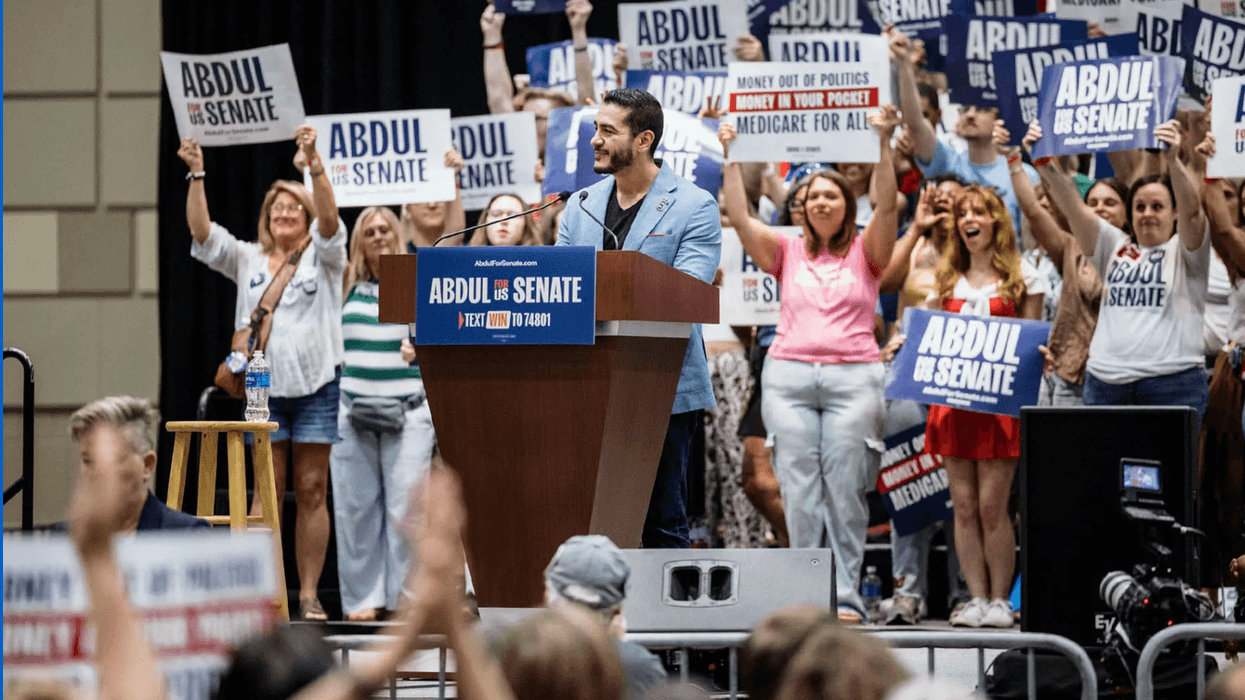
 Rep. Haley Stevens speaks at the Michigan Democratic Party Endorsement Convention in Detroit, Michigan on April 19, 2026. (Andrew Roth/SIPA/AP)
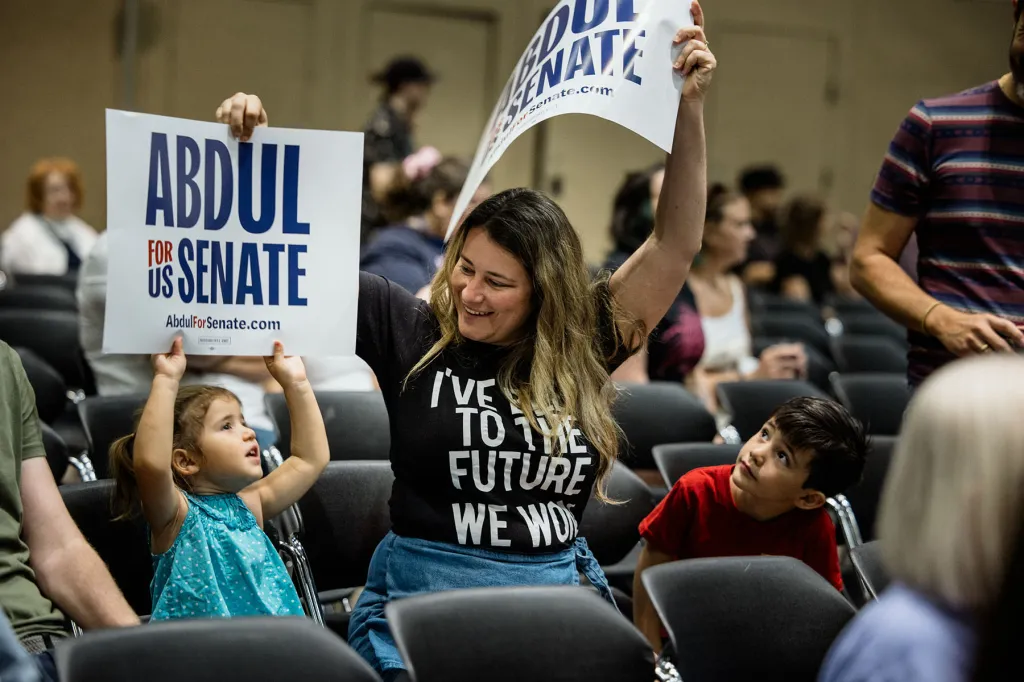 Cecelia Terraza, 36, and her children, Maya, 3, and Rio, 5, hold signs during a rally for Dr. Abdul El-Sayed in Lansing Center, Michigan on July 19, 2026. (Rosem Morton for The 19th)
 Rep. Haley Stevens talks to women working on the line as she tours the Webasto Plymouth Plant on May 1, 2026 in Plymouth, Michigan. (Sarah Rice/Getty Images)
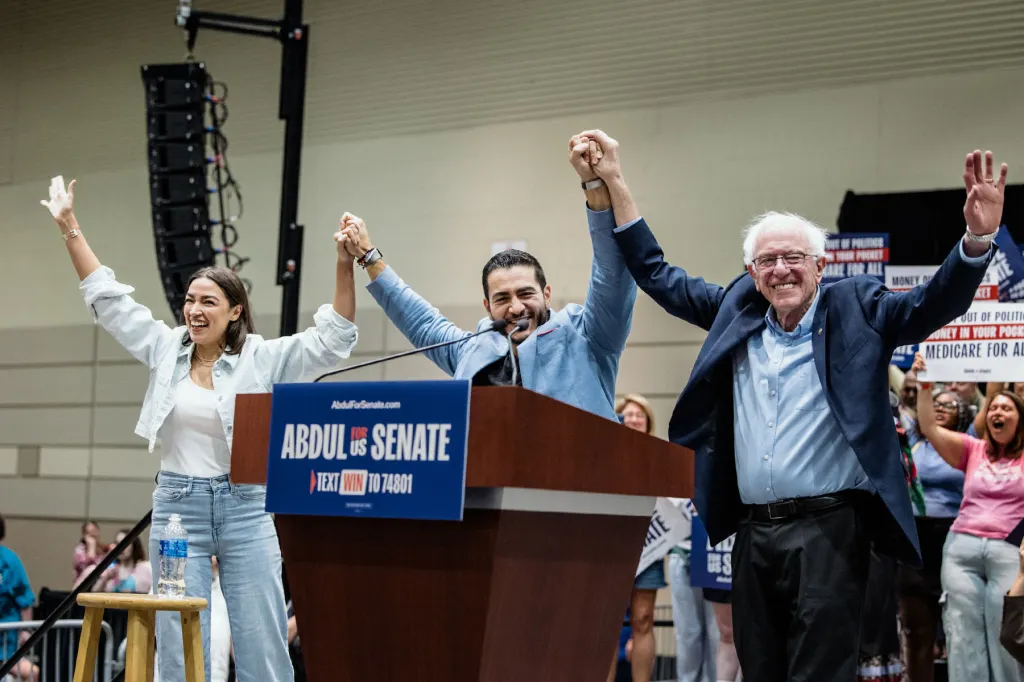 The crowd cheers as Rep. Alexandria Ocasio-Cortez, Senate candidate Dr. Abdul El-Sayed and Sen. Bernie Sanders raise their hands during the “People vs. the Powerful” rally at the Lansing Center in Lansing, Michigan, on July 19, 2026. (Rosem Morton for The 19th)