



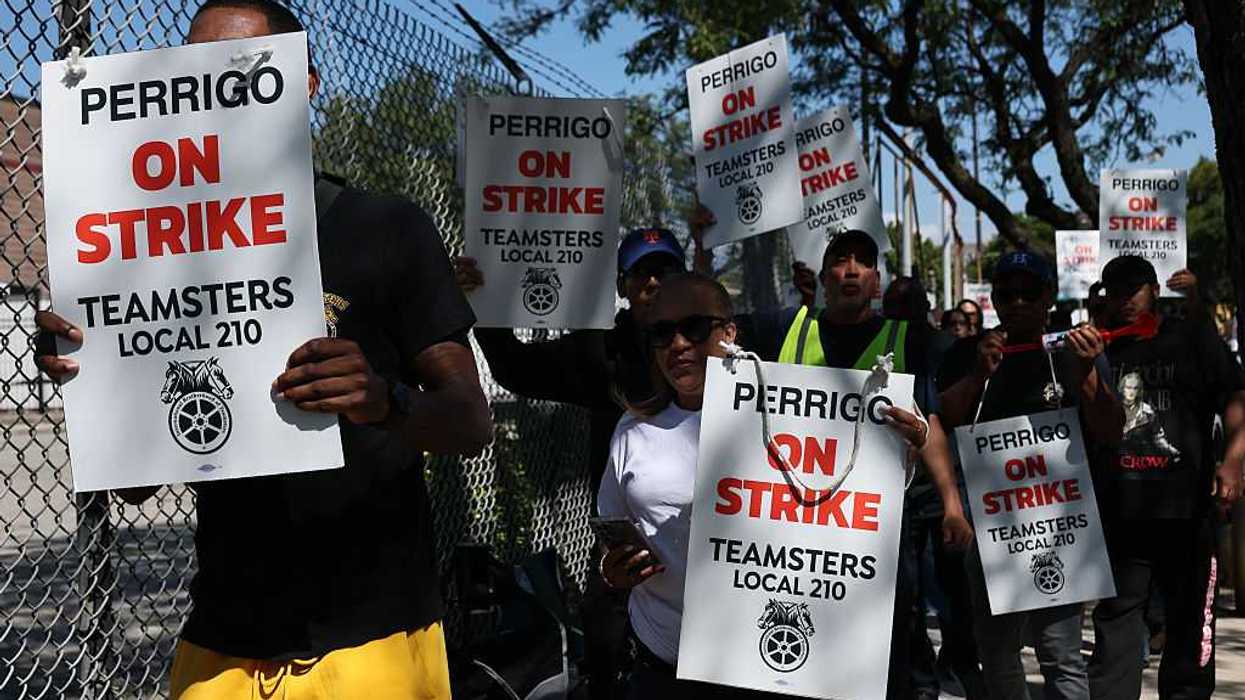

The country is in an era of work stoppage, strikes, and walkouts in response to severe pay concerns during an economic crisis of rising prices. However, these labor actions represent more than financial grievances. Contract negotiations are also an opportunity to consider the collective well-being.
Tenure line faculty and staff at my institution, the University of Illinois Springfield, continue to strike for wages and basic protections around our work.
The Economic Policy Institute reports, “Bureau of Labor Statistics (BLS) show that 306,800 workers were involved in 30 major work stoppages in 2025, a 13% increase from 2024.”
The recent TSA work stoppage is resolved, as the White House began making payments to more than 60,000 TSA workers after Congress failed to pass funding for the Department of Homeland Security.
But the uprisings in the meatpacking and poultry processing industries are a testament to the historic and ongoing struggles for human and animal liberation.
In Colorado, 3,800 unionized employees at the JBS Swift Beef plant in Greeley returned to work after a three-week strike, with no resolution or new contract. It was the first meatpacking strike in this country in 40 years.
Meanwhile, the USDA continues to push 2025 proposals to increase line speeds in meatpacking plants across the nation in an effort to lower grocery costs, even as factories are burdened by excess slaughter capacity.
This is despite concerns about worker safety and compromising on necessary safety inspections, within a factory farming industry that apparently has little regard for the cruelty it inflicts on the lives of animals meant for slaughter.
As a professor of English literature with a focus on critical ethnic studies and animal studies, I examine contemporary slaughterhouse narratives. Investigative journalism like Charlie LeDuff’s 2000 work on slaughterhouses, and Michael Grabell’s 2017 exposé on chicken plants have documented the ways in which dangerous meatpacking jobs are often left for migrant and inmate populations.
Yet these reports leverage a familiar and largely uncontroversial position—that humans (especially, in this context, people of color) should not be treated like animals. Or, as LeDuff writes, “You hear people say, ‘They don’t kill pigs in the plant, they kill people.’”
In this sense, inhumane treatment of workers is perceived to be a separate issue from the conditions of nonhuman animals.
Michelle Rojas-Soto, a member of the farmed animal protection movement, argues in a 2020 essay that a single-issue focus on animals, too, will do little to ultimately engender an equitable model of agriculture. She writes that speciesism and racism are interconnected nodes of oppression that reveal “the manifestation of our commitment to inequity.”
In my research, some authors of color tend to lean into this “entangled web” of oppression rather than shying away from it. Sesshu Foster’s speculative 2005 novel, Atomik Aztex, features a Chicano migrant laborer in Los Angeles who works as a pig butcher at Farmer John’s Meat Packing Plant, where a labor union is being organized, much to the dismay of the managerial class.
When I first came to central Illinois, I learned about Beardstown, once a sundown town where the local hog slaughterhouse sought to boost productivity by creating a second shift comprised almost entirely of newly arrived laborers from Mexico in the 1990s.
The plant went on to welcome migrant labor from West Africa, Asia, and Haiti. However, the prevailing narrative that immigration “saved the pork plant and, with it, Beardstown,” ushering in a celebration of diversity is incomplete.
In 2015, Cargill sold its entire swine and pork business to JBS USA, including the pork packing plant in Beardstown. It is nonsensical then to laud immigrant workers in Illinois when the same company was met with chants of huelga (strike) in Greeley, Col. during the first walkout at a U.S. beef slaughterhouse since 1985.
Disconnecting labor conditions from the conditions of animal life in the abattoir or slaughterhouse is absurd.
Yes, a hyperfocus on addressing any one form of oppression runs the risk of making progress at the expense of other vulnerable groups.
In Ruth Ozeki’s 1998 novel, My Year of Meats, the protagonist considers the impact of “bad knowledge” in the face of industrial slaughter, that “ignorance is an act of will, a choice that one makes over and over again, especially when information overwhelms and knowledge has become synonymous with impotence.”
Since the publication of Upton Sinclair’s famed 1906 novel, The Jungle, it has only become easier to remain willfully ignorant, as the centralized locality of Chicago stockyards in the early 20th century have been replaced by large-scale factories meant to be invisible to the public eye.
As part of a collective, however, it is possible to imagine futures free from subjugation and exploitation for all actors. This is what people can learn from animals, through whom, as Dr. Joshua Bennett argues in a 2020 essay, a “radically different set of relations is possible.” Today’s wins must be steps toward deeper, transformative change.
U.S. working conditions are in the spotlight for good reasons.
Tenure-line faculty at UIS are on strike for better working conditions because they yield better learning conditions for students.
If workers in the meat and poultry industries do not recognize the link between ethical treatment of animals and themselves, there remains little hope for systemic change that seeks to live with, not against, the nonhuman life.
Akash Belsare is an assistant professor of English at the University of Illinois Springfield and a Public Voices Fellow with The OpEd Project.














The President Invited Iran to Bomb My Home