


In South Florida, recent local elections have demonstrated a significant recalibration of the Latino vote, almost two years after the 2024 Presidential election.
A March 2026 poll from Florida International University’s Latino Public Opinion Forum (LPOF) — which uses web surveys and phone banking to collect data — shows that over 66% of Latinos disapprove of President Donald Trump.
Eduardo Gamarra, who founded the forum 12 years ago and works as a professor in the Department of Politics and International Relations at FIU, shares that, although the survey doesn’t reflect an opinion following recent tensions with Iran, it still demonstrates an “absolutely negative” national sentiment among Latinos.
“On the approval, he's down 36 points. And on the congressional ballot, the democrats are up by almost 30 points. And the democrats are up on the presidential ballot by 28 points,” Gamarra said.
In Palm Beach, Emily Gregory, a first-time Democratic candidate who ran for FL State House 87, defeated Republican Jon Maples by a 2.4% margin in a special election triggered after Republican Mike Caruso vacated the seat in August 2025 to become the Palm Beach County Clerk of the Circuit Court and Comptroller.
Caruso represented District 87 for three years, previously representing District 89, which was renumbered in 2022. Caruso won his 2024 election with a 19-point margin over Democratic candidate Sienna Osta.
Gamarra believes that Gregory’s win isn’t a coincidence. He believes it demonstrates the broader national shift reflected in the LPOF survey.
“Something is happening, and for us, really, one race does not make a realignment, certainly right. But I think you know several of these are a sign of what appears to be happening,” Gamarra said.
These recent polls and election results represent a significant shift away from the sentiment expressed by Latinos in the 2024 congressional and presidential elections.
The Americas Society/Council of the Americas (AS/COA) suggested in a November 2024 article that Trump “may have broken a Latino voting record for a Republican candidate.”
Barbara Casanova is the national secretary and membership chair for the Republican National Hispanic Assembly, a political organization seeking to promote Hispanic-American issues and interests within the Republican Party, according to the organization’s website.
Casanova explains that this initial shift towards Trump amongst the Latino electorate can be attributed to Trump’s strong personality and his emotional resonance with voters. She shares that, as we near two years into Trump’s presidency, voters must come to terms with the fact that this election won’t be like the last one.
“But in 2028, we're not going to have a Trump. We don't know who our presidential candidate will be. There's talk, there's rumors, there's stories, but we can't, we can't sit there's not going to be this beacon of issues and ideology that's going to really resonate necessarily,” Casanova said. “So it's how we look at what the actual issues are that are affecting the Hispanic community.”
However, the Latino bloc as a whole did not solely shift towards the Republican Party in 2024. Casanova shares that although voters saw an uptick in support for Trump, they also backed Democratic House and Senate candidates.
According to Sabato’s Crystal Ball, a nonpartisan political analysis newsletter at the University of Virginia's Center for Politics, 13 Democrats in Trump-won districts were elected to congressional seats in states such as California, North Carolina, and Texas, compared to only three Republicans in districts won by Democratic Candidate Kamala Harris.
Casanova interprets these results as reflecting the irregular voting patterns across different Latino groups. She shares that issues that may seem important to the Latino electorate actually aren’t.
“I find that strongly Hispanic voters, citizens or residents that come here and have gone through the process believe in legal immigration, what they feel about,” Casanova said.
In the LPOF’s findings, this idea is also clear. Gamarra explains that the sentiment is not in support of loosened migration rules, but rather sensible ones.
“They want an immigration policy that makes sense,” Gamarra said. “They want the borders to be secure, right? Which sounds like they're Republicans, right? Except, they have a very low opinion of ICE, and they have an even harsher opinion of ICE’s tactics.”
Gamarra refers to an uptick in deportations by Immigration and Customs Enforcement, or ICE. A 2025 poll from the Kaiser Family Foundation (KFF), a nonpartisan nonprofit health polling and policy organization, and the New York Times, revealed heightened fear and anxiety regarding the presence of ICE in local communities.
Sheyli Tomas-Sales, a sophomore at Florida Atlantic University in Boca Raton, Fla whose parents are Guatemalan immigrants, voted for the first time in the 2024 election for Harris — a decision she says was largely influenced by the GOP's rhetoric on migrants. She explains that, going into the upcoming elections, immigration enforcement remains a top issue on her ballot.
“Immigration, to me, is a big part of not only who I am, but kind of my representation,” Tomas-Sales said. “Both of my parents are immigrants, so it was very hard to see how [Trump] being in office affected my parents, and now going into these midterm elections, from what I've seen and what has happened so far in just these two years, I do still stand by my vote.”
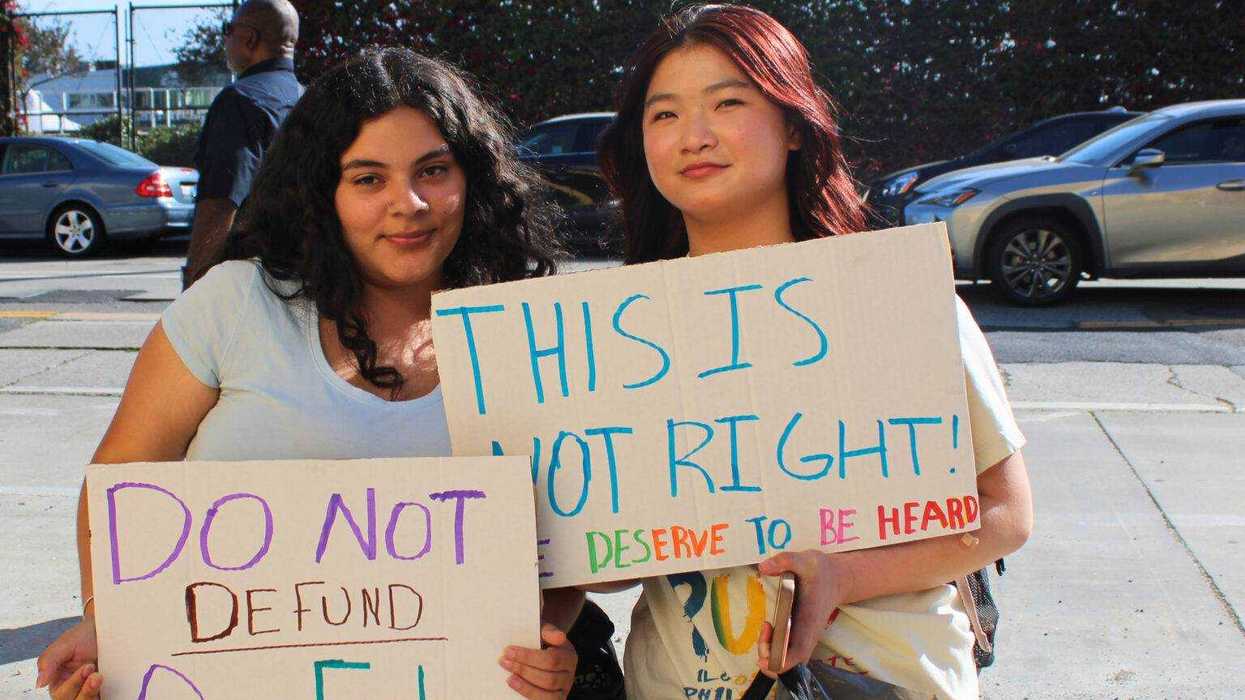
Tomas-Sales shares that as midterms approach, she has seen a surge in political activism and people in her community using their voices to express political ideals. In Boca Raton, various protests regarding ICE have shaken the local community.
“Not only are they opening their eyes to what's going on in their own community, but they're also seeing how other communities are being affected,” Tomas-Sales said.
Gamarra believes that other issues affecting the Latino community include affordability and the economy.
“The top issue is the economy, and that's to be expected. Now, if you consider what's happened in the last month, with the cost of gasoline shooting up and the prices of the supermarkets shooting up as a result, this result is likely to be to be worse,” Gamarra said. “Latinos seem to be more affected directly by these kinds of issues than other groups.”
Gamarra believes that one of the most important highlights from recent polling is Latinos’ emphasized move away from more extremist beliefs, such as those influenced by MAGA stances, or those emphasized by President Trump and his allies.
He believes this shift is encouraging many Republican candidates to adopt more centrist rhetoric. Gamarra specifically points to incumbent candidate Maria Salazar, a Republican representing State House 27, who has openly supported President Trump.
“She seems to be running nervous, and because she is, on the one hand, a very staunch supporter of the President, but has had to really, kind of play this game of where she says she's very, very much in favor of the President, etc. But then, she's had to take positions that appear to contradict the president,” Gamarra said.
As elections pass and new ones approach, Casanova believes that effectively communicating with the Latino electorate and providing consistent messaging across party lines are necessary.
“I think it's hard to say what's going to happen in the midterms. It's going to be an interesting election, but more than interesting, I think it's going to really be a reflection of what we can expect perhaps in the next presidential election,” Casanova said.
Gabriela Quintero is a High School senior at Florida Atlantic University High School and will be attending Barnard College at Columbia University in the fall to pursue her B.A. in Political Science and English. Interested in politics, migration, policy, and culture, she hopes to pursue a career in political and cultural journalism.