





Darcy Hood mailed her voter registration application to the Tarrant County elections department in July, after she turned 18.
Months later, her application still hasn’t been processed. And it’s unclear when it will be.
With the Oct. 6 deadline to register to vote in the November constitutional amendment election approaching, tens of thousands of Texans are in the same situation, waiting in suspense for their applications to go through, a process that normally takes a few days or weeks.
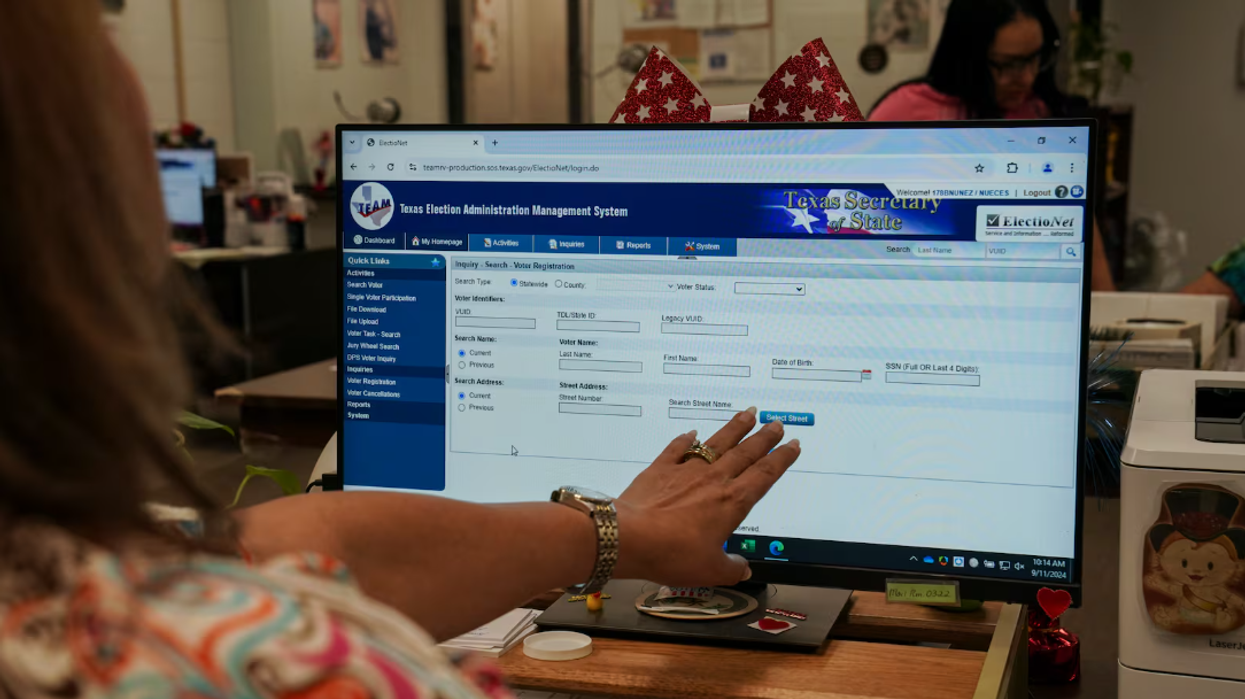
In interviews, private conversations, and emails, county elections officials from across the state point the finger at the state’s voter registration system, known as TEAM, which has long had functionality problems. They say that after the software was overhauled in July, the problems began proliferating: Voters’ previous addresses override their new ones, their voting precincts don’t populate correctly, and sometimes the registration information doesn’t save at all.
“One day it works and we can get stuff done, and the next day it doesn’t and nothing gets done,” said Pam Hill, the elections administrator in San Patricio County. “That’s the trend right now.”
The executive board of the Texas Association of County Election Officials met on Sept. 2 with Christina Adkins, the state’s elections division director, and Deputy Director Kristi Hart to discuss the problems. In an email sent afterward to association members and obtained by Votebeat, the board said it “unambiguously stated the level of frustration from our members” regarding the need for clear guidance and training, the absence of which “has placed unexpected burdens and stress on our members.” The board said it would begin offering some training and peer support itself.
The Texas Secretary of State’s Office said it anticipated some technical issues with this “once-in-a-decade upgrade.” Adkins told election officials this month that many of the problems stem from county officials not knowing how to use the updated system.
But several county election officials said the system didn’t work well during training sessions earlier this year, which limited opportunities for hands-on testing.
Meanwhile, the unprocessed registration applications keep piling up. Hood’s application is one of around 13,000 that Tarrant County election officials say are pending state verification. Travis County says it has more than 12,000 applications that need to be processed, and Bexar County has more than 40,000. A Texas voter whose application was received on time but not processed by the time of the election can still cast a provisional ballot, but there’s a risk those ballots won’t be counted.“
I hate that our voters are going through this, and it’s through no fault of their own,” said Clinton Ludwig, the Tarrant County elections administrator. The voters are doing what they’re supposed to do, and we’re also trying to do what we’re supposed to do.”
Heather Hood, Darcy’s mother, told Votebeat that for weeks she has called Tarrant County and state officials seeking answers about her daughter’s application. An official with the Texas Secretary of State’s Office told her last week “to be patient.”
“It’s so frustrating to be placated, and they’re telling me to be patient when they are the ones who have put this system into place and it is not working correctly,” Heather Hood told Votebeat in a phone interview.
State officials say they’re responding to concerns
State officials have pushed back on some of the counties’ complaints. “There is a difference between a county saying this doesn’t work and a county saying, I don’t know how to do this,” Adkins, the state election director, said in a Sept. 17 video call with local election officials that was recorded by the state and shared with Votebeat. “We want to really make sure that we’re drilling down on the things that are issues versus areas where you need more training.”
In statements to Votebeat, the Texas Secretary of State’s Office said that the rollout of the updated version of TEAM is a multi-stage process, and that the office has “planned accordingly.”
The task involves “migrating more than 20 million records and training more than 2,500 users,” the office said. “Technical issues are to be expected with a rollout of this size, and that is why we chose this constitutional election cycle for this transition.”
“We are working long hours to help our counties prepare for the November election and upgrade to a new version of TEAM that will ultimately result in more efficiently managed elections,” the office said.
The state and the vendor that developed the system “continue to respond to issues and concerns,” the office said.
The Secretary of State’s Office has assigned 30 employees to work directly with counties to train them and answer technical questions about the new system, the agency said, three times as many as it had in the previous TEAM update.
“As we are in the middle of a once-in-a-decade upgrade of the state’s voter registration system, our focus right now is on supporting counties in preparation for the upcoming election,” the agency added. “Any verdict on the new system is far too premature at the moment.”
Counties have long had issues with TEAM
TEAM — the Texas Election Administration Management system — has been around since the early 2000s, and earlier iterations prompted many complaints from election officials. The state improved the system over the years and launched a complete overhaul in July, but election officials say it is falling short of the promises that officials from the Texas Secretary of State’s Office made to election officials and state lawmakers.
The system was developed by Louisiana-based vendor Civix. All but 15 of the state’s 254 counties rely on TEAM to plan elections and maintain their voter rolls. Even counties that use software from one of two state-approved private vendors to manage their voter rolls are required by state law to sync their data with TEAM daily, and have to use TEAM to verify a voter’s identity and their eligibility to cast a ballot.
Election officials across the state have been complaining for months about struggles with the latest TEAM iteration, and at least 10 county election officials interviewed by Votebeat said the issues are preventing them from completing essential tasks.
“Some of (the problems) get corrected, and then a few days later, they’re not working again,” said Hill, the San Patricio County elections administrator.
She said her staff in the South Texas county, which has roughly 40,000 registered voters, hasn’t been able to process about 600 voter registration applications initially submitted through the Texas Department of Public Safety. To do so, her staff must use the system to make sure the voters are not already registered somewhere else, plus double-check street addresses to ensure the voter gets the correct ballot, among other tasks.
The Texas Association of County Election Officials surveyed its members Sept. 2 and found that county officials struggled with the system, but noted that TEAM representatives were helpful and responsive. Around 114 of the association’s 600-plus members responded to the survey.
“A substantial portion of users find the TEAM system’s core functionalities, particularly Voter Registration and related sub-features, to be difficult or not functioning,” says the survey summary, which Votebeat obtained through an open records request.
Chris McGinn, the association’s executive director, declined to comment on how the state has responded to complaints about the system. But he said the association is continuing to work with the Secretary of State’s Office and that the agency “has been very willing to listen to our concerns and address them as efficiently as they can.”
At least two dozen messages from 15 county officials regarding concerns about TEAM were sent to an email list of county election officials between July and September, according to records obtained by Votebeat, though some of those officials say their issues were subsequently fixed.
“Would it help if everyone just logged off until they fix everything? Thoughts?” Harrison County elections administrator Donald Robinette wrote earlier this month.Civix, the vendor that developed TEAM, declined to comment for this story. According to public records, its contract with the state is for $17 million. The Secretary of State’s Office said it’s paid by a mix of state funds and federal funds allocated under the 2002 Help America Vote Act, aimed at improving election administration.
Migrating to TEAM from private systems
While the state uses TEAM and counties must sync with it, the local offices can use a state-approved private vendor to maintain voter registration and conduct other vital tasks. But such contracts can be costly, creating an incentive for counties to use TEAM, which is free for them. Some counties switched to TEAM in the last year after becoming concerned about the viability of Votec, one of the two state-sanctioned vendors.
“Our team is systematically addressing any issues as they arise in support of the 254 counties who are adjusting to the new system,” the Texas Secretary of State’s Office’s statement said. “At the same time, we are attempting to onboard counties whose privately contracted vendor just went out of business, leaving them without a functioning voter registration system. This is an unprecedented situation.”
The struggles county election officials are having with TEAM have deterred others from making the switch away from outside vendors.
Nueces County used Votec for voter registration until August and considered switching to TEAM. But after hearing from his counterparts around the state, Kevin Kieschnick, the county’s tax assessor-collector and voter registrar, said the county decided instead to contract with the other state-approved vendor, VR Systems.
Kieschnick said he concluded that the county wouldn’t be able to transfer large files of voter registration applications, voters’ signatures, and geographical data of voters’ addresses. “There were enough issues that I heard about from a bunch of other counties that made me think, ‘Nope, we’re not going to do that,’” he said.
The state’s contract with Civix requires the Texas Secretary of State’s Office to address any poor performance, and by law, it must report information about the vendor’s performance to a state tracking system. The office did not respond directly to questions about whether it has reported any problems yet, but said it’s working closely with Civix to resolve them.
Hill, the elections administrator from San Patricio County in South Texas, said she believes the state will fix the problems, but she expects it’ll take time.
“Six months from now, I might tell you that TEAM is working great and we really like the new TEAM,” Hill said. “I hope we get there.”
Texas counties struggle to process voter registrations using state’s new TEAM system was first published on Votebeat Texas and was republished with permission.
Natalia Contreras covers election administration and voting access for Votebeat in partnership with the Texas Tribune. She is based in Corpus Christi. Contact Natalia at ncontreras@votebeat.org













The President Invited Iran to Bomb My Home