




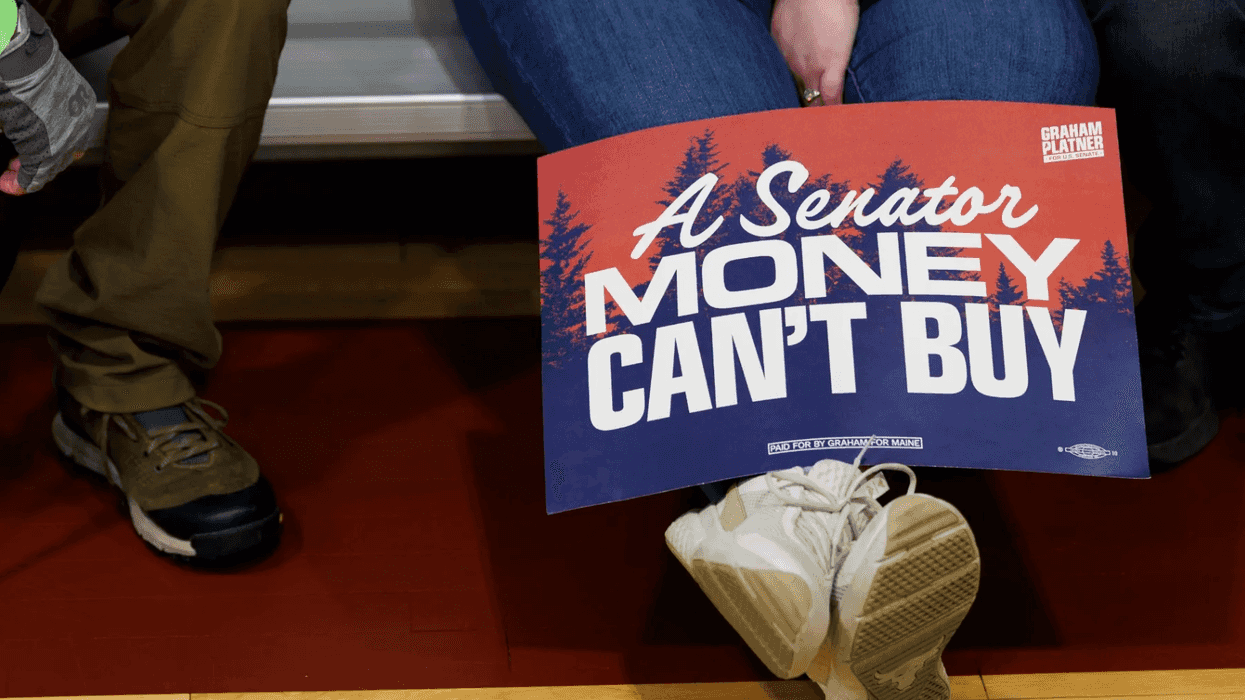

After Graham Platner secured the Democratic nomination for Senate in Maine, his first ad of the general election didn’t mention his opponent, Sen. Susan Collins, or the Republican Party. It focused on the late disgraced financier and convicted sex offender Jeffrey Epstein, and who he called the “Epstein class” of elites in both parties.
“Some of the most powerful Democrats and Republicans in the country were on Epstein island,” Platner said in the ad, referring to Epstein’s former residence in the U.S. Virgin Islands. Platner, whose economic-populist campaign combined with controversial online statements and a since-removed tattoo of a Nazi symbol have drawn national attention, framed himself in opposition to this elite class.
“It seems the only thing the party establishments can agree on is a love of Jeffrey Epstein, and a hatred of me,” he said. “I’m Graham Platner, and I approve this message because together, we will take back our government from the Epstein class.”
It’s not just Platner: In midterm races from Texas to Maine, Democrats and at least one Republican are running against Epstein and “the Epstein class,” a term Democratic Rep. Ro Khanna of California first used last year to describe the men among the economic and cultural elite who traveled in Epstein’s social circles and helped rehabilitate his reputation after the multimillionaire ex-financier became a convicted sex offender in 2008 for soliciting prostitution of a minor.
“I’ll give the survivors credit, but I did coin the phrase ‘Epstein class’ because they’re a group of rich and powerful people who are not playing by the rules, and it offends the sense that we have one tier of justice,” Khanna told The 19th.
The number of candidates highlighting Epstein in their campaign messaging, Khanna argued, “shows what a powerful issue this is to win the midterms and win back the trust of the American public.”
In two of the most competitive races to determine control of the U.S. Senate, Platner and Democratic Sen. Jon Ossoff of Georgia, who is running for reelection, have castigated the “Epstein class” and what they say is elite corruption in their ads and messaging. In Texas, Democratic Senate nominee James Talarico has criticized his opponent, Trump-endorsed Texas Attorney General Ken Paxton, for approving what critics have called an overly lenient, “Epstein-style” plea deal for a defendant charged with sexually abusing a child. And in Ohio’s Senate race, both Republican Sen. Jon Husted and his Democratic opponent, former Sen. Sherrod Brown, have run television ads attacking each other by singling out campaign donations from those in Epstein’s orbit.
Last year, Epstein’s survivors fueled a bipartisan push in Congress led by Khanna and Republican Rep. Thomas Massie to compel the Justice Department to release over 3.5 million files from its investigation into Epstein, who died in prison in 2019 while awaiting trial on federal sex trafficking charges. The release of the files, following months of resistance from President Donald Trump and the White House, provided a rare look into how the wealthy and powerful operate behind closed doors.
Epstein’s death was ruled a suicide, but it’s continued to drive scrutiny, skepticism and conspiracy theories in the years since. During the 2024 election, top Trump allies, some of whom ended up in his administration, pledged to release the Epstein files. The Trump administration’s reluctance to do so frustrated and splintered the MAGA base, resulting in a rare rebuke of the administration by Congress. Republicans who bucked Trump by pushing for the release of the files have also faced political consequences: In May, a Trump-backed primary challenger ousted Massie from his seat in Congress.
 Americans across the political spectrum have continued to ask about the late financier and convicted sex offender Jeffrey Epstein’s connections among the political elite. (Angela Weiss/AFP)
“I think the single most bipartisan issue in the country is the Epstein files investigation,” Rep. Robert Garcia of California, the top Democrat on the House Oversight Committee who has spearheaded Congress’ investigation into the Epstein case, told reporters this month. “And so I think we’re going to talk about it a lot.”
No one other than co-conspirator Ghislaine Maxwell, currently serving out a prison sentence for sex trafficking, has been prosecuted in connection to Epstein’s crimes in the United States. But Epstein courted influence and rubbed shoulders with prominent individuals associated with both parties in his efforts to rehabilitate his reputation.
Republicans have seized on Epstein’s ties to figures including former President Bill Clinton, who sat for a congressional deposition along with former Secretary of State Hillary Clinton, and Democratic megadonor Reid Hoffman, who has expressed regret for associating with Epstein, to accuse Democrats of hypocrisy. It’s also provided some Democratic candidates with a way to hit on what they cast as corruption in both parties.
The revelations from the files further fueled the widespread, bipartisan exasperation among voters with the wealthiest elites. The Epstein issue, two Democratic pollsters told The 19th, is rare for its high salience and far reach even among less politically engaged voters — and for the high levels of bipartisan agreement on the need for more action.
Surveys released this year from Democratic-aligned firm Navigator Research and progressive pollster Data for Progress back that argument up. In both polls, majorities of voters, including a majority of Republicans, believe there hasn’t been enough accountability connected to Epstein’s crimes and want to see more arrests and prosecutions. In a Navigator poll released in March, the share of Americans who said they believed Trump administration officials should resign over the Epstein matter increased when they were informed about officials in other countries being arrested, fired or forced to resign over Epstein ties.
“What has happened with the Epstein files is such a clear distillation of the frustration that Americans across different partisan ideologies, even Republicans, even MAGA Republicans, and certainly independents, feel that there’s a different set of rules — or that really no rules at all — for the elite who just seem to get ahead,” said Melissa Toufanian, managing director at Navigator.
In the Navigator survey, half of Americans, including two-thirds of Democrats and 58 percent of independents, said they believed the government was “definitely” covering up additional wrongdoing by Epstein. Seventy-two percent of Americans, including 70 percent of independents, 67 percent of non-MAGA Republicans and 57 percent of respondents identified as MAGA Republicans, said there should be more arrests and prosecutions related to Epstein. Sixty-four percent of respondents, including two-thirds of independents and half of Republicans, said they believed Epstein’s crimes were “unsurprising and the result of a broader problem.”
“It really cuts across every political divide in a way that we almost never see on other issues,” Toufanian said.
The number of red state candidates running on Epstein and the “Epstein class” demonstrates this. In addition to Talarico and Brown, Noah Taylor, an Army veteran running as a Democrat for the Senate in Kansas, and Dan Osborn, an independent Senate candidate in Nebraska, have also framed their campaigns as opposing the “Epstein class.”
Osborn, who is challenging Sen. Pete Ricketts, issued a news release pointing to a campaign rally in which Ricketts and Sen. Ted Cruz of Texas appeared together, calling them “birds of a feather who are content to carry out the agenda of the billionaire Epstein class.”
Research from Data for Progress found that voters were not only highly aware of the Epstein files issue but named specific figures, including Trump, who they believed to be part of the Epstein class. In a Data for Progress poll released in March, a plurality of likely voters said they didn’t expect to see additional arrests connected to Epstein, and majorities of voters said they held both the Trump and Biden administrations accountable for a lack of action.
“What we found there is that people are immediately able to attach this to wealthy elites and corruption and people that are rigging the system in their own interests, and then finally, that voters find those messages to be pretty convincing,” said Ryan O’Donnell, Data for Progress’ executive director.
Inflation and the high cost of living consistently rank among voters’ top concerns ahead of the midterms, an advantage for Democrats aiming to win back control of Congress. Still, O’Donnell said, surveys show that Democrats have little trust advantage on which party voters trust more to tackle corruption. Candidates’ focus on “the Epstein class,” he said, aligns with that broader anti-corruption and anti-elite messaging push many Democratic candidates are centering in 2026.
“I think it directly fits in with voters’ top concern of cost of living right now,” O’Donnell said. “Broadly, Democrats, if they want to fight their way out of this, have to show that they’re actually willing to take on corruption in that way, and I do think that the Epstein class language is one way to do that.”
Why Democrats Are Running Against the ‘Epstein Class’ was originally published by The 19th and is republished with permission.









The President Invited Iran to Bomb My Home