

America was born out of rebellion against oligarchy.
- Priya Satia, Stanford University
When a majority of citizens disagree with economic elites and/or with organized interests, they generally lose.
- Benjamin Page, Martin Gilens, 2014
Last year, voters strongly rejected Viktor Orban’s authoritarian Hungarian government, rife with corruption. Economic stagnation played a role, but corruption was the decisive factor.
America could be next. The decades of pay-to-play corruption at the center of America’s political system have delegitimized its democracy. Except in individual instances, however, corruption has rarely proven sufficiently potent at the ballot box to be determinant. That dynamic will be sorely tested in 2026 thanks to President Trump.
The Irony of America’s Oligarchic Governance
The Founding Fathers would be gravely disheartened at the state of their grand democratic experiment after 250 years.
American politics in recent decades has largely been the domain of oligarchs. It has devolved ironically to resemble the elitist political and economic system that inspired the Revolutionary War - a replica of the despised England the colonists first raised arms against at Lexington and Concord in 1775.
True, colonials believed their just cause was the rejection of an oppressive monarchy. In reality, the offending practices and policies blamed on the figurehead King George III - the tariff on Indian tea, for instance - were dictated by a Parliament dominated by oligarchs - nabobs like Sir Robert Clive and Cecil Rhodes. The 1688-89 Glorious Revolution, which deposed James II, also stripped the English monarchy of absolute power. Political, social, and economic power had abruptly migrated from the monarchy to the wealthy oligarchs who dominated Parliament– a transition that “dramatically curbed kingly authority.”
Like the England of 1775, America’s policies today are largely dictated by wealthy oligarchs like Elon Musk, many of whom share President Trump’s hostility toward taxes to fund social program spending. Charles Koch, for instance, has lobbied for cuts similar to Trump’s 2025 tax law, removing 4 million from food assistance and eliminating Medicaid health insurance for an estimated 17 million of America’s poorest, forcing rural hospitals to close.
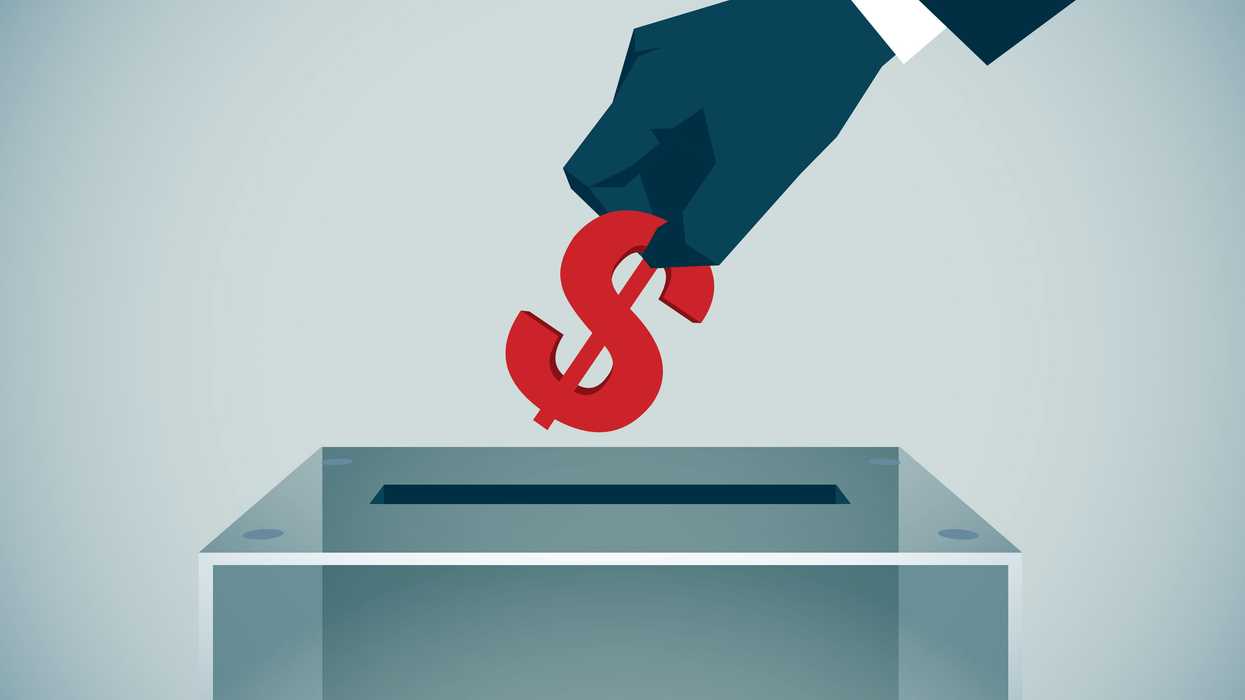
Reduced food and health care for the least advantaged is just one facet of the consequences of America’s pay-to-play political system. Republicans, beginning with Goldwater and later Reagan, fully embraced pay-to-play, genuflecting to the wealthy who still dominate their Party. Partisan loyalists appointed to the Supreme Court have legitimized the practice, ruling, rather mystically, out of whole cloth, that money is constitutionally protected political speech. We are all entitled to a corner soapbox. But it seems you are also entitled to drown out my voice a million-fold, wallet permitting. They have even ruled that the legal fiction of corporations enjoys those same speech rights, ruling in Citizens United that ethereal political donors can be incorporeal wallets.
Political scientists term America’s faux democracy a functional oligarchy like Egypt or Turkey, or 18th-century England. But most American men and women view it simply as corruption - enabling the wealthy to profit by stacking the economy “against people like me.”
A Brennan Center survey in May 2026, for instance, found that 90% of independent voters believe “corruption is responsible for policies that benefit billionaires and big corporations at the expense of the American people.” This belief has become increasingly evident since 2017. Some 57% of respondents to a March NBC poll, for instance, believed that the rich and powerful are above the law – corruption that has grown worse in “the past five or ten years,” fostering a second Gilded Age.
This erosion of America’s democratic integrity has been recognized abroad: U.S. democracy fell on Transparency International’s government Corruption Index to a record low 29th globally in 2025 from 16th in 2015, below authentic democracies that limit the role of money in politics.
The Corruption Awakening
One important reason for growing sensitivity to corruption is rising American income inequality - the record surge in wealth at the top coming at the expense of workers. Real hourly compensation - wages and benefits - has virtually stagnated for the lowest earning 80% (111 million) of nonfarm salaried workers since the Reagan administration. (You may want to read that again.) Pay-to-play politics permits employers to offshore jobs while weakening unions, labor rights, and antitrust enforcement. That enabled employers to raise profits by capping workers’ pay, thereby doubling the national income share of the top 1% since 1979.
A second factor has been blatant global grifting by Trump – a Boeing 747 from Qatar and tungsten mines in Kazakhstan – corruption in flagrant violation of the Constitution’s Articles I and II emoluments clauses.
A Political Corruption Edge?
Only rarely has corruption provided a partisan electoral advantage to either political party. But this may be one of those moments, with surveys finding that corruption offers Democrats an electoral opportunity in 2026 and 2028.
An extensive 2025 analysis drawn from a panel of nearly 2000 voters, for instance, found that independent voters view Republican Party office holders as more corrupt than Democrats. These swing voters believe Republican politicians are nearly 30% more likely to be “very corrupt” than Democrats (29% of independents believe Democratic politicians are “very corrupt” while 37% believe Republicans are). Moreover, 38% of these independent panelists believed that the wealthy have the “most influence” on the Republican Party, while only 20% believe they have the most influence on Democrats. And a study of campaign spending by billionaires in 2024 found they favored Republicans by at least 2.5:1 - and that excludes their hidden dark money spending. The margin in seven pivotal 2024 Senate races was at least 7:1.
Restoring Democratic Legitimacy
Pivotal independent voters have come to believe that political corruption is widespread, multi-faceted, deeply embedded, and adversely affecting household economics. The 2026 and especially the 2028 elections offer them opportunities to rebuild the legitimacy of American democracy.
Should reformers prevail at the ballot box, a top priority is upgrading the Supreme Court that has championed pay-to-play for decades. Congress and the President can reform the Supreme Court by term-limiting justices or by imposing judicial jurisdiction limits as permitted by Article III, Section 2 of the Constitution. But opposition will be fierce, led by billionaires determined to preserve the central role of money in American politics and their dominance.
Voters can rekindle the Founders’ high hopes for democracy in the coming elections. The question is whether the corruption issue has sufficiently ripened and economic conditions have become sufficiently dire that democratic reformers can attain a trifecta at the polls in 2028.
George Tyler is a former deputy assistant treasury secretary and World Bank official. He is the author of books including Billionaire Democracy and What Went Wrong.









The President Invited Iran to Bomb My Home