

President Donald Trump convened more than a dozen major oil executives at the White House on Friday afternoon to explore potential investment opportunities in Venezuela, coming just days after the United States removed President Nicolás Maduro from power.
Trump invoked a national emergency to protect Venezuelan oil revenues controlled by the U.S. government from being seized by private creditors, casting the move as essential to safeguarding American national security and preserving stability across the region.
The dramatic U.S. raid that captured Nicolás Maduro has been framed as a decisive blow against corruption, drug trafficking, and authoritarianism. But the facts emerging in the days since tell a far more complicated story — one that raises uncomfortable questions about American motives, regional stability, and the future of U.S. foreign policy in the Western Hemisphere.
If this were truly a mission driven by humanitarian concern or a desire to protect Americans from narcotics, it is striking how quickly the conversation shifted to petroleum and investment opportunities. The timing alone suggests that oil was not an afterthought — it was a central consideration.
The Trump administration has issued threats not only to Venezuela’s acting leadership but also to Colombia and Cuba. It has revived talk of acquiring Greenland. These statements, taken together, paint a picture of a government increasingly comfortable with the language of coercion and territorial ambition.
Americans themselves appear uneasy. Polling shows the public is split on the raid, with many still forming opinions. Nearly half oppose the idea of the United States taking control of Venezuela or choosing its next government. An overwhelming majority believe Venezuelans should decide their own political future. That instinct — a respect for sovereignty and self-determination — is one the United States would do well to heed.
None of this is to deny that Maduro faced serious allegations or that Venezuela has suffered deeply under his rule. But the manner of his removal, the immediate pivot to oil negotiations, and the administration’s increasingly expansionist posture raise legitimate concerns about what truly motivated this operation — and what might come next.
The Western Hemisphere has a long memory of U.S. interventions justified in the name of democracy but driven by strategic or economic interests. If the United States wants to avoid repeating that history, it must be transparent about its goals, restrained in its ambitions, and respectful of the sovereignty of its neighbors.
Venezuela is part of a broader, more aggressive vision of American power — one that extends from the oil fields of Venezuela to the mineral-rich ice of Greenland.
Trump’s fixation on acquiring Greenland is not new, but the timing and intensity of his renewed push are telling. Fresh off a military operation in South America, he told reporters that Greenland is “so strategic” and claimed the island is “covered with Russian and Chinese ships.” The White House then confirmed it was considering “a range of options” to bring the self-governing Danish territory under U.S. control — including the use of the military.
European leaders were alarmed. Denmark warned that such a move would effectively end NATO. Greenlanders themselves overwhelmingly oppose U.S. control. Yet the administration pressed forward.
Why? Because Greenland is not just a frozen island. It is a geopolitical jackpot.
The territory sits between the U.S. and Russia, straddling emerging Arctic shipping routes that could dramatically shorten global trade paths as ice melts. It lies atop vast reserves of oil, gas, and some of the world’s most valuable rare earth minerals — the same minerals China has used to pressure the United States. Analysts note that Greenland may be one of the most strategically important pieces of real estate for the next half-century.
In other words: this is not about democracy. It is about leverage.
When you place Greenland and Venezuela side by side, the pattern becomes impossible to miss — a foreign policy driven by the acquisition of land, resources, and strategic advantage, one that demands scrutiny, accountability, and a sober understanding of the costs of intervention.
Trump’s Venezuela Agenda Isn’t Justice — It’s Profit was first published on Latino News Network.
Hugo Balta is the publisher of the Latino News Network executive editor of The Fulcrum.





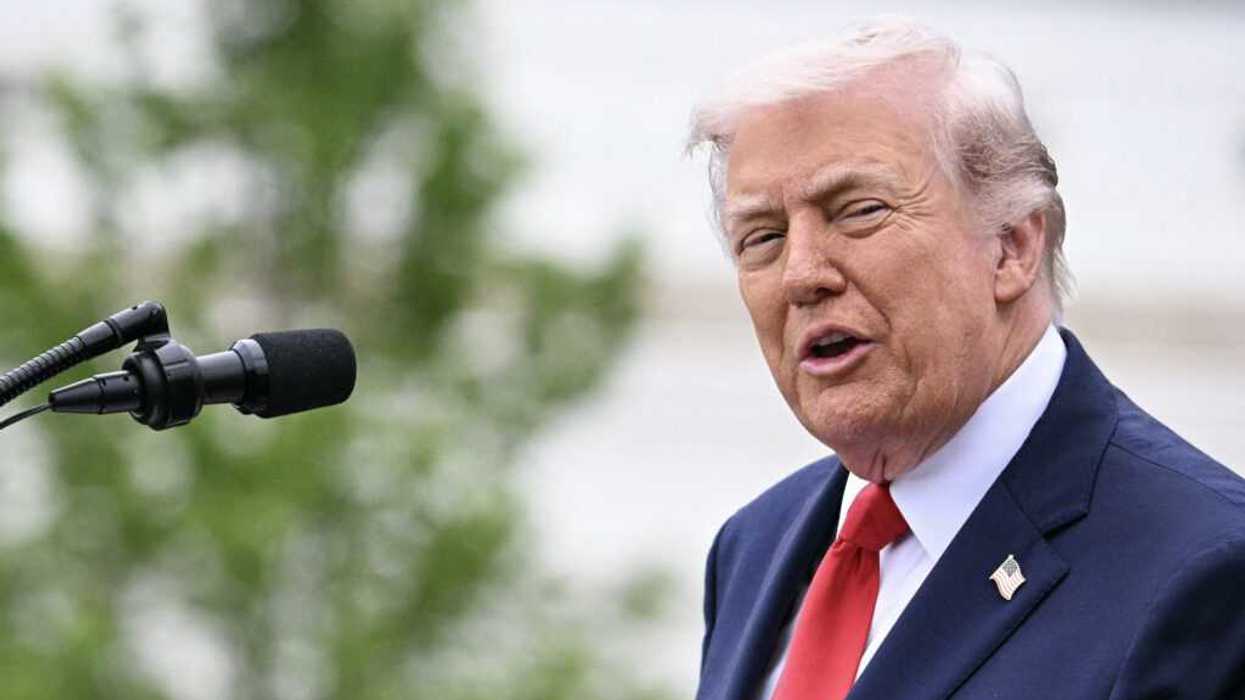

U.S. President Donald Trump speaks during a“ Steel Across America” event ahead of the 25th anniversary of the Sept. 11th attacks on the Ellipse near the White House on Sept. 8, 2026 in Washington, D.C. President Trump welcomed 9/ 11 first responders to the Tunnel to Towers Foundation’ s“ Steel Across America” event featuring a 16,900- pound, 21- foot steel beam recovered.
For Trump, even 9/11 is an opportunity
There was a reason organizers of the 9/11 ceremony in Manhattan told President Trump he could not speak at this year’s memorial service.
A good one, it turns out.
Because in a speech he gave on Tuesday in Washington, he did exactly what they were presumably worried about — he made it about himself.
According to The New York Times, Trump had wanted a speaking role at the service, but the National Sept. 11 Memorial and Museum, which oversees the site, said no, as they’ve maintained for the past decade-plus that the venue and event should be nonpartisan.
Trump has long used awful tragedies to either puff himself up, trash political opponents, or sell lies to the American people.
He blamed a deadly plane crash at Washington National Airport last year on diversity, equity and inclusion policies. He blamed Puerto Ricans for the devastation they endured after Hurricane Maria in 2017. He reportedly considered withholding disaster relief after the California wildfires based on the way affected regions voted. In an interview on Fox News meant to commemorate the 75th anniversary of D-Day in Normandy, he used the occasion to slam former House Speaker Nancy Pelosi…with graves of the dead behind him.
And now, as we approach the 25th anniversary of what many New Yorkers consider the darkest day in modern history, Trump has done it again.
He told a rambling, nonsensical story — one he’s told before — about going to Ground Zero just after terrorists flew two commercial jets into the twin towers. In the story, which no one has been able to verify, despite multiple attempts, he says firefighters had to carry him out of One Liberty Plaza, also known as the U.S. Steel Building, because they thought it was about to collapse.
As CNN fact checker Daniel Dale notes, there’s no evidence Trump went into this building, especially at a time when NYPD and NYFD had locked down the area. There’s no evidence that building was collapsing — in fact, it was deemed structurally sound and reopened within two months of the attacks. There’s no evidence he was carried out of it by firefighters.
But the lie isn’t even the worst part. Pretend it was all true — why would the leader of our country, and a New Yorker, decide to make that tragic day about himself?
Because that’s who Donald Trump is. He’s a malignant narcissist.
He’s also, incidentally, a terrible and ineffectual president, who’s made ill-fated decisions that he has to keep defending, and there’s nothing he won’t do to make himself look and feel better.
Within the first two minutes of his speech, he was cravenly using 9/11 to justify and promote his dumb war in Iran — two events separated by 25 years and 6,000 miles.
“And I will tell you, we’re right now fighting because we have a certain nation that wanted a nuclear weapon, they were very close to getting it, and now they have no chance at getting it. They will never have a nuclear weapon. Iran will not have a nuclear weapon. And they’ve been punished greatly. As you know, we’ve really taken it to them.”
As a New Yorker who lived through 9/11, still one of the worst days of my life, I’m utterly sickened by Trump’s crass, political, and self-promotional framing of that awful day.
And I’m relieved he won’t be given a platform to do it again on Friday’s anniversary in lower Manhattan.
Because for Trump, everything is his for the taking, and absolutely nothing is sacred.
S.E. Cupp is the host of "S.E. Cupp Unfiltered" on CNN.