
America’s standing in the world suffered a profound blow this January. In yet another apparent violation of international law, Donald Trump ordered the military removal of another nation’s leader—an act that would have triggered global alarm even if the target had not been Venezuelan strongman Nicolás Maduro. Days later, the killings of Renee Good and Alex Pretti were broadcast around the world, fueling doubts about America’s commitment to justice and restraint. These shootings sandwiched the debacle at Davos, where Trump’s incendiary threats and rambling incoherence reinforced a growing international fear: that America’s claim to a distinctive moral and democratic character is fighting for survival.
Our American Exceptionalism
For those of my generation, the idea of American exceptionalism was instilled from birth. We were not merely the most powerful nation on earth, but something more. As historian Daniel Boorstin argued in The Genius of American Politics, the United States was “unique,” possessing a “genius all its own.” Born of revolution and sanctified by the Declaration’s audacious claim that “all men are created equal,” America was animated by freedom, self-reliance, democratic institutions, and even a sense of moral superiority endowed by our Creator. We were a nation unlike any that had come before.
There is, of course, ample history to challenge that narrative. American exceptionalism has often functioned as myth—one used to justify imperial conquest, the dispossession of Indigenous peoples, the barbarity of slavery, Cold War interventions from Vietnam to Chile, and catastrophic misadventures such as the war in Iraq. But even those actions were often sold as a mark of our exceptionalism. “Mission accomplished” crowed President George W. Bush, after the toppling of Saddam Hussein, as virtue had triumphed over the forces of oppression.
Optimism and Idealism
Exceptionalism is, at its core, rooted in America’s optimism and idealism: the belief that no problem is unsolvable, no obstacle insurmountable, no frontier unconquerable. It is not the bleak pessimism of Trump’s “American carnage” first Inaugural or even Jimmy Carter’s “crisis of confidence.” Instead, it is Ronald Reagan’s “shining city on a hill,” Barack Obama’s promise of “hope and change,” and John F. Kennedy’s challenge to go to the Moon “not because it is easy, but because it is hard.”
Even war has been wrapped in this language of purpose. World War I was fought not only to “make the world safe for democracy,” but—with characteristic American optimism—to be “the war to end all wars.” Westward expansion was framed as Manifest Destiny rather than conquest. Vietnam was justified as a bulwark against “godless communism,” not support for an illegitimate regime. Iraq was cast as a uniquely American mission to remake a nation through “regime change.”
This is the language of mythmaking. And while nearly 250 years of history have tested America’s virtues repeatedly, the nation has long claimed a unique capacity for self-correction. Even our reckonings with injustice have been framed through exceptionalism itself. As Martin Luther King Jr. famously declared, “one day this nation will rise up and live out the true meaning of its creed….”
Today, that legitimacy—at home and abroad—is under sustained assault. With each day, democracy and the rule of law erodes, both by single dramatic ruptures, but also through a steady accumulation of abuses, all increasingly bent to the will of one man. If American exceptionalism can die by a thousand cuts, the events of January 2026 have inflicted the most dangerous wounds yet.
Losing Our Strategic Capital
Maduro’s removal was an undeniably bold display of American power. The strongman inspires little sympathy; under his rule, Venezuela’s economy collapsed and its democratic institutions withered. Most welcomed his downfall, even if they did not approve the method. But kidnapping Maduro pales by comparison to Trump’s saber-rattling about acquiring Greenland, potentially by force.
Coming on the heels of Trump’s abandonment of Ukraine, his efforts to control Greenland threaten a NATO ally while fracturing that alliance at a time when we need it the most. Once again, Trump delivered on his promise to shatter norms and institutions. And the world’s view of our stature has suffered in the process.
For decades, presidents of both parties invested in America’s strategic capital: alliances, partnerships, and trust. While the United States maintained unrivaled military power, it generally preferred to act with others rather than alone. Interventions—from Kosovo to Kuwait, Haiti to Iraq—were justified, at least rhetorically, by appeals to international law and self-determination.
Unlike many former presidents, Trump has never grasped the central truth that America’s real power does not rest solely in its arsenal, but in its legitimacy—its claim to occupy the moral high ground as a “shining city on a hill.” Our allies followed us not out of fear, but because they trusted our intentions. We have occupied the high ground of diplomacy not because we are saints, but because we typically have not been perceived–-Vietnam and Iraq being the notable exceptions—as the unilateral aggressor nation.
That legitimacy is now being squandered. America now appears less like an exceptional nation upholding international law and more like a self-interested power pursuing oil and influence. As allies grow wary, they will increasingly look for other partners. As Canada’s P.M. Mark Carney warned, “Allies will diversify to hedge against uncertainty. They’ll buy insurance, increase options….” This will not increase our strength but instead heighten our isolation. Our nation’s once-bright light will further dim.
Believe Your Eyes
The world also watches with concern the shooting of two Americans by ICE agents in Minneapolis. First, Renee Good, an unarmed 37-year-old mother, was killed when an ICE agent fired multiple shots into her vehicle moments after she told him, “I’m not mad at you.” Then, ICU nurse Alex Pretti was shot and killed while on his knees surrounded by ICE agents who had forced him to the ground. These killings were outrageous, but the statements from our leaders prompt additional alarm.
Police shootings of unarmed civilians, while disturbingly common, are often followed by official restraint—calls for calm, expressions of sympathy, and promises of investigation. Not here! Within hours of each killing, the administration launched coordinated assaults on the victims. Homeland Security Director Kristi Noem called Good’s action an “act of domestic terrorism,” and described Pretti similarly. Trump labeled Good a “professional agitator”. Stephen Miller called Pretti a “domestic terrorist” and accused him of trying to “assassinate federal law enforcement”.
Administration officials suggest that there will be no independent investigations. But as more evidence emerges, more concerns arise. The videos do not lie. The New York Times amalgam makes clear that the agent in the Good case was not been struck by her car. Videos of Pretti’s shooting shows he was shot in the back while on the ground. But initial narratives, especially from those in power, are difficult to dislodge. Facts become secondary to political allegiance.
These victims will not be forgotten. Alex Pretti had no criminal record and was working to heal veterans. An agent at the scene of Good shooting called her a “f**king b*tch.” But Renee Good was neither a terrorist nor a lunatic. ICE agents may not be rogue officers eager to play “Dirty Harry,” but their masked behavior appears lawless.
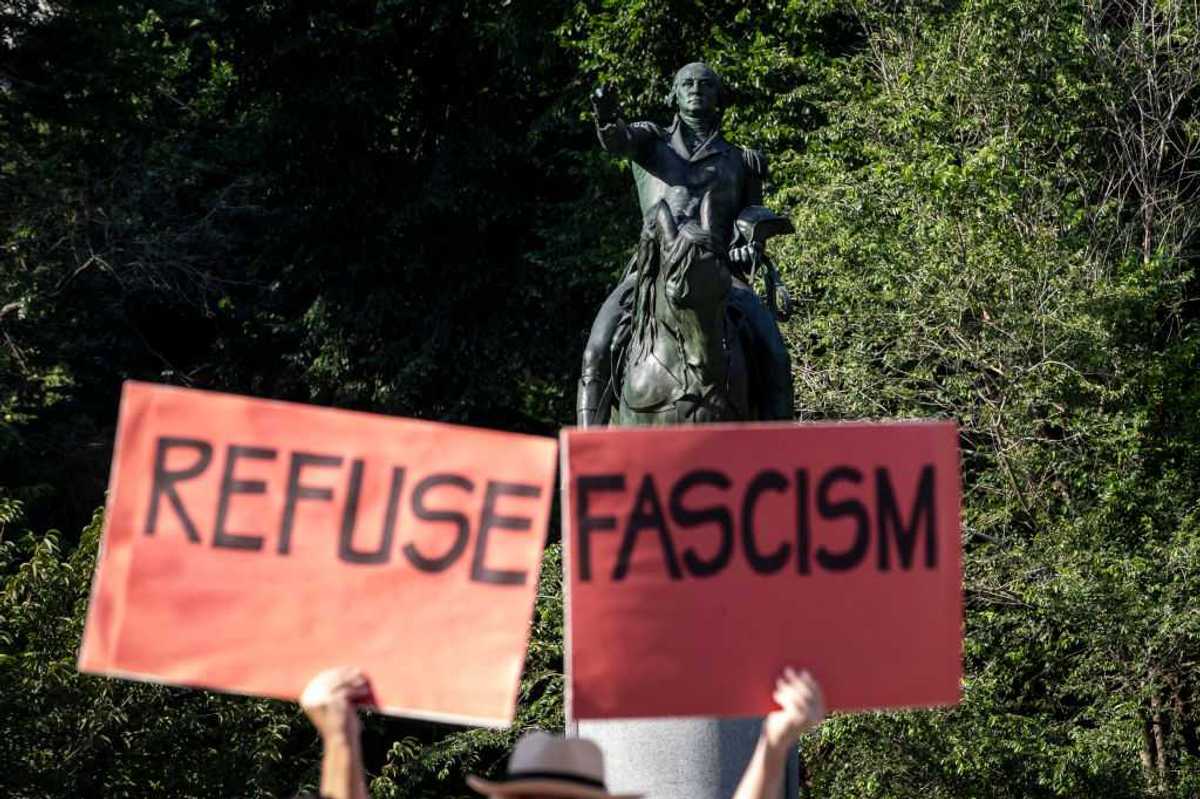
Images of the post-shooting protests evoke 1960s Birmingham and the aggressive actions of Sheriff Bull Connor and local law enforcement against peaceful demonstrations. But there is big difference; in Minneapolis, the aggressors are agents of the U.S. government who have the full support of the President.
Rules, Restraint, and What Once Made Us Different
American law enforcement policies reject “shoot first, ask questions later” approaches. DHS policy states that deadly force is justified only when an officer has a reasonable belief of an imminent threat of death or serious bodily harm. Firing on a fleeing, unarmed civilian is generally discouraged. Policy emphasizes disengagement—step back, gather information, prevent escalation.
These rules exist for a reason: to minimize unnecessary death and collateral damage. In America, we have traditionally cared about such distinctions. That concern—however imperfectly honored—has been part of what made us exceptional.
Such subtleties are lost on this administration, who prefers to distort the facts in service of its political agenda. Allowing a protester to escape is framed as weakness, as letting someone “get away with it.” When protest begins to carry a death sentence, however, we are losing our special character as a nation.
A Glimmer of Hope?
New polls reveal our discomfort with these events, a positive sign in a sea of negativity. A Quinnipiac University poll found that 53 percent of respondents believed the Good shooting was unjustified, while 57 percent disapproved of ICE’s enforcement tactics. A YouGov poll reported that 53 percent think the agent should face criminal charges, compared with just 30 percent who felt the shooting was justified.
Americans believe that Trump’s Greenland folly is just that; a recent poll reports that 75% of Americans oppose our possible takeover. And while nearly 72% of Americans initially supported the invasion of Iraq and Saddam Hussein’s removal, opinion on Maduro’s seizure is sharply divided. A Reuters/Ipsos poll found 34 percent opposed the action, 33 percent supportive, and 32 percent were unsure. Trump is increasingly isolated, at home and abroad.
For generations, American exceptionalism has shaped our national identity and our standing in the world. That construct is now crumbling under the weight of events both foreign and domestic. Whether the United States can reclaim the moral high ground that once distinguished it remains an open question. This administration—and its allies in Congress—are not up to the task. So, it is now on us!
Minneapolis, Greenland, and the End of American Exceptionalism was originally published on the Substack "Fights of Our Lives" and is republished with permission.
David J. Toscano is an attorney in Charlottesville, Virginia, and a former Mayor. He served fourteen years in Virginia’s House of Delegates, including seven as the Democratic Leader.