


More than a month into Donald Trump’s war with Iran, he still seems not to know why we are there or how we will get out. When, on February 28, President Trump launched a war of choice in Iran, he did so without consulting Congress or the American people.
The decision to start the war was his alone. Polls suggest that the public does not support Trump’s war.
A Pew Research Center survey found that “majorities of Americans say striking that country was the wrong decision and disapprove of President Donald Trump’s handling of the conflict.” Another poll reported that “six in 10 American adults say that the U.S.’s military action on Iran has ‘gone too far.’”
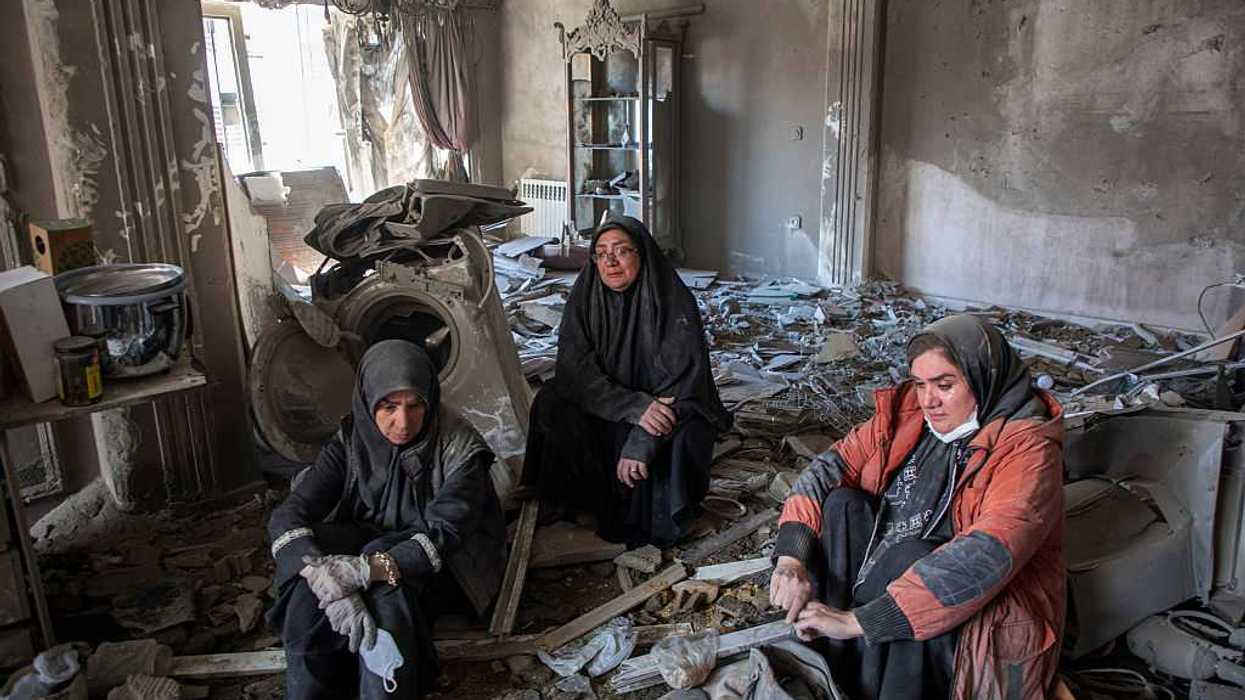
On the campaign trail, Trump said he would be a peace president and promised to end foreign wars. Those promises don’t seem to matter to the administration, which is waging a war whose costs are being borne by millions of people here and abroad.
Prosecuting the war costs more than $1 billion dollars per day. Americans are also paying for it at the gas pump and in the grocery store.
Trump’s war is an example of the dangers of being governed by one man, acting on his own impulses, beliefs, values, and interests. It should be a wake-up call for people who doubt democracy’s value or have grown weary of the responsibilities of democratic citizenship.
In a democracy, Professor Elaine Scarry explains, “If a president wants to go to war, or if anyone wants to go to war, it’s debated in open session, in both houses of Congress. It’s voted on…. Same with the citizenry; the citizenry debates…. It’s audible. It’s testable. It has to be testable. It doesn’t mean we’ll never go to war. Maybe we will find a reason to go to war. But it doesn’t mean that it’s untested.”
It is time for Americans to insist that, in the future, no president be allowed to launch a war of choice without going through that test.
Recall that Americans learned about the Iran war only after it started, when the president, wearing a hat emblazoned with the letters USA, posted a video to Truth Social. “A short time ago,” he said, “the United States military began major combat operations in Iran.”
The president characterized Iran’s leadership as “A vicious group of very hard, terrible people. Its menacing activities directly endanger the United States, our troops, our bases overseas, and our allies throughout the world.” Making clear that the attack on Iran was all about him, he added, “This regime will soon learn that no one should challenge the strength and might of the United States Armed Forces. I built and rebuilt our military in my first administration, and there is no military on earth even close to its power, strength, or sophistication.” Then, he boasted, “No president was willing to do what I am willing to do tonight.”
Contrast President Trump’s self-centered approach with the way Franklin Delano Roosevelt talked when he asked Congress for a Declaration of War against Japan. “(A)lways will our whole nation remember the character of the onslaught against us. No matter how long it may take us to overcome this premeditated invasion, the American people in their righteous might will win through to absolute victory….. With confidence in our armed forces, with the unbounding determination of our people, we will gain the inevitable triumph.”
FDR went to Congress because that is what the Constitution required. He went to Congress to enlist its support, as a body representing the people, to get their consent.
He did what the people who founded this nation wanted and expected.
During the Constitutional Convention, Charles Pinckney, a delegate from South Carolina, opposed giving the president the power to decide when to take the nation to war. In his view, such an assignment “would render the Executive a Monarch, of the worst kind . . . an elect[ed] one.” George Washington agreed.
As he put it, because “The Constitution vests the power of declaring War with Congress… no offensive expedition of importance can be undertaken until after they shall have deliberated upon the subject, and authorized such a measure.”
The delegates to the Constitutional Convention were initially inclined to give Congress the power to “make war.” Pierce Butler, another South Carolina delegate, led the opposition to that proposal. He argued for “vesting the power in the President, who will have all the requisite qualities, and will not make war but when the Nation will support it.”
Butler’s comment that the President “will not make war but when the Nation will support it,” suggests that the decision to go to war would be made in as democratic a way as possible.
The Convention eventually substituted the power to “declare” for the power to make war. But one of the delegates, Roger Sherman, worried that “substituting the term ‘declare’ would narrow congressional authority too significantly.” Sherman argued that the original term, “make,” better made clear that the president could not “commence war” on his own.”
History has proven that Sherman was right to be worried.
Trump’s war in Iran is just the latest example of the fact that the power to declare war has been rendered meaningless. During the twentieth century, Congress declared war eight times.
The last time was on June 5, 1942, when it declared war against Bulgaria, Hungary, and Romania.
As a 2003 report by David M. Ackerman and Richard F. Grimmett noted, “There is a striking similarity of language in the eight declarations of war passed by the Congress in the twentieth century.” With the one exception, the “declarations characterize the state of war as having been ‘thrust upon the United States’ by the other nation.”
The war in Iran, in contrast, was thrust on us by Donald Trump, with no declaration. A declaration of war, political scientist George Friedman explains, “holds both Congress and the president equally responsible for the decision and does so unambiguously. Second, it affirms to the people that their lives have now changed and that they will be bearing burdens.”
“(B)y submitting it to a political process,” Friedman argues, “many wars might be avoided . . . . “
President Trump’s insistence that Congress could have no role in making the decision to attack Iran and his recent tendency to refer to the war euphemistically are an insult to the Constitution. The Center for American Progress’s Damian Murphy and his colleagues are right to say that “Trump has undermined the very foundation of American democracy… denying the American people a meaningful role in decisions of war and peace.”
We are learning the hard way that democracy matters most when those decisions are made.
Austin Sarat is the William Nelson Cromwell professor of jurisprudence and political science at Amherst College.