



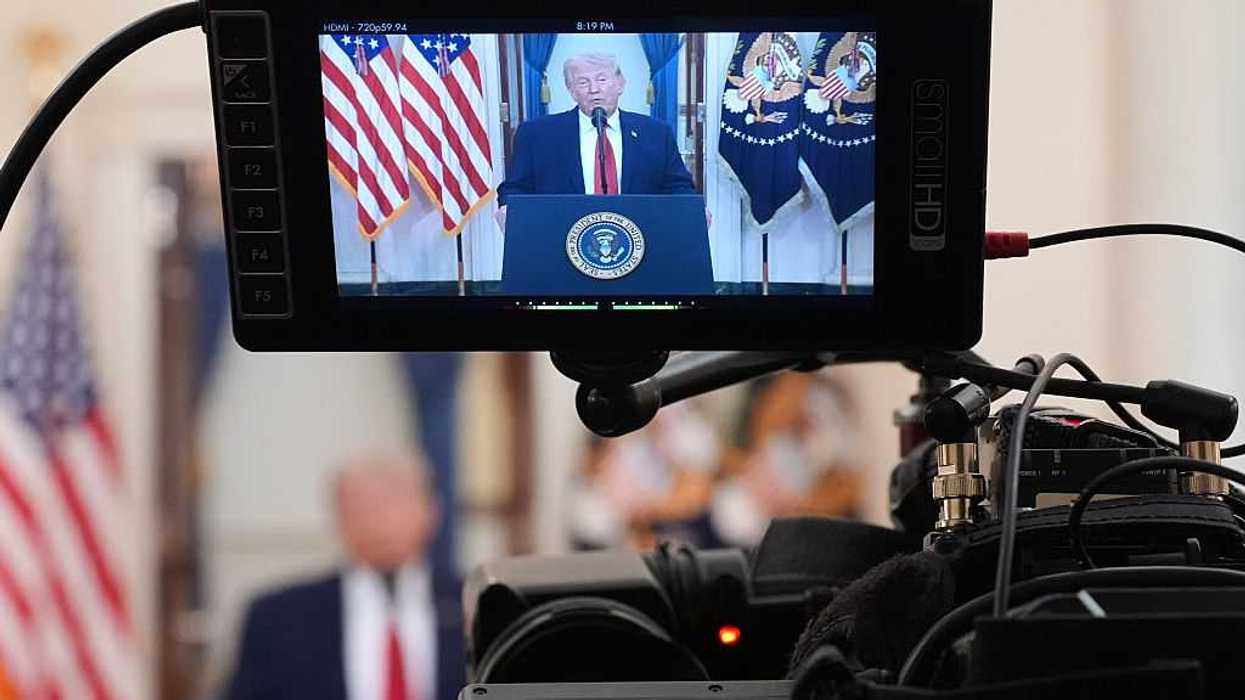

President Trump’s primetime address Wednesday night was meant to project clarity, strength, and purpose. Instead, it revealed something more troubling: a commander‑in‑chief describing a war that exists in two incompatible realities. In one version, the United States has achieved “core strategic objectives,” Iran has been “eviscerated,” and the conflict is “essentially over.” In the other, the U.S. continues to strike targets in multiple countries, the Strait of Hormuz is effectively closed, and the president warns the war will continue for “two to three more weeks” of heavy bombardment.
Both realities cannot be true. Yet Trump shifted between them effortlessly, often within the same paragraph.
Take one of the most sweeping claims of the night:
“We are on track, and the country has been eviscerated and essentially is really no longer a threat.”
If Iran is “no longer a threat,” why are U.S. forces still striking targets in Iraq, Syria, Yemen, and Iran? Why is the administration warning commercial shippers to avoid the Strait of Hormuz, one of the most vital waterways on Earth, except that it is too dangerous to navigate? The contradiction is glaring. A country that poses “no threat” can shut down a global shipping artery that deeply impacts the world economy.
Then there was the triumphant declaration:
“Victories like few people have ever seen before.”
Yet moments later, Trump insisted the war must continue for several more weeks. Victories “few have ever seen” do not usually require another half‑month of bombing. If the victories are that overwhelming, why is the war not over now, and why are more weeks needed? If the end is not in sight, what exactly is being celebrated?
The contradictions deepen when Trump describes U.S. objectives. At one point, he claimed the United States has “achieved our core strategic objectives.” But in the next breath, he said the U.S. is “nearing completion” of those same objectives. Trump's doublespeak manages to be both definitive and non‑definitive at once. Either the objectives have been achieved or they have not. “Nearing completion” is not the same as “achieved,” and the president’s inability to distinguish between the two is not a semantic quibble. It goes to the heart of whether the administration has a coherent strategy or simply a shifting narrative to justify anything that follows.
Other contradictions were subtler but no less revealing:
- Trump described Iran’s navy as “gone” and its air force “in ruins,” yet he also warned that Iran retains the ability to strike U.S. forces and allies.
- He claimed Iran’s missile stockpiles are “just about used up or beaten,” yet U.S. officials continue to brief reporters on the threat of additional missile launches.
- He praised the “masterful job” of U.S. forces in Venezuela, a country not at war with the United States, as if it were part of the same campaign.
- He spoke of “swift, decisive, overwhelming victories,” yet also framed the conflict as a generational struggle that calls for patience and resolve.
The result is a speech that fluctuates between triumphalism and alarmism, between declaring victory and demanding endurance. It is a rhetorical strategy that allows Trump to claim success regardless of what happens next, a pattern familiar from his business career and even from the narrative methods he described in The Art of the Deal. If the war drags on, it is because the U.S. is "finishing the job." If it ends suddenly, it is because the U.S. has already "won." If Iran retaliates, it proves they were still dangerous. If they do not, it proves they were defeated. Every outcome allows Trump to declare victory.
A further sign of the administration’s inconsistencies is reflected in the wild gyrations of the stock market, which swings from optimism to anxiety several times a day in response to presidential tweets and off‑the‑cuff comments. Markets have no political objective; they simply price the probability of future outcomes. When the president’s narrative shifts by the hour, the markets respond in kind because the signals from the White House are inconsistent.
But presidential rhetoric cannot change the reality of war. Wars follow the logic of strategy, capability, geography, and human consequence. And the contradictions in Trump’s speech are not harmless flourishes. They obscure the real questions the public deserves answers to:
- What is the actual endgame?
- What conditions must be met for the United States to stop bombing?
- What risks remain for U.S. forces and civilians in the region?
- What diplomatic or political strategy accompanies the military one?
Most importantly: How can the public evaluate the administration’s claims when the president’s own descriptions of the war contradict themselves?
The American people are capable of handling the truth, even when it is complicated, incomplete, or evolving. What they cannot accept is a narrative that shifts from sentence to sentence, where victory is both achieved and not achieved, where the enemy is both destroyed and still dangerous, where the war is both ending and escalating.
The contradictions in Trump’s speech are not simply rhetorical inconsistencies. They are symptoms of a deeper problem: a war unfolding faster than it is being understood, and a president more committed to the appearance of victory than to the clarity required for democratic accountability.
Until those contradictions are resolved, the public will remain in the dark, and the war will remain detached from the very strategic logic the president insists is guiding it.
David Nevins is the publisher of The Fulcrum and co-founder and board chairman of the Bridge Alliance Education Fund.




 Ben Droz
 Ben Droz







The President Invited Iran to Bomb My Home