



Skip to content
Search

Latest Stories

Follow Us:
Top Stories

Moonshot hope amid despair of Trump’s Iran war

Opinion

Moonshot hope amid despair of Trump’s Iran war

ASA's 322-foot-tall Artemis II Space Launch System rocket and Orion spacecraft lifts off from Launch Complex 39B at Kennedy Space Center on April 1, 2026 in Cape Canaveral, Florida.

(Chip Somodevilla/Getty Images/TCA)

On Wednesday evening, two historic things happened, almost simultaneously.

First, four courageous astronauts successfully lifted off from Launch Complex 39B at Kennedy Space Center aboard Artemis II, which will attempt the first lunar flyby in more than 50 years.


It was a stunning sight, and one that turned out more than three million people just who watched the official NASA launch broadcast alone.

It recalled a nostalgia for the days of Apollo, which excited and inspired so many Americans, and for just a moment, stirred up the kind of patriotism and hope that’s felt hard to come by in recent months.

In a parallel universe this would have been the perfect moment for the president to address the nation with a soaring speech marking the moment. We could have seen the kind of speech John F. Kennedy gave in 1962, inspiring an anxious nation to believe in possibility and progress amidst a backdrop of Cold War fears.

But that’s not the universe or timeline we’re living in. America is at war, and we don’t really know why.

President Trump finally delivered his first national address more than a month into his self-proclaimed — and unauthorized — “excursion” into Iran, an incursion that’s resulted in numerous U.S. casualties, strangled the free-flow of oil, created turmoil in the markets and world economies, and created fear among the U.S. and our allies that our actions will have dangerous ripple effects in the region and here at home for months, possibly years.

But a speech that was meant to satisfy the concerns of a skeptical public — two-thirds of which disapprove of Trump’s war and don’t believe he has a clear plan — failed to meet the mark.

Despite Trump’s rah-rah declarations of victory and decimation, no one with even a cursory knowledge of Iran’s history and capabilities could believe this reckless and aimless war of attrition is anywhere close to being over.

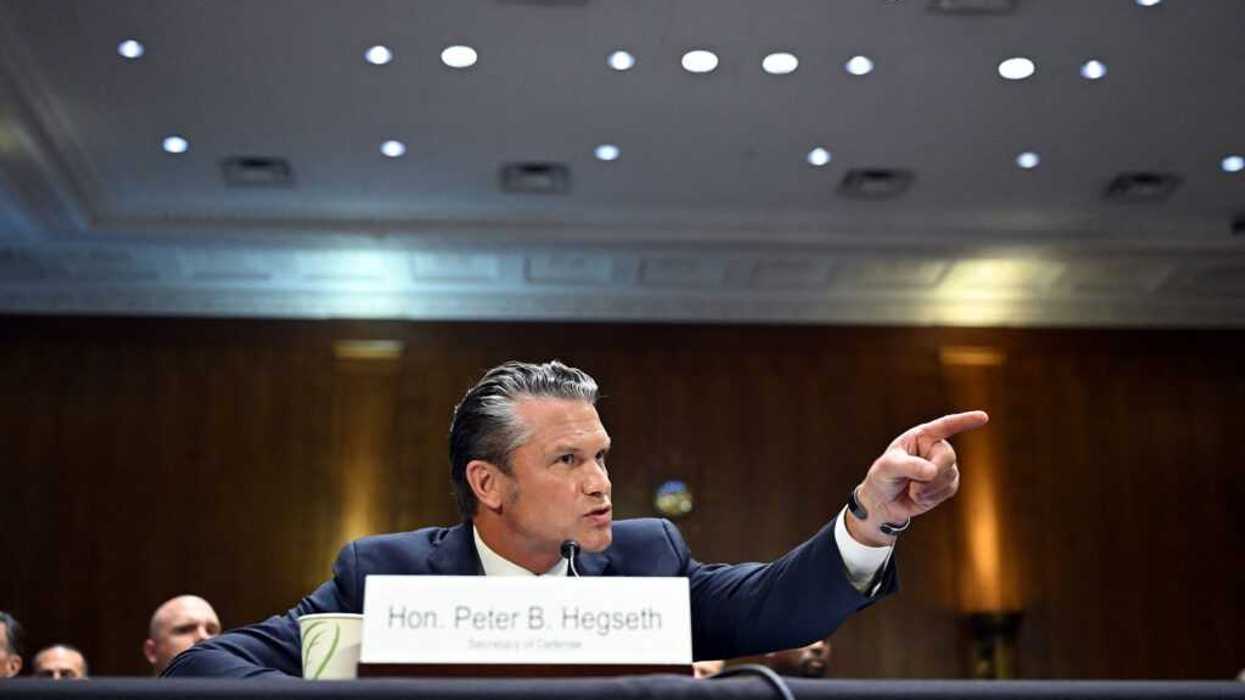
Offering no real plans to recover the roughly 1,000 pounds of highly enriched uranium buried in the rubble at Natanz and Isfahan, offering no real plans to liberate the people of Iran from a regime that’s thus far no different from the last one, offering no real plans to reopen the Strait of Hormuz and the world’s free flow of oil, Trump blustered, boasted, and balked, all while wagging an indignant finger at our allies for not jumping into this ill-advised quagmire with us.

And in fact, in his attempt to brag about how short this war has lasted, his comparisons to other lengthy conflicts like Vietnam and the Iraq war only reminded Americans how costly and consuming this one is likely to be.

The speech also comes against the backdrop of Trump’s threats to withdraw from NATO, the post-World War II treaty that’s kept Soviet and other tyrant states from attacking the Western alliance for more than 70 years.

While Trump may not understand its importance, the world certainly does, and is collectively rebuking his reckless efforts to weaken the body that is crucial for ensuring our own national security and stability and that of Europe.

But times feel fraught, without question. A corrupt, ignorant, and self-motivated wannabe dictator is prosecuting an ill-advised war using American blood and treasure, all while threatening to isolate our nation and endanger others even further. He’s wreaking economic havoc at home and across the globe, and without much care or consideration.

If we look at this mess Trump’s created too closely or for too long, it feels impossible to have hope for a better tomorrow. Perhaps that’s why now, more than ever, we need to look up and away, toward the stars, where actual heroes are leading the way. We’re all cheering you on, Artemis II.

S.E. Cupp is the host of "S.E. Cupp Unfiltered" on CNN.


Read More

A TSA employee standing in the airport, with two travelers in the foreground.

A Transportation Security Administration (TSA) worker screens passengers and airport employees at O'Hare International Airport on January 07, 2019 in Chicago, Illinois. TSA employees are currently working under the threat of not receiving their next paychecks, scheduled for January 11, because of the partial government shutdown now in its third week.

Getty Images, Scott Olson

Nope. Nevermind. Some DHS agencies still shut down.

House Republicans reject clean bill to open shut-down DHS agencies (March 28 update)

House Republicans (and three Democrats) rejected the Senate's clean bill to end the shutdown late Friday night. Instead, the House passed a different bill that fully funds every agency in the Department of Homeland Security (DHS) but for only 60 days with the knowledge that this short-term continuing resolution will not pass in the Senate.

Both chambers are out until April 13 so the shutdown is expected to last until then at least. Hope that no major weather disasters occur before then because FEMA is one of the DHS agencies out of commission (though some of its employees may be working without pay). It's possible that air travel security lines won't get worse since the President signed an Executive Order authorizing DHS to pay TSA workers. New DHS Secretary Mullin says paychecks will start to go out as early as Monday. How long can this approach continue? Unknown. Leaving aside the questionable legality of repurposing funds in this way, DHS may not be willing to keep paying TSA from these other funds long-term.

Keep Reading Show less
Protestors holding signs, including one that says "let the people vote."
Attendees hold signs advocating for voting rights and against the SAVE America Act at a rally to outside the U.S. Capitol on March 18, 2026 in Washington, DC.
Getty Images, Heather Diehl

The Senate Was Meant to Slow Us Down—Not Stop Us Cold

The Senate is once again locked in a familiar pattern: a bill with clear support on one side, firm opposition on the other—and no obvious path forward.

This time it’s the SAVE Act, framed by its supporters as a safeguard for election integrity and by its opponents as a barrier to voting access. The arguments are well-rehearsed. The positions are firm. And yet, beneath the policy debate sits a more revealing truth: in today’s Senate, the outcome of legislation is often shaped long before a final vote is ever cast.

Keep Reading Show less
Clarity Is Power: The Three Pillars That Keep the People in Charge
man in white robe holding a book statue
Photo by Caleb Fisher on Unsplash

Clarity Is Power: The Three Pillars That Keep the People in Charge

American democracy does not weaken all at once. It falters when citizens lose clarity about how power is being used in their name. Abraham Lincoln warned that “public sentiment is everything… without it, nothing can succeed.” When people understand what their leaders are doing, they can hold them accountable.

But when confusion takes hold, power shifts quietly, and the public’s ability to act begins to erode. Clarity enables citizens to participate fully in democratic life and shape a government that responds to them. Confusion is not harmless; it erodes the safeguards, public awareness, and civic action that make self‑government possible. Clarity strengthens all three pillars at once — it protects our constitutional safeguards, sharpens public awareness, and fuels civic action.

Keep Reading Show less
CONNECT for Health Act of 2025
person wearing lavatory gown with green stethoscope on neck using phone while standing

CONNECT for Health Act of 2025

How does a bill with no enemies fail to move? That question should trouble anyone who cares about Medicare, about rural health care, and about whether Congress can still do straightforward things.

In plain terms, the CONNECT Act would permanently end the outdated rule that limits Medicare telehealth to patients in rural areas who travel to an approved facility. It would make the patient's home a covered site of care. It would protect audio-only services, critical for seniors without broadband or smartphones, especially for behavioral health. It would ensure that Federally Qualified Health Centers can be reimbursed for telehealth, and it would lock in the pandemic-era flexibilities that Congress has been extending on a temporary basis since 2020. In short, it would turn five years of emergency workarounds into permanent, accountable policy.

Keep Reading Show less