


Claiming Contested Values: How Fairness, Stability and Freedom Can Help Us Build Demand for Transformative, Structural Change, produced by the FrameWorks Institute, explores how widely shared yet politically contested values can be used to strengthen public support for systemic reform. Values are central to how advocates communicate the importance of their work, and they can motivate collective action toward big, structural changes. This has become especially urgent in a climate where executive orders are targeting diversity, equity, and inclusion initiatives, and some nonprofits are being labeled as threats based on their stated missions. Many civil society organizations are now grappling with how to communicate their values effectively and safely.
The report focuses on Fairness, Stability, and Freedom because they resonate across the U.S. public and are used by communicators across the political spectrum. Unlike values more closely associated with one ideological camp — such as Tradition on the right or Solidarity on the left — these three values are broadly recognizable but highly contested. Each contains multiple variants, and their impact depends on how clearly advocates define them and how they are paired with specific issues.
Fairness is the most consistently effective value for building support for structural change. When framed around system design, power imbalances, and the causes of inequity, it helps people understand how laws and policies shape outcomes. Stability can also support progressive narratives when framed as the goal of system redesign rather than a call to preserve the status quo. Freedom is the most challenging value to use because it easily triggers individualistic interpretations, but it can be powerful when explicitly tied to system design and collective conditions.
Across all three values, the report recommends leading with a shared value, explaining how current systems violate it, and showing how redesigning those systems can better uphold it. This approach helps audiences connect values to policy and understand why transformative, structural change is necessary.
Click HERE to read the report.
About FrameWorks: The FrameWorks Institute is a non-profit think tank that advances the mission-driven sector’s capacity to frame the public discourse about social and scientific issues. The organization’s signature approach, Strategic Frame Analysis®, offers empirical guidance on what to say, how to say it, and what to leave unsaid. FrameWorks designs, conducts, and publishes multi-method, multidisciplinary framing research to prepare experts and advocates to expand their constituencies, to build public will, and to further public understanding. To make sure this research drives social change, FrameWorks supports partners in reframing, through strategic consultation, campaign design, FrameChecks®, toolkits, online courses, and in-depth learning engagements known as FrameLabs. In 2015, FrameWorks was named one of nine organizations worldwide to receive the MacArthur Award for Creative and Effective Institutions. Learn more at www.frameworksinstitute.org













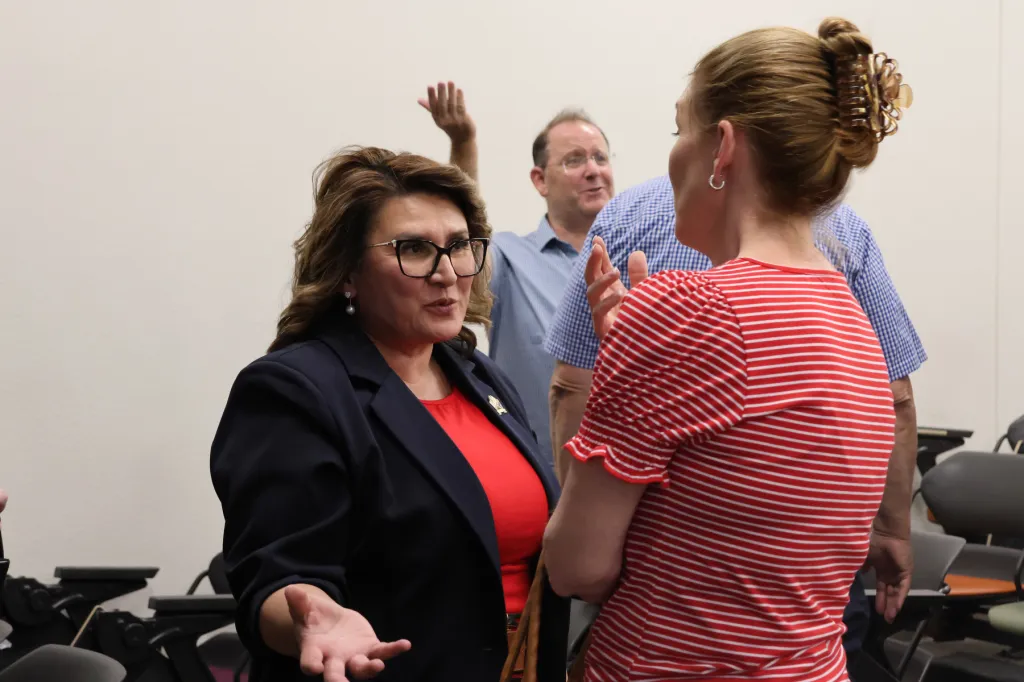 Congressional candidate JoAnna Mendoza has leaned into her working class background as she runs for a seat in the U.S. House to represent Arizona’s 6th congressional district. (Courtesy JoAnna Mendoza campaign)
 Politicians who come from working class backgrounds, like Minnesota Lt. Gov. Peggy Flanagan (center) and Minnesota state Sen. Omar Fateh (right), are resonating with voters during a particularly challenging economic period. (Stephen Maturen/Getty Images)