


ReUnion Series
- A Lesson from the Last Time America Felt This Fragile
- The Rings and the Great Debate
- A Lantern in the Rain - A Beacon in Dark Times
- The Reward: Angela and James: An American Dynasty
- Steady As She Goes - Red and Eleanor
- The ReUnion
Around 9 PM on May 1, 1865, John Ring lit his lamp and headed to the horse barn. A steady rain was falling. He hung the light on a hook, scanned the stalls, checked the bridle and harness, and moved to the horse. Then he filled the lanterns with kerosene and began rigging the wagon.
Inside, Mary dressed in proper attire and made sure the children — John Jr. (17), Julia (14), Belle (10), Patrick (8), and little Martin (4) — were ready. John Jr., Julia, and Belle would walk behind the wagon in the rain; Mary, John, Patrick, and Martin would ride under a tarp. It would be a two-hour trip to Joliet. They started down the nearly pitch-black road, the wagon rocking in potholes.
As they neared the old Sauk Indian Trail, they saw flickers of light in the mist — a steady stream of lanterns moving toward town. They joined the pilgrimage. Eventually they parked the wagon in a field and walked together toward the depot, joining hundreds of others moving silently through the dark streets. Lanterns hissed in the rain. Torches sputtered. Church bells from St. John’s and St. Patrick’s began to peal.
Farmers, canal workers, laborers, craftsmen, and their families gathered around the depot, draped in black bunting. Suddenly a mournful whistle pierced the night as the engine emerged, hissing, steam rising. One black-and-silver car rolled slowly into view and stopped. Minute cannons fired. Somber music played. A silent crowd of 12,000 watched with reverent eyes.
Abraham Lincoln was going home.
The Rings were overwhelmed, as was everyone. Then, just as suddenly, the train came to life again. The whistle shrieked, and Lincoln’s presidential car disappeared into the night. People lingered, reluctant to leave, waiting for the last echo of the whistle. Joliet had swelled to nearly four times its size that night. From that rain-soaked vigil, the shared experience would carry them — and us — forward.
It was about 3 AM when Mary lit the lamp. Its glow caught the glint of the ornate coffee pot as the flame sputtered to life. The showpiece of their civic identity spoke to her. She teared up, then took a deep breath and sat down. She lifted the pot and recalled its meaning: the griffin handle symbolizing strength and guardianship; the ring for continuity and unbroken lineage; the eagle spout for national identity, courage, and loyalty to the Union; the acorn leaf pattern for potential and new generations; the seal finial for transition and safe passage between worlds. She clutched it close and sobbed as John came through the door. His eyes said everything. It had been a long night. They went to bed with their children.
The next day came too fast. The hangover of the night was still palpable. They rested, gathered themselves, and prepared for the days ahead. Julia took a long walk and picked prairie flowers blooming everywhere.
It was hard at first, but John and Mary were nothing if not resilient. They had already passed the hardest test — entering America through New York City, navigating the bustle, competition, and rough-and-tumble of immigrant life. They had come through America’s front door as part of the Irish migration wave. They set up briefly in the city, prepared for their first son’s birth, and learned quickly how to navigate American life amid the tumult.
Now on the farm, years passed. Buildings rose. A well was dug near the barn. The homestead became a working farm. And Julia blossomed. She was intelligent, attractive, and fully aware of her moment when she met Peter — first at church gatherings, later at her uncle’s dry goods store. Mary spoke of him often with her brother Thomas. They agreed Peter should become his business partner. Julia noticed Peter’s character, integrity, and decency. It felt familiar — the same qualities that defined the Ring household.
Peter had come directly from Armagh, Ireland, at 21. He had heard of Chicago and the opportunities for the Irish expatriate community. He recognized instantly that his future lay in America. He read about American ideals — equality, opportunity, self-creation. Status here was earned, not inherited. He liked that. He left Armagh and headed straight for Will County.
Peter reached out to Thomas Delaney, the owner, hoping for a position in his dry goods business. Thomas observed Peter’s way of doing business — fairness, steadiness, integrity. Still in his early twenties, Peter had a maturity that stood out. Thomas saw how he navigated the Panic of 1873–74, how customers trusted him. It was so antithetical to the times in America — a nation awash in price-fixing, stock manipulation, rebates, kickbacks, and corruption in local law enforcement and the courts. Peter and the Rings stood in stark relief to all of it. They held to their principles and endured. They followed their builder instincts and looked for common ground to strengthen their community.
Thomas offered Peter an earned partnership. Peter, now 26, bought in.
Within two years, a fire destroyed the store. But Peter, instead of being daunted, reached deep. He bought Thomas out and reopened within two more years. At 28, he felt confident he had landed on his feet. And Julia Ring — 22, striking, smart, steady — was catching his eye. They were mirrors of each other. They married, and Julia moved into a small apartment above the store at 33 Chicago Street, next to the Joliet courthouse.
Within a year, Julia was expecting. They were elated. Patrons wished them well. They had found in each other their match.
But in the autumn of 1882, as their first child was due, Peter fell ill. Within ten days he was dead — typhoid, common and untreatable. Julia, now 24, was an expectant widow. She planned the funeral at St. Mary’s and was overwhelmed by the turnout. It was noted that no fewer than 85 carriages were parked outside — not counting those who came on foot or horseback.
Alone and with a business to run, she turned to her Uncle Thomas. Together they decided to close the store. With Thomas’s help, they wound down the business. Mary and John helped her pack and brought her and her newborn daughter Angela back to the farm.
The lives of the Rings and Peter Mackin weren’t perfect — they simply kept building, even when the country around them faltered. They endured their nation’s shortcomings by working together, not because America was flawless, but because it offered the strongest promise yet written for equality and opportunity. They lived in integrity while the nation drifted, trusting that ordinary people make the founding ideals real. That responsibility has not changed. Corruption comes and goes; the ideals remain.
Their example reminds us of something simple yet instructive: that we endure by choosing the Union again and by voting for the system that keeps aspiration possible in a diverse society as it actually exists. If we can still make it work here, we can make it work anywhere. We are Americans first and foremost by choice — and into that choice, that possibility, Angela was born, carrying the next chapter of what we build together forward.
The American Experiment continues.
Patrick Fitzgerald is a Buffalo-based writer whose work explores civic responsibility, community life, and the quiet virtues that hold people together. Raised in the Midwest and shaped by the steadiness of farm communities, he writes about proportion, neighborliness, and the shared duties that form the backbone of American civic life. His essays draw on lived experience, family lineage, and a deep sense of place to offer readers a grounded, reflective perspective on how we can rebuild trust in one another.











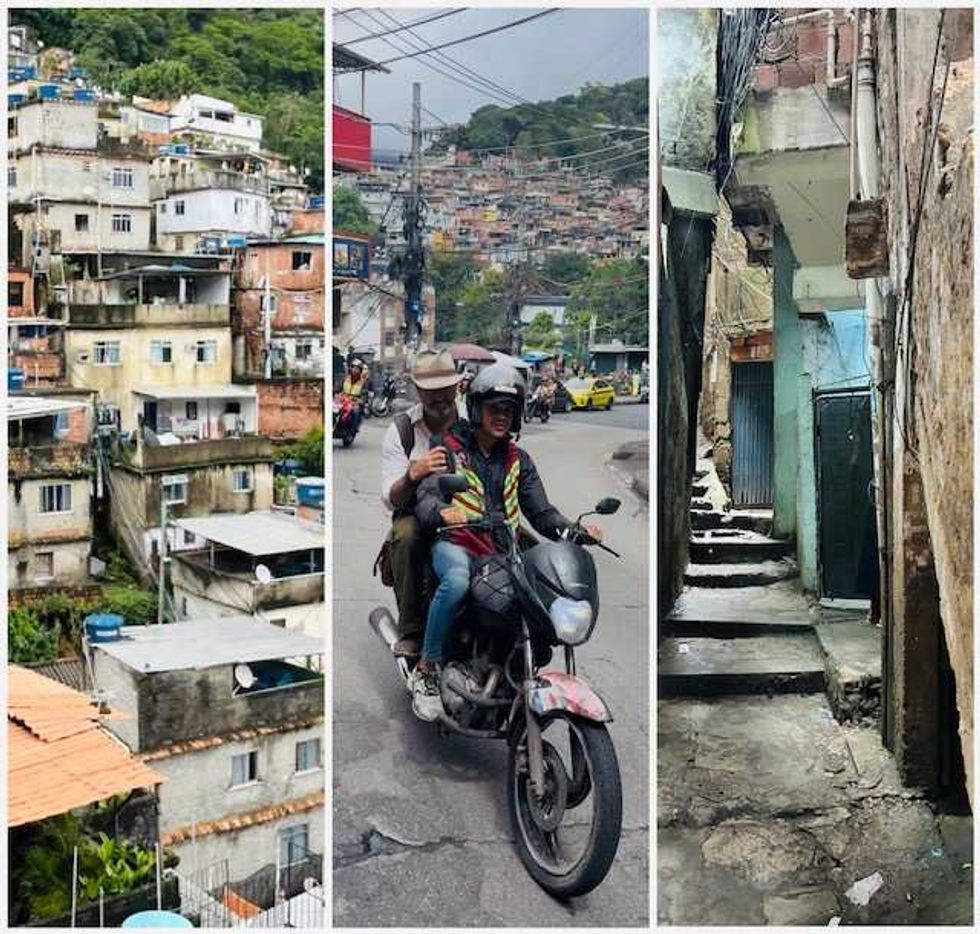 Scenes from Favela Rocinha, Brazil - (R-L) Rows of brick homes, Hugo Balta on a motorcycle taxi, and steep, winding roadsHugo Balta