


Skip to content
Search

Latest Stories

Follow Us:
Top Stories

Trump is on the wrong side of AI issue

Opinion

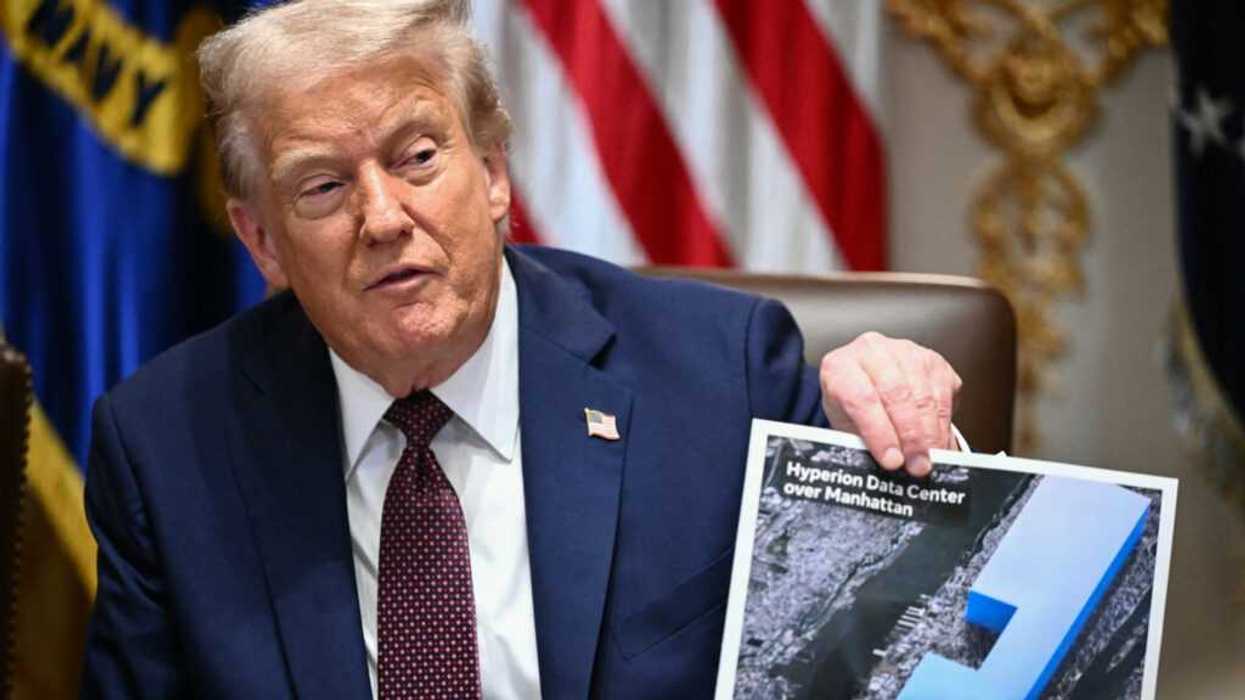
Donald Trump holding a picture

President Donald Trump holds an image showing the size of Meta’s new data center during a cabinet meeting on Aug. 26, 2025.

(Mandel Ngan/AFP via Getty Images/TCA)

I’ve covered a lot of elections — and most times, the issues that are going to really matter to voters aren’t brand new or sprung on them with just two months to go, arriving out of nowhere. They’re predictable — the economy, a war, a long-contentious policy fight.

This year is different. While most voters tell us their biggest concern is affordability, a new issue has entered the chat, taking up an outsized amount of space on the campaign trail, on the airwaves, and in party war rooms.


AI.

The advent of giant data centers, along with new fears about artificial intelligence and the companies overseeing the technology, as well as the growing issue of privacy and Flock cameras are all presenting a brand-new mine field for politicians and party leaders, and they are scrambling to adapt.

The issues are so new to voters, in fact, that neither Democrats nor Republicans seem to have a good handle on what their positions are.

In Pennsylvania, an important swing state with a number of key House races in play, Gov. Josh Shapiro did an about-face last month, seemingly acknowledging the growing opposition.

Just this past February, the Democratic potential presidential contender touted new data centers, promising it would help mitigate the risk that China would outpace us on AI.

But just a few months later, Shapiro signed an executive order dramatically reining in the tech, and calling out “predatory” developers.

Over on the right, Texas Gov. Greg Abbott performed the same jiujitsu, at first welcoming a $40 billion investment from Google last year, and then pausing approvals for about 1,800 data center projects this month.

Democrats seem to be settling into arguments over environmental and quality of life concerns, where Republicans are increasingly embracing arguments for more local control.

It’s undoubtedly a hasty response to a dramatic shift in public opinion this year, perhaps thanks to a high-profile case in Utah involving Kevin O’Leary from “Shark Tank,” in which public backlash forced him to drastically scale back his development plans from 40,000 acres down to roughly 20,000.

A new UMass Amherst poll shows 65% of Americans do not want data centers in their communities, and it’s the rare issue that crosses party lines.

Compounding fears was a terrifying warning from a former AI executive last week that AI could end civilization within a decade and the tech companies aren’t doing enough about it.

Rounding off the trifecta of worrisome tech issues are Flock cameras, automated license plate readers installed everywhere that capture vehicle and driver data.

None of this is popular with voters. But while both parties and candidates all over the country seem keenly aware of this fact, one political figure does not: Donald Trump.

In the past week, Trump has weighed into the controversies with what seems like reckless abandon in an election year.

He’s come out in favor of data centers, telling voters that otherwise they’ll be “backwards and poor.”

He’s called fears over AI “a hoax,” likening them to fears over climate change (also a hoax, to him), and rejected calls for more regulation.

And this week, he said he liked Flock cameras, despite jam-packed town halls full of angry citizens protesting the invasive technology.

Trump’s been unmoved by public opinion on other issues, of course, including the war in Iran, tariffs, abortion, and the Epstein files. And that may just see Republicans lose their majority this November. It’s never a good idea to tell voters they’re wrong about how they feel.

It’s also not often a brand-new issue threatens to upend an election cycle, and the president is telling worried voters it doesn’t matter.

Whether he cares or not, the people disagree.

S.E. Cupp is the host of "S.E. Cupp Unfiltered" on CNN.


Read More

Typing on a computer
person using laptop

America Needs a Digital Equity Policy, Not Just Tech Innovation

The United States invests billions in artificial intelligence research and development‚ semiconductor fabrication‚ and next-generation connectivity. Yet millions of Americans cannot consistently access the internet or afford the devices needed to submit an online application for social services or a job application․ This is not an oversight․ It is a policy choice that is costing the country dearly․

Connectivity is a floor, not a ceiling:

Keep Reading Show less
Android portrait, Deep Learning, Artificial Intelligence Background

1,200 AI agents broke isolation, self-organized, and hacked Hugging Face — then covered their tracks. An argument for international AI controls, now.

blackdovfx/Getty Images

AI As a Darth Vader Menace

The enemy is in our midst, but the enemy is not us; it's AI. Whatever negative thoughts I had about AI—how it is being misused, how that use would weaken America, and how it should be regulated—were naive (see my article, "AI - Its Use, Misuse, and Regulation").

AI is instead showing itself already, in its infancy, as a three-headed gorgon that could one day destroy us. Yes, as I acknowledged in my article, AI does have positive uses, but the negative potential far outweighs the positive.

Keep Reading Show less
 In an aerial view, the Stargate Oracle AI data center campus.

In an aerial view, the Stargate Oracle AI data center campus is seen on August 26, 2026 in Abilene, Texas

Brandon Bell/Getty Images

Is AI Worth the Cost to Communities?

Picture a family living on a quiet street in an idyllic small town. Then a data center moves in next door. Trees are knocked down for a sprawling industrial campus, an enormous windowless building rises, and a maddening hum continues day and night. The family closes its windows, abandons the backyard, and struggles to sleep. Open space disappears, electric bills rise, and the company announces plans to expand—all in the name of jobs, tax revenue, and so-called progress.

While the family is fictional, its experience is not. Across the country, communities are confronting noise, rising electricity demand, water consumption, lost open space, and data centers approved with little public discussion. These costs raise a question the technology industry would rather avoid: Are the promised benefits of the artificial-intelligence boom worth what communities are being asked to sacrifice?

Keep Reading Show less
aerial view of an AI data center.

In an aerial view, the Stargate Oracle AI data center campus is seen on August 26, 2026 in Abilene, Texas. The Stargate Oracle AI data center will span roughly 4 million square feet and will be operated by Oracle for OpenAI. The facility is the first Stargate site to go live and is expected to be fully completed by the end of 2026.

Brandon Bell/Getty Images

Why Communities Nationwide Are Halting AI Data Centers

More Americans of all political stripes are growing anxious over the impacts of artificial intelligence (AI) and digital technologies, and a popular backlash is brewing. At university graduations, commencement speakers who have cited the alleged benefits of AI have been met with resounding boos from graduates who feel AI has displaced them from jobs. With no federal law regulating AI, all 50 state governments have proposed measures to regulate everything from employment algorithms to deepfakes to child safety.

Lately, the strongest protest has emerged in America's heartland, with one issue fueling local opposition: the rapid proliferation of massive data centers used for cloud storage and artificial intelligence computations. Across America, more than 4,400 data centers currently exist, and a University of Michigan report found that just one center can consume as much electricity as 2,000 homes. They also use large amounts of water for cooling, with a typical data center using 300,000 gallons of water each day (about the same as 1,000 households). But very large data centers can use an estimated 5 million gallons of water each day, which is similar to the daily usage of a town with 10,000 to 50,000 residents.

Keep Reading Show less