


Skip to content
Search

Latest Stories

Follow Us:
Top Stories

Texas is Center Stage During National Muslim Advocacy Day on Capitol Hill

Groups named the state as a site of rapidly growing Islamophobia due to recent Texas legislators’ actions

News

Texas is Center Stage During National Muslim Advocacy Day on Capitol Hill

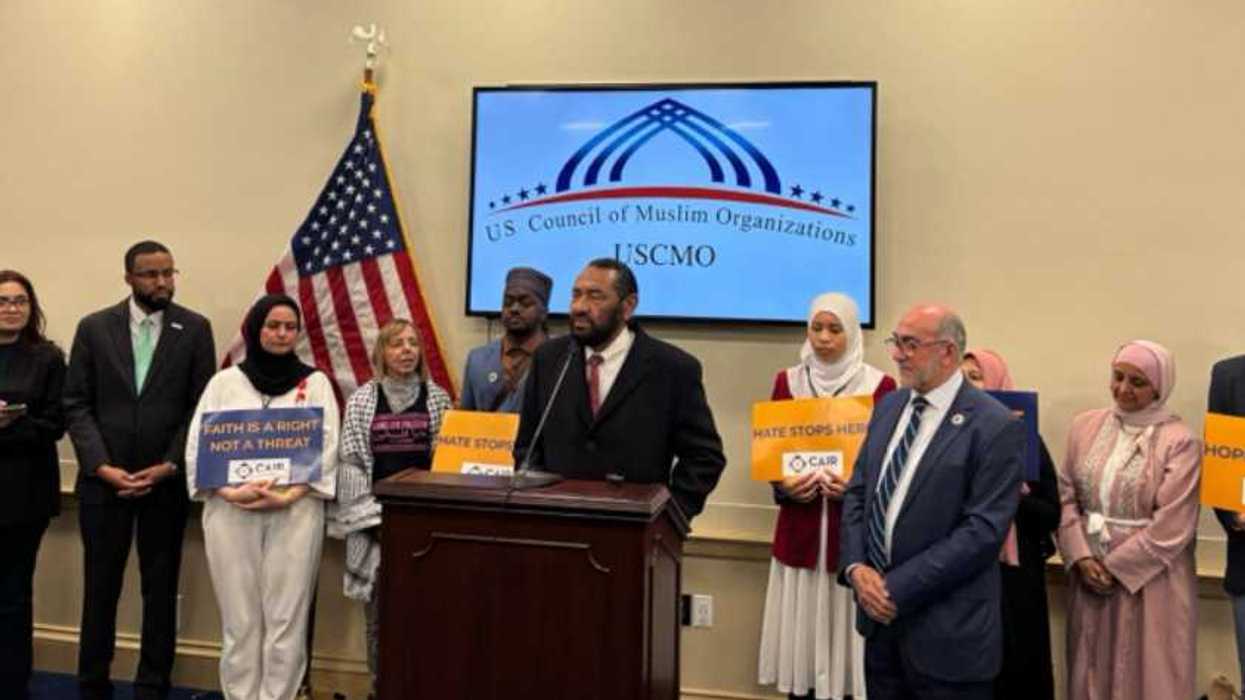
Rep. Al Green speaking at the USCMO Press Conference on Tuesday.

Credit: Olivia Ardito

WASHINGTON, D.C. – With more than 1000 Muslims traveling to the nation’s capital last week for the 11th National Muslim Advocacy Day on Capitol Hill, Texas was cited as a state of increased Islamophobia.

Hosted by the U.S. Council of Muslim Organizations, this two-day event saw advocates calling attention to what they believe to be the most pressing issues that the Muslim community is facing.


“We would like elected representatives in Congress to know their Muslim constituents, hear their concerns, and hopefully, God willing, act on them,” Robert McCaw, committee chair for Muslim Hill Day and board chair of the U.S. Council of Muslim Organizations, said.

The event in Washington was held in light of rising anti-Muslim sentiments as the war in Iran and the conflict between Israel and Gaza continue.

The themes of the advocacy day focused on pushing back on Islamophobia in Congress, comprehensive immigration reform and human rights-centered policy that labels what is happening in Gaza as genocide.

Advocates expressed anger over recent comments from Representative Andy Ogles, Republican - TN. In March, Ogles posted “Muslims don’t belong in American society. Pluralism is a lie” on the social media platform X. Ogles’ office has not responded to requests for a comment.

Representative Al Green, Democrat - Texas, joined advocates at a press conference on April 21 and discussed his recent resolution to formally and officially condemn Ogles.

“What this representative did, and what the President of the United States has done on certain occasions, all of these things are unacceptable,” Green said regarding why he put forward his resolution.

Many advocates also expressed their concern over the recent vilification of Sharia law. Representatives Keith Self and Chip Roy recently created the “Sharia Free America Caucus,” which they claim aims to preserve American values.

“Sharia stands in direct opposition to our country and is totally anathema to the concept of individual freedom and our founding principles,” Self said in a recent press release.

Advocates harshly refuted this claim. “For Muslims, Sharia is simply a way of life, a moral framework that guides everyday practices… at its core, it emphasizes justice, mercy, and human dignity. It requires Muslims to follow the laws of the land we live in, like the U.S Constitution,” Sameeha Rizvi, the Civic Engagement Organizer with the Council on American Islamic Relations Texas, said during the press conference.

The Council on American Islamic Relations was recently designated as a foreign terrorist and transnational criminal organization in Texas by Governor Greg Abbott in November. The Council’s legal team responded to these claims by saying that Abbott is incorrect and spreading debunked conspiracy theories.

Faruq Baqi, the deputy director of public relations for Muslims of America, said one reason he joined advocates on the Hill was to express his discontent with politicians who describe Muslims and Sharia Law as un-American.

“It’s a concerted effort amongst the GOP to demonize Muslims in a very reckless manner… [the GOP] wants to have some kind of demon, some kind of bad guy out there so people don’t focus on the economy, and focus on civil rights, and focus on those things that really matter,” Baqi said.

At the two-day event, advocates held up signs that said “Faith is a right, not a threat” and “hope over hate.”

Advocates fear that these acts of Islamophobia by members of Congress could have broader, worse implications if they remain unchecked. “States like Texas and Florida, they have now become the epicentre of anti-Muslim hate, where we are seeing this trend rise. But we’re also seeing part of a broader national pattern of discrimination targeting Muslim communities,” McCaw said.

From a House Office meeting where signs expressed messages of unity and hope, “We are your constituents, and we are part of this country. Yesterday and today, we brought one of the largest delegations from Texas for Muslim Hill Day. People of all races, ages, and backgrounds, united by our faith and our shared belief in the promise of this country. Not in spite of who we are, but because of it,” Rizvi said.

Olivia Ardito is a graduate student in journalism with Northwestern University's Medill School of Journalism


Read More

A close up of a person reading a book in a bookstore.

As literacy declines in America, what happens to democracy? This essay explores how falling reading levels, digital media, and the loss of “deep literacy” threaten self-government and the foundations of equality.

Getty Images, LAW Ho Ming

Promoting Civic Literacy for America’s 250th

We Americans have always felt anxious about our democracy. As Benjamin Franklin famously said, ours is only “a republic, if you can keep it,” and we’ve been plagued by a nagging feeling ever since that we can’t. The latest bout of handwringing is brought on by declining literacy and the threat it poses to liberal democracy, and—aware of our penchant for anxiety though we may be—it is hard not to feel concerned.

The fact is that we have large and growing numbers of kids who can’t read well. National Assessment of Education Progress scores reveal that the number of students scoring below NAEP basic has grown steadily since 2019. While the percentage of students considered proficient has held steady, decreased literacy is reported even in elite colleges and universities. Adult reading is way down as well.

Keep Reading Show less
Bar graph of shopping carts

A deeper look at inflation in today’s economy—beyond money printing. Explore how trade fragmentation, geopolitics, tariffs, and industrial policy are driving structural inflation and rising costs in the U.S.

Andriy Onufriyenko/Getty Images

Inflation Has Changed—And So Has Who Pays for It

A familiar conservative argument is back: inflation is the result of government printing and overspending. Too many dollars, too much demand, not enough goods. It is a tidy explanation, one that has the advantage of clarity and a long intellectual pedigree. It is also incomplete.

That story assumes a stable, globalized economy in which production is efficient, supply chains are reliable, and market signals dominate political ones. In that world, inflation can plausibly be reduced to a question of monetary discipline or fiscal restraint. But today’s economy no longer operates under those conditions. Inflation is now driven less by excess demand and more by rising costs tied to trade fragmentation, industrial policy, and geopolitical conflict. These forces are not temporary disruptions. They are reshaping how goods are produced, where they are produced, and at what cost.

Keep Reading Show less
A Ballroom Won’t Save Our Children
people walking on street during daytime
Photo by Chip Vincent on Unsplash

A Ballroom Won’t Save Our Children

When an active shooter threat disrupted the White House Correspondents’ Dinner, the president and members of his cabinet were evacuated swiftly and efficiently. The threat ended with a shooter apprehended and a Truth Social post. Then President Trump returned to the podium, bypassing the persistence of gun violence in this country to make the case for his long-sought $400 million White House ballroom, one that would supposedly prevent criminals from entering the space. The solution to a potential mass killing was a bulletproof ballroom.

I was an elementary student when Columbine made school shootings a national emergency. The safe haven of school became a potential war zone overnight, and the fear that settled into children that year never fully left. But how could it? The Sandy Hook Elementary School shooting happened when I was a new high school teacher. Parkland when I was a doctoral student. Uvalde during my first faculty position. The shooting at Brown University happened during my fifteenth year working in education. Gun violence has followed me the entire length of my educational career, from K-12 student to high school teacher to university professor. Nearly three decades later, I am still waiting for the final straw, the moment that produces gun reform and makes school feel safe again. Instead, I have more thoughts and prayers than ever, and no gun reform in sight.

Keep Reading Show less
Death with Dignity: A Person's Right to Choose Life or Death

Funeral, cemetery and hands with rose on tombstone for remembrance, ceremony and memorial service. Depression, sadness and person with flower on gravestone for mourning, grief and loss in graveyard

Getty Images

Death with Dignity: A Person's Right to Choose Life or Death

There is much debate around the world regarding both physician-assisted dying legislation—often called "Death with Dignity"—and expanding the circumstances in which it is applicable. Eight countries and 19 states already permit it in some form.

It is controversial for many reasons. Part of the controversy stems from our cultural discomfort with death. Part of it results from the medical profession's focus on keeping people alive and its fear of malpractice suits. Part of it is religious.

Keep Reading Show less