
Skip to content
Search

Latest Stories

Follow Us:
Top Stories

Preserving Latino History and Community Life in Washington

News

Preserving Latino History and Community Life in Washington

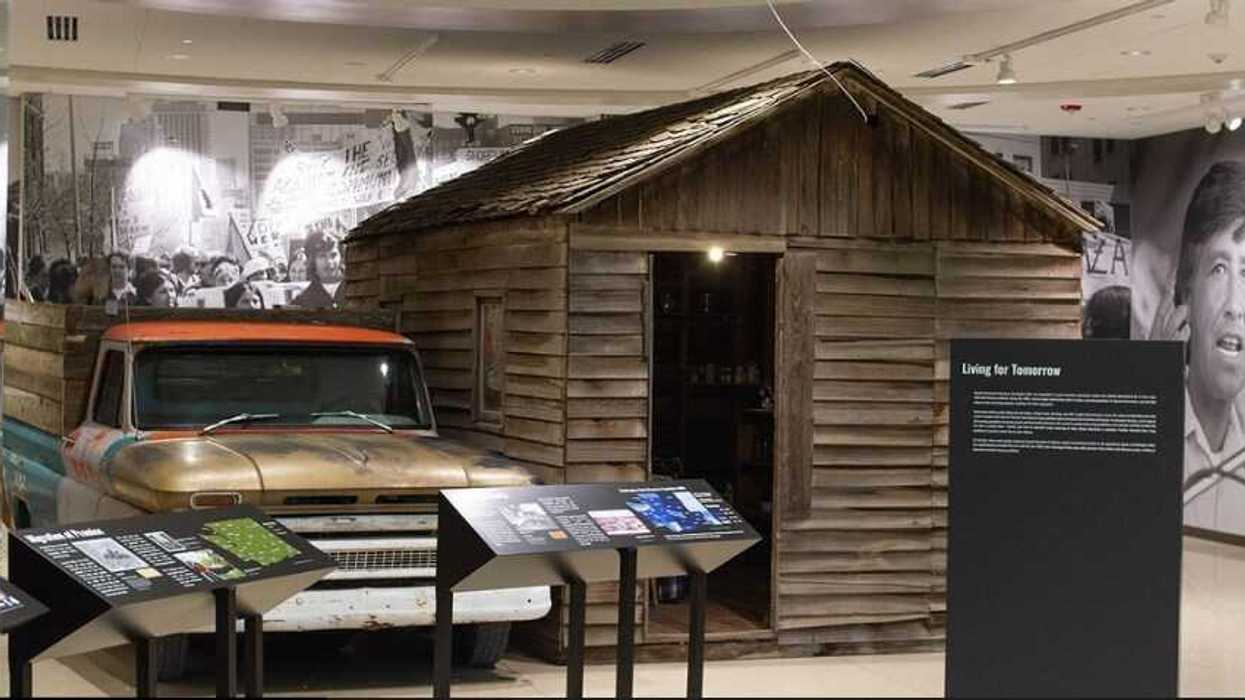
Original farmworker cabins, transported from Eastern Washington.

Credit: Sea Mar Museum of Chicano/a/Latino/a Culture

On a quiet stretch of Des Moines Memorial Drive in South Seattle, the Sea Mar Museum of Chicano/a/Latino/a Culture rises like a long‑overdue acknowledgment. Its brick exterior doesn’t shout; it invites. Inside, the rooms hum with the stories of families who crossed borders, harvested fields, organized classrooms, and built communities across Washington state—often without seeing their histories reflected anywhere on a museum wall.

For Rogelio Riojas, founder and CEO of Sea Mar Community Health Centers, the museum is a promise kept. “We wanted to make sure the contributions of Latinos in Washington state are recognized and preserved for future generations,” he told The Seattle Times when the museum opened in 2019. It was a simple statement, but one that captured decades of work—both visible and invisible—by the region’s Latino communities.


Walking through the galleries feels like stepping into a living archive. One of the most arresting sights is a pair of original farmworker cabins, transported from Eastern Washington. Their narrow wooden frames and sparse interiors speak volumes about the migrant families who once slept inside after long days in the fields. The cabins are not replicas or artistic interpretations; they are the real thing, weathered by sun, dust, and time. They anchor the museum’s narrative in the physical realities of labor that shaped the state’s agricultural economy.

Sea Mar describes the museum as “dedicated to sharing the history, struggles, and successes of the Latino community in Washington state,” a mission that plays out in photographs, letters, student newspapers, and oral histories contributed by community members themselves. These aren’t artifacts chosen from afar—they’re family treasures, personal archives, and memories entrusted to the museum so they can live beyond the kitchen tables and shoeboxes where they were once kept.

The story extends beyond the museum walls. Just steps away is the Sea Mar Community Center, a sweeping, light‑filled gathering space designed for celebrations, performances, workshops, and community events. With room for nearly 500 people, a full stage, a movie‑theater‑sized screen, and a catering kitchen, the center was built with one purpose: to give the community a place to see itself, gather, and grow. Sea Mar describes it as “a welcoming space for families, organizations, and community groups to gather, celebrate, and learn,” and on any given weekend, it lives up to that promise.

Together, the museum and community center form a cultural campus—part historical archive, part living room for the region’s Latino communities. Students come to learn about the Chicano activists who reshaped the University of Washington in the late 1960s. Families come to see their own histories reflected in the exhibits. Visitors come to understand a story that has long been present in Washington, even if it wasn’t always visible.

The Sea Mar Museum is open Monday through Friday from 8:00 a.m. to 5:00 p.m. and Saturdays from 10:00 a.m. to 3:00 p.m., offering free admission to anyone who walks through its doors. For many, it’s more than a museum—it’s a recognition, a gathering place, and a testament to the people who helped shape the Pacific Northwest.

Preserving Latino History and Community Life in Washington was first published on Washington Latino News (WALN) and republished with permission.



Read More

What Will It Take To Truly Negotiate Paid Leave? Getting to "Yes" on Three Questions
blue and yellow i heart you print textile
Photo by Sandy Millar on Unsplash

What Will It Take To Truly Negotiate Paid Leave? Getting to "Yes" on Three Questions

Everyone in the United States deserves time to care for themselves and their loved ones, whether to see a baby’s first smile or hold the hand of a parent who takes their last. This month, Virginia became one of a growing number of U.S. jurisdictions enacting statewide paid leave programs—forward-looking states that have taken matters into their own hands in the absence of a federal policy that the vast majority of the public across party lines wants and has wanted for quite some time.

Beginning in 2028, Virginia will join its regional mid-Atlantic neighbors, the District of Columbia, Maryland, Delaware, New Jersey, and New York in guaranteeing this basic protection to millions of workers caring for a new child, a loved one, or their own serious health need. Pennsylvania’s legislature, too, is moving paid leave legislation, and with bipartisan support. Evidence shows that paid family and medical leave programs offer multiple sources of value to workers, families, businesses, and communities.

Keep Reading Show less
Humanoid Educators Will Widen Inequality—And Only Tech Overlords Will Benefit
a sign with a question mark and a question mark drawn on it
Photo by Nahrizul Kadri on Unsplash

Humanoid Educators Will Widen Inequality—And Only Tech Overlords Will Benefit

In March, First Lady Melania Trump hosted an AI-powered humanoid robot at the White House during the Fostering the Future Together Global Coalition Summit, and introduced Plato, a humanoid educator marketed as a replacement for teachers that could homeschool children. A humanoid educator that speaks multiple languages, is always available, and draws on a vast store of information could expand access in meaningful ways. But the evidence suggests that the risks outweigh the benefits, that adoption will be uneven, and that the families most likely to adopt Plato will bear those risks disproportionately.

Research on excessive technology use in childhood has found consistent results. Young children and teenagers who spend too much time with screens are more likely to experience reduced physical activity, lower attention spans, depression, and social anxiety. On the same day that Melania Trump introduced Plato, a California jury ruled that Meta and YouTube contributed to anxiety and depression in a woman who began using social media at age 6, a reminder that the consequences of under-tested technology on children can be severe and long-lasting.

Keep Reading Show less
New York's Childcare Fundraising Bet: What New York City Can Learn from Nairobi
a group of children playing with toys on the floor
Photo by BBC Creative on Unsplash

New York's Childcare Fundraising Bet: What New York City Can Learn from Nairobi

New York City Mayor Zohran Mamdani recently launched the Childcare Action Fund with an appeal to philanthropists to help raise $20 million toward providing free childcare for every New Yorker who needs it.

Critics have lambasted Mamdani’s universal childcare plan as too costly to sustain through public funding alone. Bringing philanthropy into the picture, to some, reinforced that concern.

Keep Reading Show less