In 2002, U.S. Rep. Henry Bonilla, a Republican, nearly lost his South Texas seat to Democrat Henry Cuellar. So when the GOP used its newfound majority in the state Legislature to redraw the voting maps the next year, they sawed through Cuellar’s hometown of Laredo and scattered Latino voters, who tended to vote Democratic, into other districts.
Latino advocacy groups sued under Section 2 of the Voting Rights Act, the cornerstone provision of the law that prevents government bodies from diluting the voting power of specific groups. The Supreme Court found Texas lawmakers had taken away Latino voting power “because they were about to exercise it.”
“Latino voters were poised to elect their candidate of choice,” Justice Anthony Kennedy wrote for the majority. “The State not only made fruitless the Latinos’ mobilization efforts but also acted against those Latinos who were becoming most politically active.”
Bonilla’s 23rd Congressional District was redrawn, and he lost to a Democrat. Just five years later, Latino voters flipped it back to Republican control; the seat was held most recently by GOP Rep. Tony Gonzales, who resigned last month.
Nina Perales, who argued that case at the Supreme Court, sees that district as an enduring testament to the power of Section 2 of the Voting Rights Act.
“A lot of the districts that we see in the map today were created to make sure that minority communities were not accidentally chopped up, and that minority communities could have a voice in some parts of the state,” Perales said. “In CD-23, when a majority of Latino voters support Gonzales, they get to elect Gonzales, and it’s irrelevant what Gonzales’ political party is.”
On Wednesday, the Supreme Court gutted Section 2, raising the bar for voter dilution claims so high as to make the statute a “dead letter,” as Justice Elena Kagan wrote in her dissent. Partisan gerrymandering, like the type used to try to keep Bonilla in power, is a defense against allegations of vote dilution, the conservative majority ruled. Under the new standard, plaintiffs will have to prove mapmakers intentionally set out to discriminate against voters on the basis of their race.
Even as it diminishes in power, the legacy of Section 2 of the Voting Rights Act is deeply woven into Texas’ political maps, reflected in districts carefully drawn to ensure voters of color could have a say. The landmark 1965 law also gave rise to a new generation of leaders, elected from Black, Hispanic and Asian communities. From that point on, both parties would have to look out for voters of color when drawing their maps — and if they didn’t, voters would have legal recourse.
Rep. Marc Veasey, D-Fort Worth, said his career has been “defined” by the Voting Rights Act. As a young Black state representative, he was elected in 2012 to a congressional district drawn to right what a court found to be a legislative wrong: Texas had divided communities of color in North Texas across multiple majority-white seats designed to elect Republicans. Fourteen years later, Veasey is now departing Congress after GOP lawmakers redrew the district out from under him last summer.
With Section 2 of the VRA now significantly weakened, it will be harder to make the legal case that this redraw had an improper racial, rather than partisan, intent.
The recent hollowing out of the Voting Rights Act created a disconcerting full circle moment for Veasey, who recalled that his district was originally drawn for Willow Park GOP Rep. Roger Williams. Under the new lines, Veasey noted, Williams “will end up representing my neighborhood after all.”
How Section 2 remade Texas’ maps
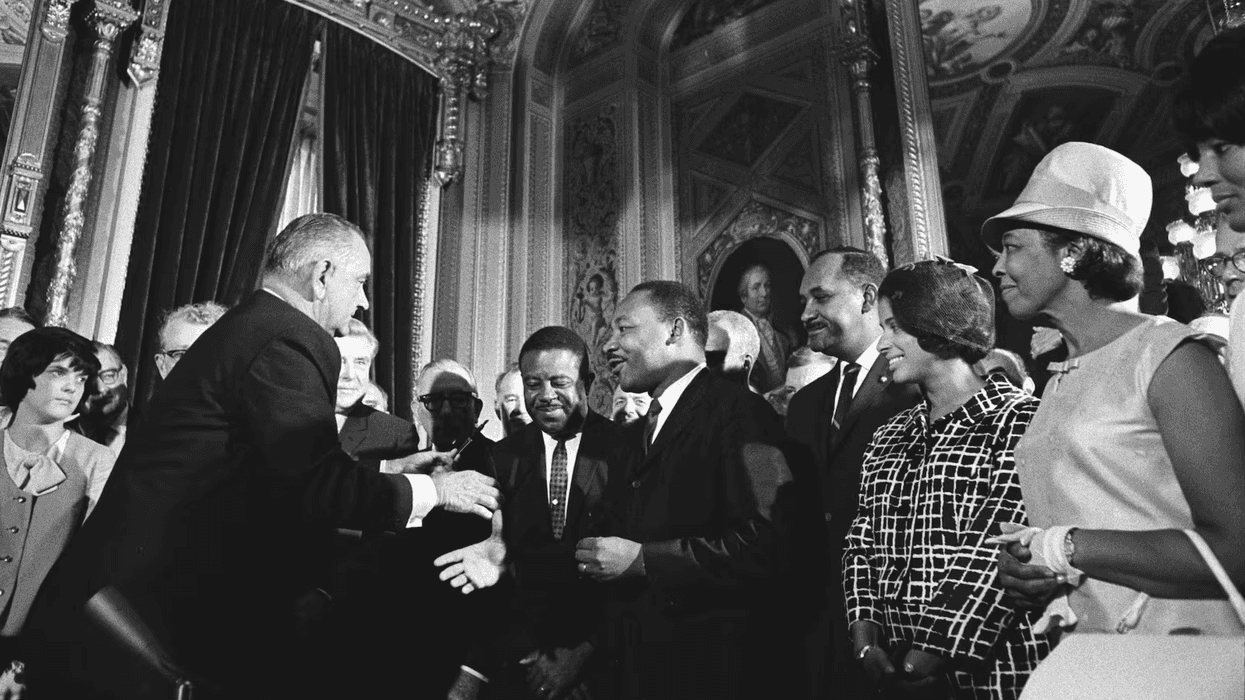
In 1965, when Texas’ favorite son, President Lyndon B. Johnson, signed the Voting Rights Act into law, he said the vote “is the most powerful instrument ever devised by man for breaking down injustice.”
The law included two pillars with significant implications for Texas — Section 2, which prohibits voter discrimination based on race, and Section 5, which requires jurisdictions with histories of racial discrimination to get preapproval from the Department of Justice for any voting changes, including new electoral maps.
Before the law went into effect, Texas had just two people of color in its congressional delegation — Reps. Henry Gonzalez of San Antonio and Kika De La Garza from the Rio Grande Valley, both of whom were Mexican-American. They each voted for the Voting Rights Act that would enable the ranks of Hispanic lawmakers to swell significantly.
In the 1970s, Barbara Jordan became the first Black member of Congress from Texas. As a state senator, Jordan helped draw the district she would soon be elected to, a seat that provides Black Houstonians the opportunity to elect their candidate of choice to this day. Three new representatives of color joined Texas’ congressional delegation in the 1980s. By the 1990s, there were 13 members of color who served at any point during the decade. With two more election cycles to go, the 2020s have already reached a peak of 22 members of color, some of whom have represented white-majority districts.
During her sophomore term, in 1975, Jordan got Texas added to the list of states that needed preclearance for its maps. In 1982, Congress reinforced the law with an amendment that said maps ran afoul of the law if they had the effect of diluting racial or ethnic groups’ vote, even if that wasn’t the intent. These new provisions, the second of which overruled a Supreme Court decision to the contrary, opened the floodgates to litigation against Texas’ maps, at every level of government.
In each decade since the law’s passage, at least one of Texas’ maps has been found to have violated the law, and courts have ordered at least one new district to be drawn. The maps drawn in 2021 and 2025 are still under active litigation.
In the 1980s, plaintiffs successfully sued over the congressional, state Senate and state House maps under the Voting Rights Act, compelling redraws of legislative seats that were found to have diluted Black and Hispanic voting strength through packing them into just a few districts in the state’s urban counties — and into a single district in South Texas. Through preclearance, the Department of Justice also ordered Texas to redraw districts that diluted Black and Hispanic voters’ strength. The effects of those redraws can still be seen in today’s maps.
“You had charges and claims against the South Texas district, because they were packed down against the border,” said Matt Angle, a Democratic strategist and founder of the Lone Star Project who has been involved in Texas redistricting cases for decades. “That’s why now, you see South Texas districts running north and south instead of along the bottom. It’s because [of] the court rulings under the Voting Rights Act, that you couldn’t pack those districts down against the border.”
More subtle, but just as important, was the way the Voting Rights Act pushed Texas lawmakers to proactively consider voters of color when drawing their electoral maps, Perales said. In the 1990s, for example, the majority-Hispanic 28th and 29th Congressional Districts “were born out of an understanding that the state needed to comply with Section 2,” she said.
Having grasped that it would be better to comply on the front end than be hauled into court later, the Legislature used to bring MALDEF and other groups in around the decennial census to train legislators on how to draw maps that met the law’s requirements.
“Part of that legal training was always on the obligation to avoid discriminating against minority voters under Section 2 the Voting Rights Act,” she said. “The guidance was, don’t inadvertently chop up minority communities when you’re drawing lines, because even if it’s inadvertent, it could be a legal problem.”
In 2013, the Supreme Court eliminated preclearance for most jurisdictions, including Texas. The state immediately reinstated a voter ID law that had been caught up under Section 5. The decision also freed Texas’ 2011 electoral maps from preclearance, though some parts of the map were later redrawn over Section 2 violations.
“A pre-1965 posture”
The centerpiece of the court’s redrawn map was the new 33rd Congressional District, crafted to allow voters of color to elect their preferred candidate in fast-growing Dallas and Tarrant county. The new lines were later upheld after a trial, in which the court concluded that lawmakers had “acted at least in part with a racially discriminatory motive … with regard to the districts in DFW in particular.”
Veasey was a state representative planning to run for reelection — and on his way to see a pre-Thanksgiving movie with his family — when he got a call that changed his career.
“I heard, hey, they’re gonna draw a new map, and there’s probably going to be an opportunity for you to run,” Veasey said. “You’ve got to make up your mind quick over whether you’re going to do it.”
He ran, and won, giving him a chance to represent a district that was as diverse as the state of Texas — one that would last about a decade and a half before falling victim to the GOP’s mid-decade redistricting.
Several other congressional districts that were shaped by the Voting Rights Act were subsequently dismantled by Republicans last summer. Among them are Hispanic-opportunity districts in South Texas, such as the 28th District represented by Cuellar, who rebounded from his loss to Bonilla to become one of Texas’ longest-tenured members of Congress.
The VRA also helped create Houston’s 9th Congressional District, where more than four in five residents are Black or Hispanic.
Last summer, lawmakers redrew it to a “bare majority” — 50.3% Hispanic — as they did several other districts.
Early last week, the Supreme Court allowed that map to go into effect while a trial proceeds. Just two days later, the court ruled in Louisiana v. Callais that the results-based test that had been used for decades should be replaced with a new, higher bar that allows for an easier partisan defense.
Justice Samuel Alito, writing for the majority, said lower courts had applied Section 2 “in a way that forces States to engage in the very race-based discrimination that the Constitution forbids.” Under the new framework Alito laid out in the decision, a Section 2 claim must prove that the state “intentionally drew its districts to afford minority voters less opportunity because of their race.”
Angle said Texas’ most recent rounds of redistricting demonstrate what a post-Section 2 future may look like.
“You’ve got a situation in which a state that’s over 60% people of color is only going to have somewhere between 20% and 30% of the districts where voters of color’s vote matters at all,” Angle said.
State Rep. Matt Shaheen, a Republican from Plano, said the U.S. had a long history of vote suppression that made the Voting Rights Act necessary.
“But we’ve moved on from that, clearly, and I think people recognize minority voters are entitled to equal representation but not certain election outcomes,” Shaheen said. “It really is more of a colorblind society, and elections are very much driven now by principles and policies, and not so much on skin color.”
Shaheen is among several GOP lawmakers who say they hope Texas takes up redistricting anew during the 2027 legislative session, this time with a focus on the state House and Senate lines.
Perales agrees that the Voting Rights Act is not about specific electoral outcomes. But she disagrees that the country is ready to move on from ensuring racial and ethnic voters have the opportunity to elect a candidate of their choice, regardless of political party or the ethnicity of the candidate.
“As much as Justice Alito wanted to make it seem like a case about partisanship, it isn’t,” she said. “It’s about dismantling something much more historic and much more deeply needed in our country, which is equal opportunity for everybody.”
For Veasey, the ruling was not a surprise. But now that his district has been chopped up and the VRA’s core provision has been kneecapped, the retiring congressman sees a bleak future for the representation of Black and brown voters.
“It’s going to go back to a pre-1965 posture,” he said. “We just won’t have nearly as many voices pushing. It’s just be [like] when we had one or two voices that were pushing back before the VRA was passed — that’s what it’s going to be like now.
How the Voting Rights Act Reshaped Texas’ Electoral Maps was originally published by The Texas Tribune, shared by VoteBeat Texas, and is republished with permission.