

The American stage has long served as a place where we gather to confront the deeper truths of who we are. Across the generations, playwrights and performers have turned the theater into a kind of public square, inviting us to face our history, our contradictions, and our aspirations. In recent years, works as different as Hamilton and What the Constitution Means to Me have shown how powerful theatre can be for both reflection and change. They tell us that democracy is not only debated in courtrooms or decided at the ballot box; it is equally shaped by the stories we tell, the questions we ask, and the courage we summon to look deeply within ourselves.
Recently, at Cape May Stage in Cape May, New Jersey, I attended a performance of What the Constitution Means to Me. The play centers on fifteen-year-old Heidi Schreck, who financed her college education by winning national constitutional debate competitions, using the nation’s founding document as both a guide and a lens for interpreting the world.
As an adult, Heidi reflects on her adolescence, and she presents a narrative that is both deeply personal and distinctly American. She perceives the Constitution not as a remote, outdated document, but as an influential force shaping her family, her identity, and her understanding of the nation’s expectations and promises. Her account demonstrates that the Constitution is not merely a historical relic but remains embedded in our daily lives, decisions, vulnerabilities, and aspirations.
By integrating humor, historical context, and candid storytelling, the play prompts the audience to reconsider democracy, individual rights, and civic responsibility without the acrimony we witness every day in mainstream and social media.
I departed from the show with a renewed sense of optimism that civil discourse on challenging topics remains achievable, and that genuine reflection is still possible in a nation where polarization often undermines nuance and critical thought.
When the final applause faded, I found myself thinking not only about Heidi’s story, but also asking myself, if a single play can open a space for honest, unguarded reflection on the Constitution, then perhaps this is exactly the kind of reflection we need, especially now, as we are living through a moment when polarization can feel like the country’s defining feature, when the distance between us seems to widen faster than our attempts to bridge it.
The Constitution was never meant to be an artifact or a weapon; it was meant to be a shared inheritance, a living framework that “We the People” must continually interpret, renew, and keep. Benjamin Franklin understood this fragility. When asked what kind of government the delegates had created, he famously replied, “A republic — if you can keep it.” His warning was not for the politicians of his day but for every generation that would follow. It was an alert for us today.
Keeping the republic has always depended on citizens willing to look inward, to ask what democracy itself means to them, and to do that work not in isolation but together. If we can reclaim that shared act of reflection, if we can remember that the story of America is still ours to write, then perhaps the next chapter can be one that draws us closer rather than drives us apart.
That is why Civic Season, a growing national tradition stretching from Juneteenth to July 4, feels so vital. Civic Season is a nationwide invitation — especially to young Americans — to explore our history honestly, participate meaningfully with our democracy, and imagine the future we desire to build together. It connects our newest federal holiday, Juneteenth, with our oldest, Independence Day, symbolically linking the full arc of the American story: the triumphs, failures, reckonings, and unfinished work.
As the nation approaches its 250th anniversary, Civic Season serves as a reminder that democracy is not a static inheritance but an evolving project. Its endurance depends on the active participation of each generation. The future of the republic will be determined by the curiosity, courage, and engagement of young people and their successors. These qualities are not merely commendable; they are indispensable. Let Civic Season serve as a reaffirmation that Franklin’s challenge remains relevant: “a republic, if you can keep it,” and that its preservation has always relied on our collective commitment.
Do You Want to Make a Difference?
Democracy is not a spectator activity; it requires active participation from every individual. When civic engagement declines, collective influence over decisions that shape our lives and communities diminishes. In such circumstances, hope is often replaced by cynicism.
The freedoms valued by society rarely vanish abruptly; rather, they erode gradually through neglect if permitted. It is imperative to recognize that democracy merits our sustained time, attention, and courage.
Now is the moment for yall Americans to step forward, embrace our individual and collective role as stewards of our nation, and boldly shape the next chapter. If you believe in a stronger, more inclusive future, your voice and actions are essential. Let us rise to Franklin's challenge and show that together, we can keep the republic—strong, vital, and united.
David Nevins is the publisher of The Fulcrum and co-founder and board chairman of the Bridge Alliance Education Fund.












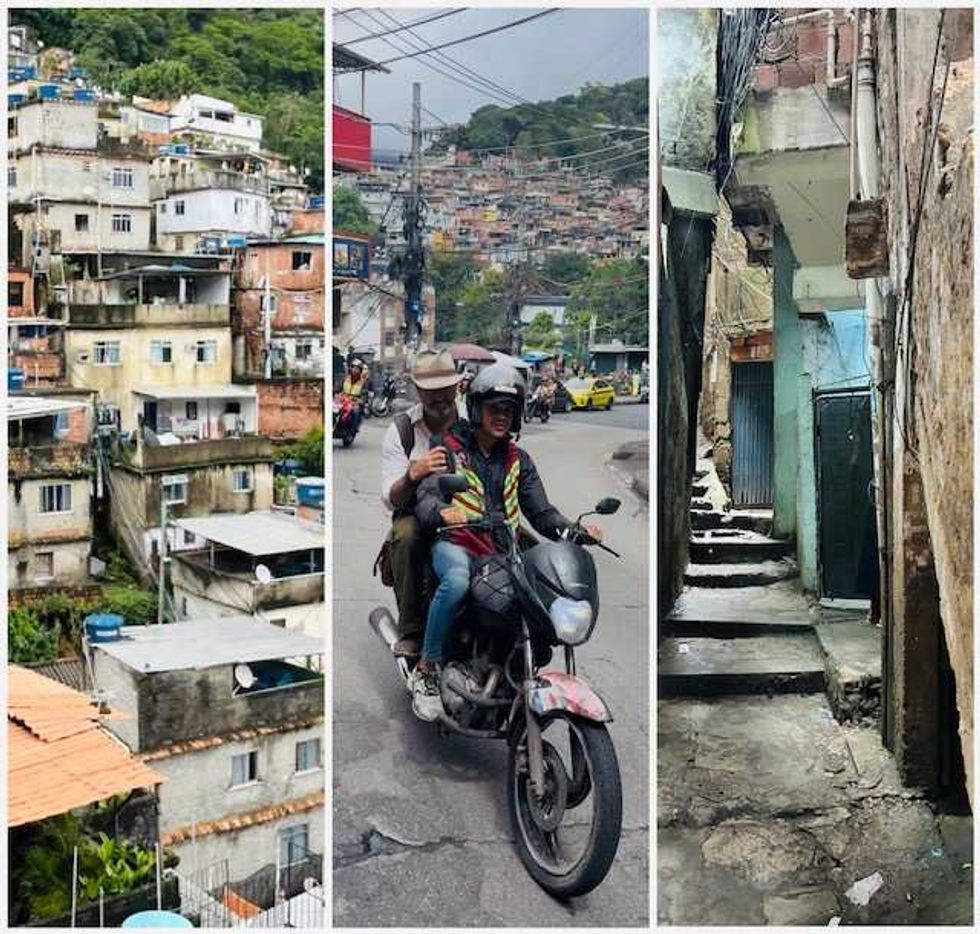 Scenes from Favela Rocinha, Brazil - (R-L) Rows of brick homes, Hugo Balta on a motorcycle taxi, and steep, winding roadsHugo Balta